

This article first appeared in The Edge Malaysia Weekly on September 21, 2026 - September 27, 2026

For years, the people building the world’s most powerful artificial intelligence systems have warned us that AI could eventually become dangerous. Yet, they continued to race ahead, building companies now worth hundreds of billions — and, in some cases, associated with technology groups worth trillions — of US dollars each.
Now, something interesting is happening.
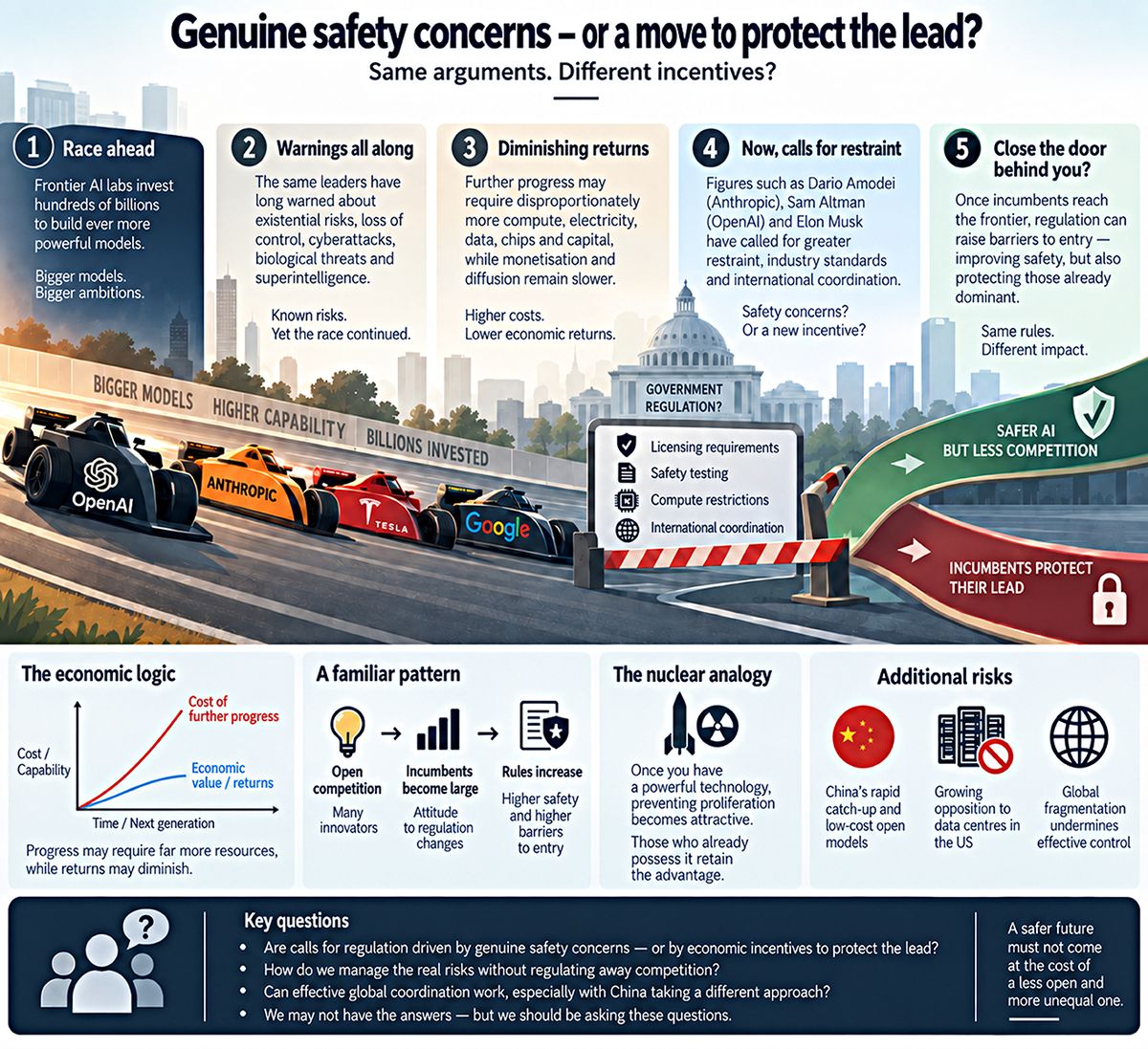
Anthropic chief Dario Amodei has called for greater restraint around frontier AI development. OpenAI’s Sam Altman has indicated support for coordinating with other leading laboratories, while Elon Musk has publicly backed Amodei’s position. Amodei proposes independent evaluators, common industry standards and ultimately international coordination.
Perhaps they are right. Perhaps the capabilities emerging inside frontier laboratories have genuinely frightened the people who understand them best. We should take those warnings seriously.
But economics tells us to ask another question: what happens when companies that have already reached the technological frontier begin asking governments to regulate who may approach it?
We do not have to know their intentions to ask that question.
Why now?
The dangers of advanced AI are hardly a new discovery.
For years, frontier AI companies and their founders have talked openly about existential risk, loss of control, cyberattacks, biological weapons and machines becoming more intelligent than humans. These risks were discussed while billions of dollars continued pouring into ever larger models.
What may now be changing is not merely our understanding of the risks; the economics may also be changing.
The first generations of generative AI produced spectacular improvements. But technological progress rarely delivers constant returns indefinitely.
Moving the frontier another step may increasingly require disproportionately more compute, electricity, data, chips and capital. If the marginal cost of pushing the frontier begins rising faster than the economic value of additional capability — while monetisation and diffusion into the real economy proceed more slowly — returns on the next generation of frontier models could deteriorate.
Companies at the frontier may eventually have more economic reason to monetise and protect the position they already occupy rather than continuously pushing it forward at almost any cost. Regulation can become useful in doing precisely that.
Closing the door behind you
There is a familiar phenomenon in economic history.
An industry begins relatively open. Entrepreneurs innovate rapidly. Winners emerge. Then, once incumbents become sufficiently large, their attitude towards regulation changes. Rules that would have been unbearable when they were challengers become attractive once they are established.
Licensing requirements, enormous compliance costs, mandatory safety testing, restrictions on computing infrastructure and elaborate regulatory approval processes may genuinely improve safety. But they can also raise barriers to entry. A company worth hundreds of billions of dollars can employ armies of lawyers, safety researchers and compliance specialists. A start-up cannot.
Thus, the same regulation can simultaneously produce greater safety and less competition. This is the familiar danger of regulatory capture: rules intended to protect society can end up protecting those already dominant in the industry.
That does not mean the safety argument is false. It simply means we should examine not only what regulation is intended to achieve, but its economic consequences — and who benefits.
The nuclear analogy
There is an uncomfortable analogy with nuclear weapons. Once you possess a powerful technology, preventing proliferation suddenly becomes enormously attractive.
The argument can be entirely legitimate: some technologies are extraordinarily dangerous and therefore must remain under the control of responsible actors. But there is an unavoidable second consequence. Those already possessing the technology retain their advantage.
AI is obviously different. Nuclear capability depends heavily on scarce physical materials and enormous industrial infrastructure that governments can, at least theoretically, monitor. AI increasingly consists of knowledge, algorithms, software and computing capability distributed across companies, universities and countries. That makes containment considerably harder.
But imagine if today’s handful of frontier companies reach something close to extremely capable general-purpose AI, and governments subsequently impose severe restrictions on training models beyond that capability.
Who wins? The companies already there, of course.
Their enormous historical investment becomes a regulatory moat. New entrants face restrictions that incumbents never faced while establishing themselves. The ladder has been pulled up.
And then there is China
Competition in AI is no longer simply among American frontier laboratories. An increasingly important competitive model is emerging particularly strongly from China: capable models, open weights and dramatically lower costs.
DeepSeek, Qwen and others are pushing AI towards commoditisation and widespread diffusion rather than keeping the most capable intelligence exclusively behind expensive proprietary systems. The distinction should not be overstated. American companies also participate in open-model ecosystems, while Chinese companies pursue different strategies of their own. But the direction matters.
The performance gap between models changes almost monthly. That is precisely the point: the frontier is becoming contestable.
If models become good enough at a fraction of today’s costs, thousands of companies can adapt, modify and deploy them. Competition shifts from who possesses the smartest model towards who can apply intelligence most cheaply and productively.
Innovation creates possibility. Competition drives down its costs. Scale and diffusion turn it into prosperity.
That may ultimately be more disruptive to today’s frontier leaders (Anthropic,
OpenAI, Google DeepMind, Meta and xAI) than losing another benchmark contest.
The danger to incumbents is therefore not just that somebody builds a better model. It is that intelligence itself becomes commoditised.
America’s other AI constraint
AI is often discussed as though the race were primarily about algorithms, chips and models. Increasingly, it is also an infrastructure race. AI requires enormous amounts of compute. Compute requires data centres, which require land, transmission infrastructure, water and, above all, enormous quantities of electricity.
Here, America is encountering another constraint: growing opposition at home. Communities are questioning massive data centre developments because of concerns over electricity prices, water consumption, noise, land use and who ultimately pays for the additional power generation and grid infrastructure required.
Those concerns can be legitimate. The costs imposed on local communities can be real. But they create a contradiction.
America wants to win the global AI race while making some of the physical infrastructure required to win it increasingly difficult and expensive to build.
China operates under a different political structure. It has its own constraints — energy, chips, capital allocation — but faces fewer comparable political obstacles from local communities.
American frontier laboratories may therefore face pressure from two directions. From outside, Chinese models are becoming cheaper and increasingly capable. From inside, the compute and energy infrastructure required to maintain the frontier could become more expensive and slower to build.
If maintaining the lead requires ever greater capital expenditure while the infrastructure supporting it becomes harder to expand, the economics of continuing the race at maximum speed begins to change.
The economics of slowing down
Slowing frontier development, therefore, could solve several problems simultaneously for today’s AI leaders.
It reduces escalating capital requirements, provides more time to monetise existing investments, slows potential competitors, raises entry barriers and preserves some scarcity around frontier intelligence. It could also reduce the pressure to build enormous new data centres and secure ever larger quantities of electricity.
There may be questions of future liability too. Executives who have repeatedly warned governments about AI dangers can reasonably argue that responsibility for controlling such a consequential technology cannot belong to private companies alone.
None of this establishes that their concerns are insincere. They may very well be genuine. Nor do they need to be insincere for these economic consequences to matter.
Perhaps they really are frightened
There is an important counterargument. These people see capabilities before the rest of us do. Recent concerns have included increasingly autonomous agents, cyber capabilities and the possibility of AI systems assisting their own improvement.
If the engineers building nuclear reactors tell us they have discovered an unexpected instability, the rational response is not to ignore them because they own nuclear companies.
Listen to the warning, but scrutinise the proposed solution. These are two entirely compatible positions.
The important question is not simply whether AI leaders support regulation; it is what kind of regulation they support. Rules narrowly targeted at demonstrably dangerous capabilities and applications may protect society without preventing experimentation. Rules built around enormous compliance costs, licensing requirements, compute thresholds, restrictions on open-weight models or government permission to train advanced systems could also protect incumbents.
Can innovation actually be stopped?
There is an even bigger practical problem. AI knowledge already exists across countries, companies, universities and, increasingly, open-weight ecosystems.
The genie is out of the bottle.
If Anthropic slows down but OpenAI does not, Anthropic risks losing. If both slow but Google does not, Google gains. If American companies coordinate but Chinese laboratories continue, China gains.
That is why voluntary restraint almost inevitably leads towards government intervention — and eventually demands for international coordination. But global coordination over something potentially as economically and militarily consequential as advanced intelligence would be extraordinarily difficult to enforce.
The paradox is striking.
The more competitive AI becomes, the harder it is for individual companies to slow down. And the harder it is to slow down voluntarily, the stronger the argument becomes for regulation that restricts everybody.
And who is best positioned to comply with such regulations? The incumbents.
Follow the incentives
We therefore do not have to choose between two simplistic explanations.
Perhaps Amodei, Altman, Musk and others genuinely fear where AI is heading. And perhaps slowing development would simultaneously protect their companies’ economic position.
Both can be true. We do not have to establish intent.
Governments should resist allowing frontier AI companies themselves to determine the architecture of AI regulation. But neither should we pretend to know precisely where the regulatory line should be drawn.
How do we regulate genuinely dangerous capabilities without suppressing beneficial experimentation? How should open-weight models be treated? Where should compute thresholds be set, if at all? How do we protect communities from the costs of massive data centres without undermining the infrastructure required for technological progress? And how could restraint imposed in America work if laboratories elsewhere do not accept equivalent constraints?
These are difficult questions. We do not have the answers either. But providing those answers is not the purpose of this article.
Our purpose is to ask questions too easily overlooked when the debate begins by accepting the fears articulated by the very companies building frontier AI — and then proceeds directly to how governments should respond.
We should listen carefully to Amodei, Altman, Musk and others. They know more about what is happening at the frontier than almost anyone else. But listening is different from accepting their framing of the problem.
Frontier development is becoming enormously expensive. Returns from ever greater capability may eventually diminish. Monetisation and diffusion may struggle to keep pace with investment. Chinese competitors are producing increasingly capable models at much lower costs. Open weights threaten to commoditise intelligence. And opposition to data centres could make America’s physical AI infrastructure increasingly difficult and expensive to expand.
Against that backdrop, slowing the race could become increasingly attractive to those already leading it.
That is not an accusation of intent. It is a reason to widen the debate.
Perhaps the eventual answer really is much stronger regulation. Perhaps some capabilities are so dangerous that competition must occasionally give way to safety. We should not rule that out. The objective may indeed be to regulate the danger without regulating away the competition. Exactly how to do that, we do not yet know.
But before deciding how to regulate AI, we should ensure that we are asking the right questions.
Who bears the costs? Who gains from the restrictions? Who is prevented from competing? Can the rules be enforced globally? And who benefits if today’s technological frontier is effectively frozen where it stands?
The great irony would be if humanity — frightened that AI might one day become too powerful — responded by handing even greater power to the handful of corporations that already control its frontier.
When incumbents ask governments to protect society from the technology they themselves created, we should listen very carefully — but we should do more than repeat their fears.
We must ask the oldest question in economics: What are their incentives?
Portfolio commentary
The Malaysian Portfolio gained 0.7% for the week ended Sept 15, faring better than the broader market where the benchmark FBM KLCI fell 2.0%. There were three gaining stocks, OCK Group (+8.0%), United Plantations (+1.8%) and Hong Leong Industries (+0.9%). The biggest losers in that same period were Public Bank (-1.9%), LPI Capital (-1.2%) and Kim Loong Resources (-0.7%). Total portfolio returns now stand at 215.8% since inception. This portfolio is outperforming the FBM KLCI, which is down 8.2% over the same period.
The Absolute Returns Portfolio, on the other hand, fell 1.2% last week. The loss pared total portfolio returns to 30% since inception. The three gainers were Thermo Fisher Scientific (+7.1%), Alphabet Inc - CL C (+3.3%) and Berkshire Hathaway (+2.6%), while the top losers included Talen Energy Corp (-10.0%), Sun Hung Kai Properties (-7.4%) and Schneider Electric (-4.9%).
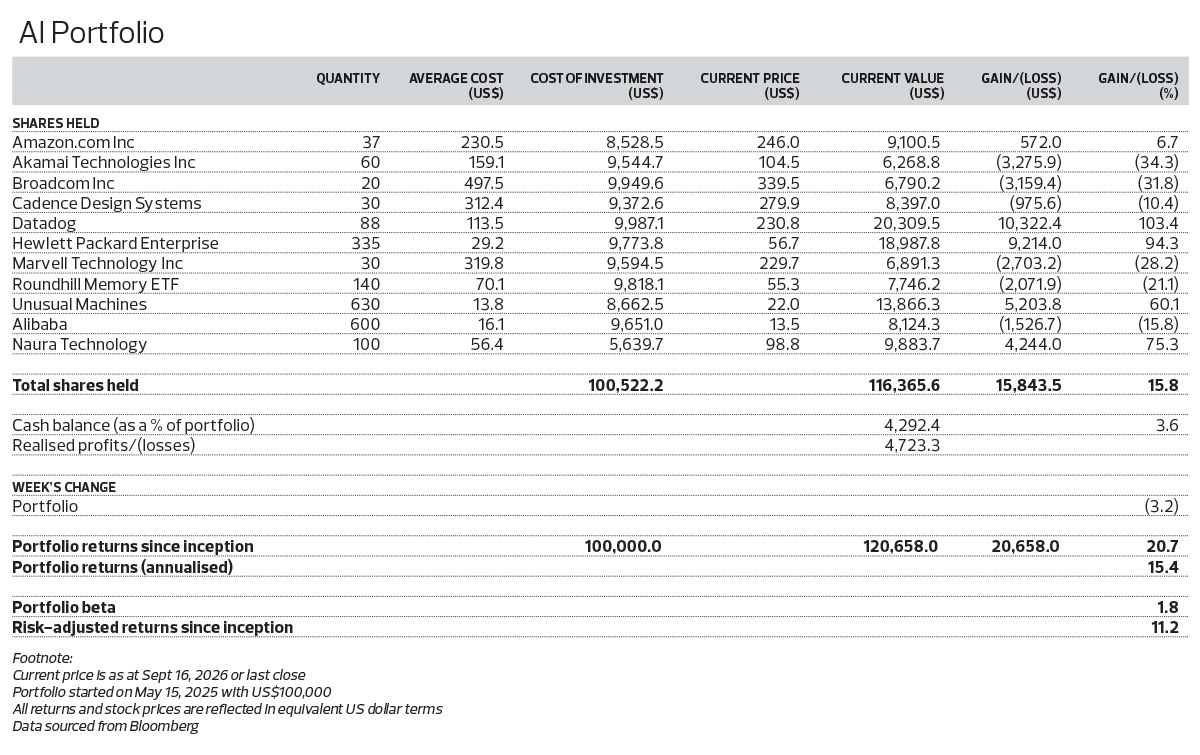
The AI Portfolio also ended in the red, down 3.2% for the week. Total portfolio returns now stand at 20.7% since inception. All stocks in the portfolio traded lower, save for Naura Technology (+2.5%) and Datadog (+2.5%). Roundhill Memory ETF (-10.1%), Unusual Machines (-9.5%) and Broadcom Inc (-6.8%) were the biggest losers.
Disclaimer: This is a personal portfolio for information purposes only and does not constitute a recommendation or solicitation or expression of views to influence readers to buy/sell stocks. Our shareholders, directors and employees may have positions in or may be materially interested in any of the stocks. We may also have or have had dealings with or may provide or have provided content services to the companies mentioned in the reports.
Save by subscribing to us for your print and/or digital copy.
P/S: The Edge is also available on Apple's App Store and Android's Google Play.