

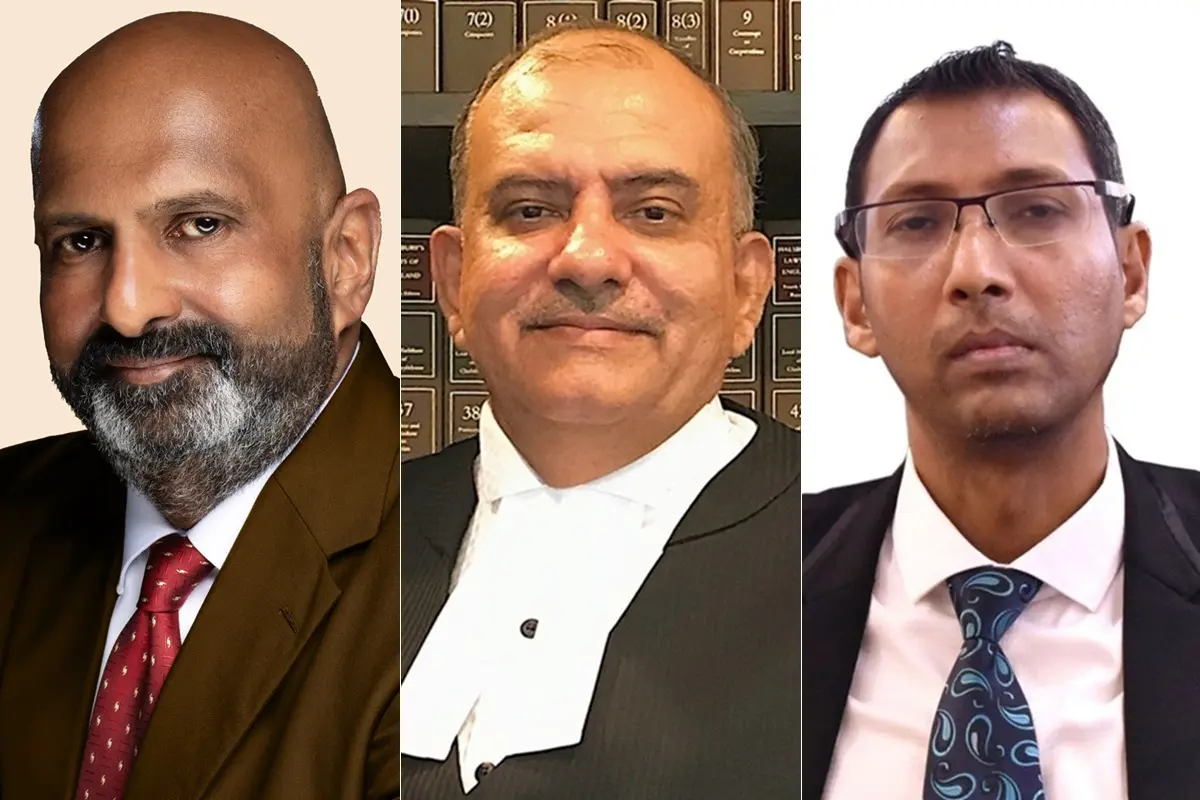
KUALA LUMPUR (Sept 18): The pardon given by the Federal Territories (FT) Pardons Board on Friday — for imprisoned former prime minister Datuk Seri Najib Razak to serve the remainder of his prison sentence for his SRC International Sdn Bhd conviction under house arrest until the end of his sentence in August 2028 — on condition that the RM50 million fine he had been given is paid first, sets a precedent for white collar crimes, says senior criminal lawyer Datuk N Sivananthan.
Sivananthan opined that this precedent may not only be applicable for white collar crimes, but could also apply to other crimes.
“This is the first time that the board has commuted a jail sentence for a prisoner by letting him serve the remainder of his sentence under house arrest.
“This creates a precedent for those who are serving prison sentences for white collar crimes, [who] can possibly apply for this alternative [method of serving their sentence]. However, first of all, Najib has to pay the RM50 million fine as stipulated,” he told The Edge.
Sivananthan compares this with the case of former Selangor menteri besar Dr Mohd Khir Toyo, who had been allowed to serve the remainder of his one-year prison sentence under house arrest, during the remission period.
That, Sivananthan added, was different, as the matter had not gone to the Pardons Board.
In Khir’s case, the prisons parole board had issued the house arrest order in 2016, allowing Khir to serve his sentence under house arrest — but only after he had served six months in prison out of his one year’s jail sentence.
Khir had been convicted for abuse of power as a civil servant in the purchase of two lots of land and a bungalow in Shah Alam worth RM6.5 million for RM3.5 million in 2007.
In Najib’s case, the former prime minister had originally been sentenced to 12 years in jail and fined RM210 million by the Federal Court on Aug 23, 2022, after being convicted of the SRC International crimes.
The former PM and former Umno president had been found guilty of three counts of criminal breach of trust, three counts of laundering RM42 million of SRC International funds, and one count of abuse of power of RM4 billion in Retirement Fund Inc (KWAP) funds, which he had approved in 2011 and 2012.
On Jan 29, 2024, the FT Pardons Board had sat to discuss Najib’s initial pardon petition, and thereafter, the then Yang di-Pertuan Agong, Al-Sultan Abdullah Ri’ayatuddin Al-Mustafa Billah Shah, had then decreed for a reduction of Najib’s prison term to six years and the fine to RM50 million.
Najib’s lawyers must seek a stay of 1MDB conviction and sentence
Sivananthan is also of the view that should the RM50 million fine be paid, Najib’s lawyers should apply for a stay of his 1Malaysia Development Bhd (1MDB)’s High Court conviction and sentence, which the politician is appealing to the Court of Appeal.
This conviction and sentence are different from the SRC International case.
Sivananthan says this is because with this house arrest pardon, Najib is technically released from a proper prison to his own residence.
“I cannot remember if his lawyers had sought a stay of the conviction and sentence. If this is not done, then his lawyers may have to file an application to the High Court to seek a stay of the 1MDB conviction and sentence.
“They have to go to the High Court to seek a stay, and though this is the High Court’s discretion, this has to be done first by Najib’s lawyers before he can be released after the RM50 million fine is paid,” he said.
For 1MDB, Najib was sentenced to 15 years’ jail and RM11.38 billion fine by the High Court on Dec 26, 2025, for which then-High Court judge Datuk Collin Lawrence Sequerah had ordered the former PM to serve his sentence after he completes serving the SRC International prison sentence.
The former Umno president was found guilty on all four counts of abuse of power and 21 counts of money laundering to the sum of RM2.27 billion.
Sequerah in his 810-page written grounds had said that the plunder of 1MDB’s funds made Attila the Hun look like a choirboy.
No limit in pardon application
When asked by The Edge whether a person can make multiple pardon applications, as in this case, Sivananthan replied that there are no limits for a person serving a sentence to file a pardon.
This is Najib’s second pardon, after the one he had been granted in 2024.
“A person can file a pardon [application] multiple times and not [be] limited to one,” Sivananthan said.
Another senior lawyer, Datuk Baljit Singh Sidhu, said Friday’s commuting of Najib’s prison sentence to house arrest is a legal decision, compared to the addendum decree after the Jan 29, 2024 decision was announced.
“This follows there are questions on where are the minutes that grant the former PM to serve the remainder of his sentence under house arrest.
“The meeting and decision today were attended by members of the board, in comparison with the addendum (where the order was issued after the meeting),” he added.
On Dec 22 last year, then High Court judge Alice Loke Yee Ching (now a Court of Appeal judge) had ruled that an additional order issued by the then-Yang di-Pertuan Agong was not valid and cannot be enforced, as the King cannot decide independently of the Pardons Board.
The judge said that although the Ruler has the prerogative to exercise mercy, the act must be within the constraint of the Federal Constitution, particularly Article 42 on the Power of Pardons. There was also no precedence for the order contained in what is now known as the “royal addendum”.
"It significantly alters the nature of the imprisonment term and ought to be deliberated at the Pardons Board meeting," she had said.
It was reported on Friday morning that Federal Territories Minister Hannah Yeoh, Attorney General Tan Sri Mohd Dusuki Mokhtar, and former inspector general of police Tan Sri Razaruddin Husain were seen leaving Istana Negara soon after the FT Pardons Board meeting ended.
Prisons Department must dictate conditions
Sivananthan and Baljit also said that soon after the RM50 million fine is posted, the Prisons Department must stipulate what are the conditions for a house arrest.
Baljit said this is to ensure the prisoner and people know the boundaries of this alternative sentence.
Sivananthan said that under the Prisons Act, the Prisons Department can gazette any building as a prison, and this has to be done with regards to Najib’s residence, as well as to whether prison guards can be stationed at the residence, before he is released.
"Parliament is now tabling conditions under house arrests. However, some of the provisions are there [already present] in the current Act," he added.
Hence, both lawyers said the house arrest condition should also be made known before Najib is released.
Former Malaysian Bar president Salim Bashir said the pardon that ordered the house arrest comes with stipulated conditions.
"Najib has to comply with the said conditions, and any breach risks him being sent back to prison. The public must be aware that house arrest doesn't mean Najib is a free man — the order comes with essential conditions, with a caveat that he is now allowed to serve his remaining sentence outside the prison walls.
"[But] the prison authorities can still impose essential conditions that need to be complied with by Najib."
A statement issued by the Legal Affairs Division of the Prime Minister’s Department has stipulated that Najib can serve the remainder of his prison sentence, which now amounts to less than two years and is scheduled to be completed in August 2028, under house arrest.