


Malaysians have always been fascinated by the household names of colossal tech giants leading the global AI race. These names bring global reputation and prestige. However, many may not realise that these multinational tech giants are set to physically establish their presence in Malaysia within the next two to five years. The government has worked hard to position the country as a crucial AI industry player in the region, including through the Malaysian Digital Action Plan launched in 2025. But has it worked out well?
The answer perhaps, is yes. On Sept 7, Bloomberg wrote: “Malaysia Bonds Draw Record US$3.9 Billion Inflows in August on AI Boom.” The news reported that a massive bond inflow from foreign investors poured in the country due to strong confidence from the spillover of AI giant investments in the region. In the last three years, Malaysia drew a string of global technology giants; Nvidia, Google, Oracle, Microsoft and Amazon, all had signed agreements that translated into a substantial wave of investment into Malaysia, spread across Johor, Sarawak, Negeri Sembilan, Selangor and Penang. Chinese multinationals, ByteDance and Ali Baba Group among them, have since joined the country's data centre race as well.
The headline numbers back this up. According to the Malaysian Investment Development Authority (Mida), accumulative FDI inflow reached around RM993.9 billion (US$214 billion) in 2024, rising a further 9.7% to RM1.09 trillion (US$255 billion) in 2025. This year, it is forecast to increase further, as evidenced by the strong growth in 1Q approved FDI alone, which reached as high as RM92.8 billion (US$23.2 billion). Mida's own reporting attributes roughly 35.8% (US$91.3 billion) of last year's investment to AI-related projects. On paper, at least, Malaysia looks to be one of the clearer winners of the current global data centre build-out, with the promise of new jobs and a broader digital economy base to follow.
For many Malaysians, the arrival of household giant technology names carries a symbolic weight beyond the balance sheet: it is the kind of foreign direct investment long associated with more advanced economies, now landing on home soil. Prime Minister Datuk Seri Anwar Ibrahim's public appearances alongside executives from firms such as Microsoft have reinforced that narrative of a country finally arriving at the top table of the digital economy.
How Malaysia stacks up regionally
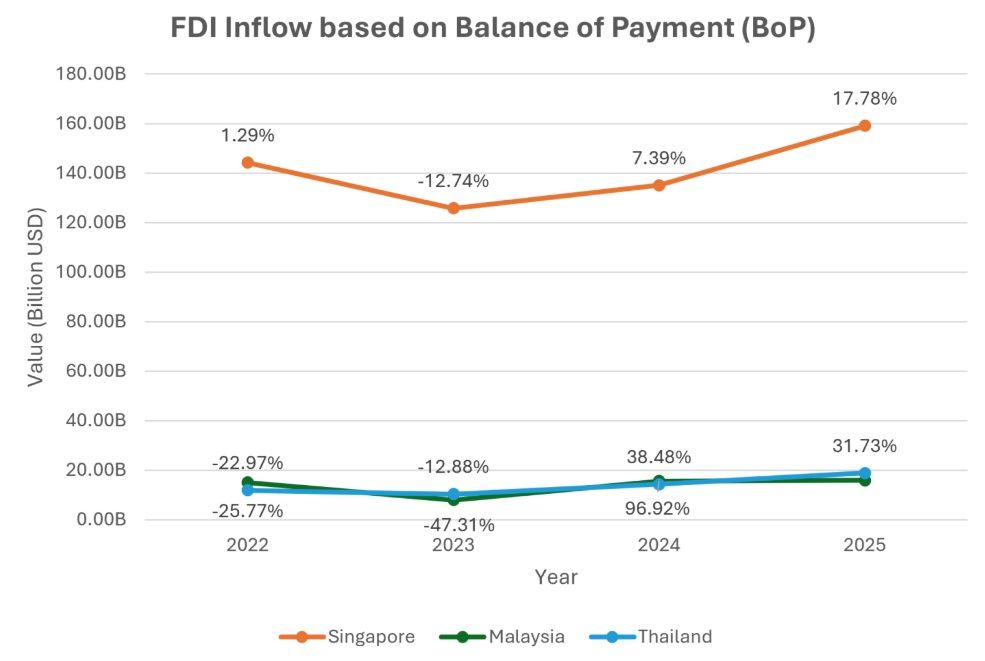
Within Asean, Malaysia has narrowed the gap with its two principal rivals for AI-related FDI: Singapore and Thailand. Singapore remains the region's clear leader, continuing to draw large commitments from Amazon, OpenAI, Microsoft and Databricks. Notably, though, Singapore's own government has begun to apply the brakes. Its Energy Market Authority announced in April that it would cap newly approved data centre capacity, citing land constraints and a deliberate policy to moderate the pace of data centre growth which is the latest in a series of interventions dating back to a 2019 moratorium, eased in 2022, and tightened again with fresh rules in July 2026.
Thailand, meanwhile, has secured a comparable number of headline deals with major AI conglomerates but trails Malaysia in cumulative value. Between 2021 and 2025, AI-related data centre FDI into Malaysia totalled an estimated US$62.5 billion, against US$56.3 billion for Thailand. Thus, Malaysia's advantage sits behind Singapore, not ahead of it. The more meaningful comparison is with Thailand and, further afield, with the far larger AI infrastructure investment programmes under way in Japan, Korea, Taiwan and China, all of which continue to outspend Malaysia by a wide margin. Malaysia's story is one of a strong second place in ASEAN, not in global leadership.
Why Malaysia, why now: Beyond pure economic fundamentals and geopolitics
Malaysia's investment readiness as reinforced by the World Bank's projection that the country will reach high-income status by 2028–29 is part of the explanation. But it is not the whole story. A prolonged period of instability in the Middle East has also played a role. Escalating tension between Iran and neighbouring states hosting Western and Israeli-linked military and strategic infrastructure has led to the destruction of AI data centre assets in the UAE and Bahrain, according to national reports, with facilities in Qatar and Kuwait facing ongoing threats. That regional risk has made investors more cautious about concentrating AI infrastructure in the Gulf, and Malaysia has been a beneficiary of that reallocation.
The government has moved to capitalise on the moment. The Malaysia Digital Action Plan, launched in December 2025, sets a target for AI and the digital economy to contribute up to 30% of GDP by 2030, alongside 500,000 high-income jobs over the same period. Officials have also been explicit that foreign capital cannot be relied on indefinitely; the stated long-term objective is to cultivate a homegrown base of digital start-ups and innovation, with an ambition to place Malaysia among the top ten countries on Stanford's AI Index.
The price of first place: What the headline numbers leave out
This is where the caution belongs. Hyperscale AI data centres are unusual investments in that their economic footprint is dominated by two inputs; first, is electricity and second, is water. Both of which are already under strain in Malaysia, and neither of which shows up cleanly in an FDI headline figure.
On energy, a single hyperscale facility can draw anywhere from 20 to 100 megawatts (MW), according to the Netherlands-based research platform DataCentre.com. That is enough, as Khazanah Research Institute has separately noted, to power a small Malaysian town. Larger committed capacity is precisely what makes a site attractive to investors seeking to host frontier AI infrastructure, but it comes at a cost that is easy to overlook in an investment announcement. Datuk Seri Fadillah Yusof, Minister of Energy Transition and Water Transformation (Petra), has put current combined data centre demand at around 1,000MW, roughly half of the 2,000MW ceiling the country has set aside for the sector. That leaves considerably less headroom than the raw FDI figures might suggest, and it raises three specific concerns that deserve more attention than they currently receive in the public debate.
The first is a measurement problem: double counting in Renewable Energy Certificates (RECs). Where data centre operators purchase RECs to claim a "green" or net-zero energy profile while continuing to draw power from a grid still heavily reliant on fossil fuels, the same unit of renewable generation risks being counted twice — once by the certificate holder and once within the national renewable energy statistics used to track Malaysia's own decarbonisation targets. Without tighter accounting standards, Malaysia's claims about the "clean" nature of its AI investment pipeline may overstate the actual environmental benefit and could eventually expose the country to scrutiny from investors and export markets that apply their own carbon-accounting rules.
The second is the strain that rising data centre electricity demand places on an energy mix that remains roughly 85% dependent on coal. Every additional megawatt committed to a data centre is a megawatt not available to households, existing industry, or the renewable capacity Malaysia has pledged to build. Petra has stated that the government remains committed to a supply mix that is 70% clean by 2050, comprising 58% renewable energy, 10% hydrogen and 2% nuclear, as agreed at the JPPPET meeting in early 2026. But, the arithmetic of that transition becomes considerably harder if data centre demand continues to grow faster than clean generation capacity can be brought online. There is a real risk that AI-driven FDI, marketed as a step toward a high-income and high-tech economy, ends up locking Malaysia into its existing fossil fuel dependence for a longer rather than shorter time.
The third is water. Cooling a 100MW facility requires an estimated two million litres (roughly 530,000 gallons) of water per day. In a country where seasonal water stress and treatment plant shutdowns are already recurring news items in several states, adding water-intensive industrial demand at scale is not a cost-free decision, even where the investment itself brings clear economic benefits elsewhere.
None of this is an argument against AI-related FDI. It is an argument for treating the headline investment figures as the start of the analysis rather than the end of it. A dollar of committed FDI that draws down scarce electricity and water capacity without a matching increase in clean generation and water infrastructure is not equivalent, in net economic terms, to a dollar of investment in a less resource-intensive sector. The policy question is not whether to keep attracting AI investment, but how to price and sequence it against the country's actual energy and water constraints.
Conclusion
Malaysia's performance in the AI FDI race is something the country can be genuinely proud of, coming second only to Singapore in Asean and pulling ahead of Thailand in cumulative investment value. Strong fundamentals, a fast-moving government, and a bit of good timing with instability elsewhere in the Middle East have all worked in Malaysia's favour. What matters now is making sure the country can carry this momentum forward responsibly. The electricity and water demands of these data centres are significant, and issues like REC double counting, continued reliance on coal, and the volume of water needed for cooling are the kind of practical challenges that come with hosting an industry this resource intensive. None of these are reasons to slow down, they are reasons to plan properly, strengthen the grid, speed up the clean energy transition, and tighten the accounting standards so that Malaysia's AI success translates into lasting value rather than strain on systems the rest of the country also depends on.
Wan Omar Fadhli Wan Mahmud Khairi is a lecturer in economics at University of Kuala Lumpur.