

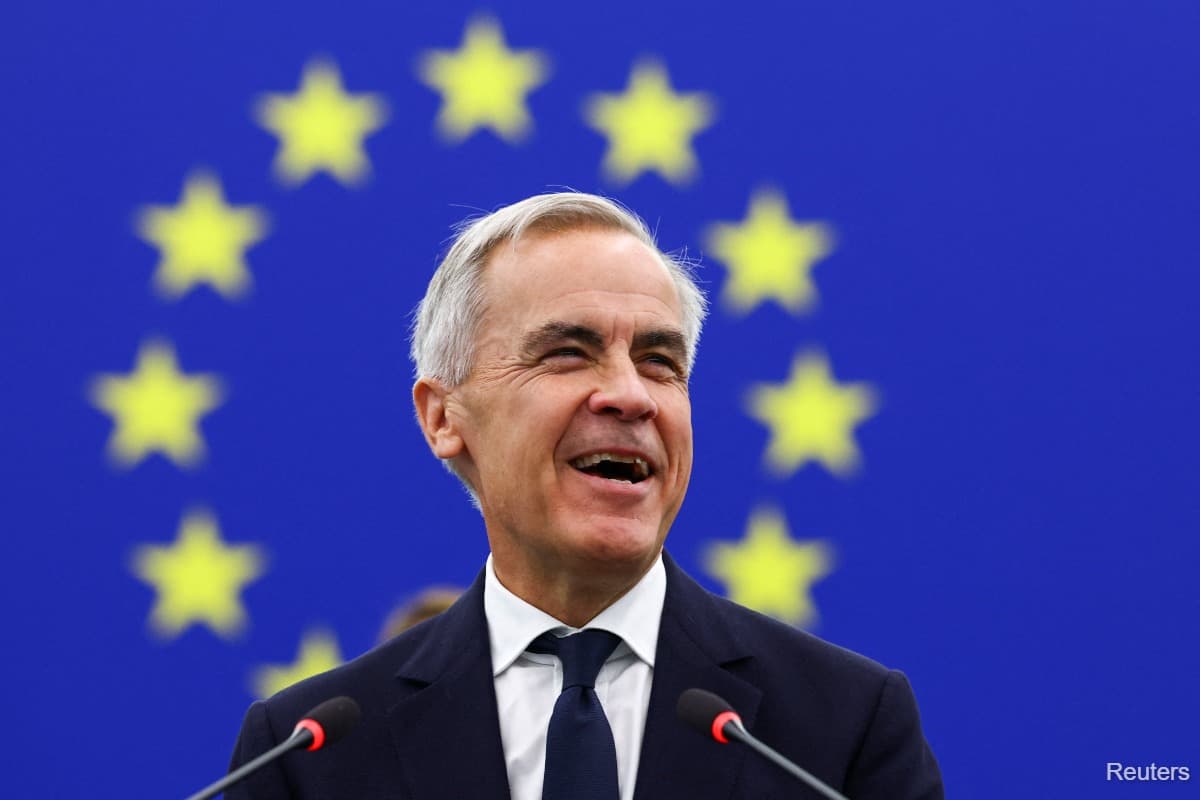
STRASBOURG (Sept 17): Canada and Europe should ally to protect their markets, democracies and rule of law in a world dominated by the United States and China, Prime Minister Mark Carney said on Thursday, after an EU proposal to make Canada an "associate member".
The Canadian prime minister received warm applause for his speech to the European Parliament, delivered hours after US President Donald Trump threatened trade sanctions in response to European Commission President Ursula von der Leyen's proposal to create a new status for the EU-Canada relationship.
Carney did not adopt the term "associate member" used a day earlier by von der Leyen, but said he appreciated "the ambition" that her suggestion conveyed.
"Europe and Canada are each strong. Europe and Canada are even stronger together," Carney said.
He was not seeking to form a "third bloc" to act as "a great-power rival" to Washington and Beijing "only with better manners," Carney said in a line that drew laughs.
"We do not seek power to dominate others. On the contrary, we are pursuing resilience, so that no one can control our open markets, impair our sovereignty, threaten our territorial integrity, or undermine our freedoms, our democracies, our rule of law."
He told reporters after the speech that it would be up to the EU how it proposed to describe any future relationship, and that the substance of any agreement would be more important than the name given to it.
Trump threats
Trump threatened late on Wednesday to take action against the EU if it moved forward with von der Leyen's proposal to make Canada an 'associate member' of the bloc.
"If they do that, if I think it's at all a hostile act, I will put very serious tariffs or stop trading with Europe on many things," Trump told reporters en route to an event in North Carolina, calling the proposal "laughable".
"If it's a good intention, that's fine. If it's a bad intention, we'll put very heavy tariffs on Europe," he added.
The European Commission said von der Leyen's proposal — which had yet to be fleshed out and would need to be approved by EU member states to go forward — was not a hostile act.
"As our president (von der Leyen) made clear yesterday, the proposed strengthening of our partnership with Canada is not against anyone else, but for our common strength," said Olof Gill, a European Commission spokesperson.
Asked about Trump's threats, Carney told reporters: "Canadians are united that nobody is going to tell us what language we speak. No one is going to dictate our culture or with whom we can strike agreements internationally."
Among areas in which he said Canada would want closer ties with the EU, he mentioned seeking strategic autonomy through deep cooperation in critical minerals, defence industrial capacity, AI and computing, energy security, space, and payments.
He also mentioned digital trade and building more secure broadband connections between Europe and Asia via their common geography.
Trump cannot choose for EU, France says
Earlier on Thursday, France's Europe Minister Benjamin Haddad said the United States has no power to veto the EU's geopolitical choices.
"It is not up to the United States — or anyone else — to choose the political and geopolitical direction of the Europeans," he told Public Senat TV.
Von der Leyen made the proposal on Wednesday during her annual State of the Union speech, attended by Carney, as she sought to deepen ties among allies in what she called "an openly hostile world".
But it is unclear whether the idea of associate membership would be backed by EU member states.
One EU diplomat expressed surprise on Wednesday at the proposal, saying "nobody really knows what it means," adding there were concerns that the European Commission chief was "overpromising and won't be able to deliver".
On Thursday, another European diplomat called it an "unfortunate proposal, which has never been discussed with member states."
Uploaded by Magessan Varatharaja