


(Sept 17): Malaysia’s struggling bond market may see an outflow of Japanese capital as its yield premium shrinks.
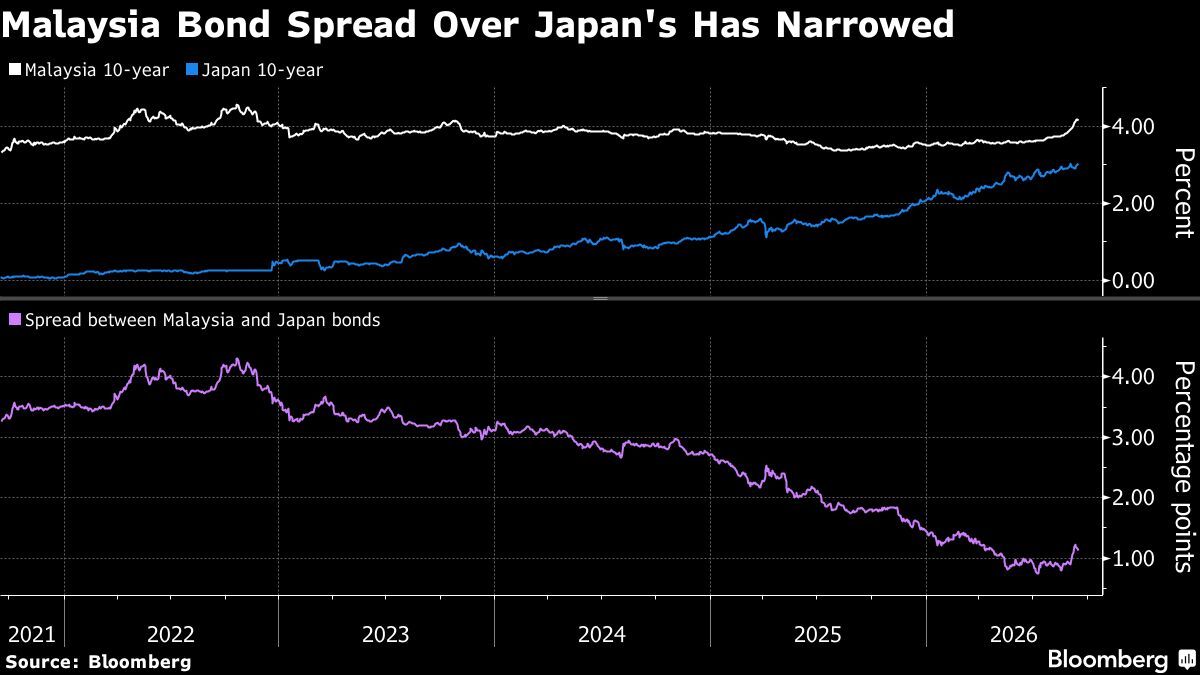
The premium that 10-year Malaysian bonds command over equivalent Japanese notes has shrunk to around 112 basis points, well below the five-year average of 278 basis points as borrowing costs jumped in Japan, data compiled by Bloomberg show.
The Southeast Asian country’s bonds have been under pressure in recent months, due to increased supply and a stronger-than-expected economy that raised the odds of monetary tightening. The weakness may extend if the Bank of Japan delivers a widely anticipated interest rate hike on Friday, a decision set to intensify worries about the departure of Japanese investors holding a record amount of Malaysia debt.
“Malaysia government bonds face pressure from elevated US Treasury yields, while higher Japanese government bond yields raise the opportunity cost of overseas duration, increasing the risk of yen carry-trade unwinds and Japanese repatriation flows,” said Michelle Chia, regional head of treasury and markets research at CIMB Bank.
A sell-off in US government debt has deepened in recent weeks, sending the 10-year Treasury yield to the highest in almost two decades this week. Meanwhile, a sharp rebound in the value of yen has upended the once-popular carry trade that involves borrowing cheaply in the Japanese currency to seek higher returns elsewhere.
Japanese investors owned ¥1.1 trillion (US$7.1 billion or RM28.9 billion) worth of Malaysian debt securities as of the end of 2025, according to the Bank of Japan’s latest data. This was the largest amount since the data became available in 2014 and constituted 13% of Japan’s total bond investment in Asia. The exposure to Malaysia was higher than that to regional peers such as Thailand, Indonesia and the Philippines.
Japan’s 10-year yield rose to a three-decade high earlier this month, fuelled by concerns over inflation and fiscal spending, as well as the prospect of a fresh BOJ rate hike. As Japanese bonds become more attractive, chances are rising for a long-discussed risk for global investors to materialise: the nation’s vast pool of overseas capital returning home.
Even if that prospect doesn’t materialise in the near term, there are enough local factors weighing on Malaysian bonds, especially the growing bets on a hawkish-turning Bank Negara Malaysia. The country’s central bank extended its interest rate pause earlier this month but signalled that borrowing costs could start rising.
The local swaps market is now pricing in a near half-percentage-point rate hike over the next 12 months, versus less than a full quarter-percentage-point at the end of August, according to data compiled by Bloomberg.
The yield on benchmark 10-year Malaysian government paper has risen 51 basis points since the end of June, on track for its biggest quarterly jump in nearly a decade. On Thursday, authorities announced a plan to sell another RM5 billion worth of sovereign debt due in 2033.
Other headwinds for the Southeast Asian nation’s debt market are robust economic growth, inflation risks and fiscal pressures from increased fuel subsidies, said Chandresh Jain, EM Asia rates and FX strategist at BNP Paribas SA. “We anticipate further sell-offs in Malaysia bonds.”
Uploaded by Chng Shear Lane