

(Sept 17): Over the past two years, I have occasionally written about some of the people I regard as role models in Malaysia's plantation and palm oil journey — Tun Dr Lim Keng Yaik, Tun Raja Muhammad Alias Raja Muhammad Ali, Tan Sri Abdul Khalid Ibrahim, Tan Sri Datuk Dr Augustine Ong Soon Hock, Datuk Boon Weng Siew, fondly remembered as “Uncle Boon”, MR Chandran and Mahbob Abdullah, among others.
They travelled different roads as institution-builders, corporate leaders, scientists, innovators, bridge-builders and practitioners of the old plantation school. Each left footprints in the soil and lessons for those who followed.
I have always felt that an industry should remember its people while they are still among us. We are good at recording hectares planted, tonnes produced, profits earned and companies built. We are sometimes less diligent in recording the values, judgement and character of the people behind those numbers.
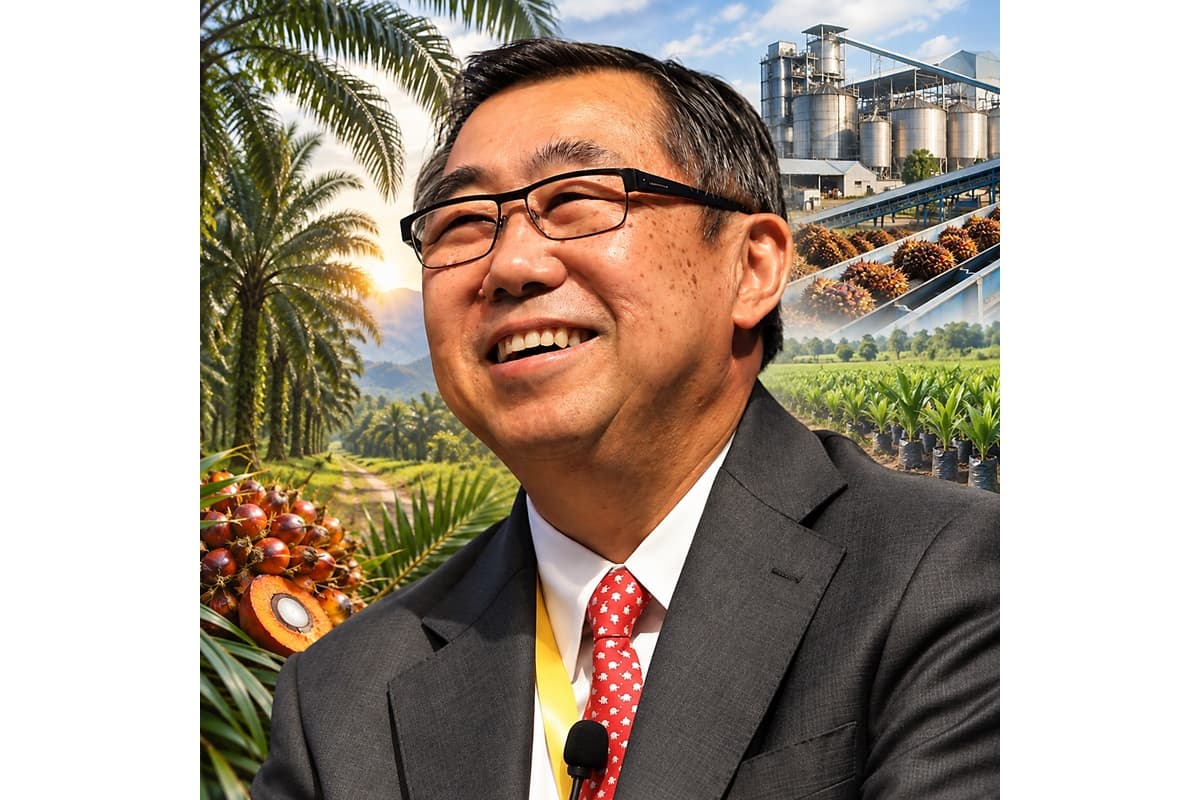
This time, I wish to reflect on another senior figure whose journey has intersected with much of modern Malaysian plantation history — Tan Sri Lee Oi Hian.
Over my years in plantations, I encountered him at different points and in different capacities. Never closely enough to pretend this is an intimate portrait, but often enough to observe the consistency of the man — experienced, measured, understated, knowledgeable and unmistakably a planter. In an industry where personalities can sometimes grow faster than palms, his has generally been a quieter form of leadership.
There is also a particular reason to reflect on his journey now.
On Oct 1, 2026, his son Lee Jia Zhang, 43, will assume the role of chief executive officer of Kuala Lumpur Kepong Bhd (KL:KLK), while Tan Sri Lee remains as the executive chairman. Jia Zhang joined KLK in 2010 and has spent 16 years progressing through the organisation before taking the CEO's chair.
So this is not really a retirement story. It is something more interesting — succession without disappearance, continuity without stagnation and stewardship moving from one generation to another.
More than inheritance
Tan Sri Lee's plantation story began before the boardroom. As a boy, he accompanied his father, the late Tan Sri Lee Loy Seng, on estate visits. He later graduated in agricultural science from the University of Malaya in 1974, joined KLK that year and subsequently obtained his MBA from Harvard Business School.
Agriculture from UM and management from Harvard was a formidable combination. Yet Lee would later recall, with refreshing candour, that after university, some early working experience and Harvard, he thought he knew rather a lot.
Many graduates will recognise the condition. Some of us may even have suffered from a mild case ourselves.
Fortunately, agriculture provides an effective cure. Rain does not fall because the budget says it should. Palms do not increase yield because management has produced an impressive PowerPoint presentation. Labour shortages cannot be solved by moving a cell on an Excel spreadsheet. Biological cycles remain notoriously unimpressed by quarterly reporting deadlines.
Lee continued learning from his father, experienced planters and others in the industry. He joined the KLK board in 1985, became the managing director in 1988 and, following his father's death in 1993, assumed the positions of chairman and CEO while still in his early forties. His own succession, too, had been a progression rather than an overnight appointment.
It is one thing to inherit something valuable. It is another to take what the previous generation built, develop it and eventually leave it stronger for the generation after you.
The scale of that development is worth remembering. When Lee took over in 1993, KLK already had more than 100,000ha in Malaysia and some downstream interests. By 2022, its planted area had grown to 284,000ha, with the business extending much further along the palm oil value chain and beyond Malaysia.
Yet perhaps the more revealing point is how Lee himself has described his place in that journey — as a second-generation steward of what his father had begun.
For those of us in agriculture, the idea feels familiar. The land was there before us and, if we do our job properly, will remain productive after us.
A planter occupies only one season in a much longer story.
The true-blue planter
When Lee assumed leadership in 1993, KLK was already a substantial plantation enterprise. His achievement was not merely to preserve that inheritance but to take it into a different world.
KLK expanded internationally, particularly into Indonesia, while moving increasingly beyond the estate gate into resource-based manufacturing. Under Lee, the group built a substantial Indonesian plantation presence while pushing deeper downstream into oleochemicals and specialty chemicals across Asia and Europe. What had traditionally been a journey from seed to mill became a much longer value chain.
The agriculturist had entered the boardroom, but agriculture remained beneath the business.
Among his peers, perhaps the more revealing description of Lee was simply “a true-blue planter”.
Plantation people have their own informal test of authenticity. Titles help, but only so far. A planter wants to know whether you understand harvesting rounds, labour shortages, replanting, rainfall, fertiliser, roads, mills and commodity cycles.
Nature has a useful way of keeping management humble.
Beyond one company
Lee's contribution was never confined to KLK. He served as the president of the Malaysian Estate Owners Association (MEOA) from 1986 to 1990 and later as the chairman of the Malaysian Palm Oil Council (MPOC) from 1996 to 2009. He also served the Malaysian Cocoa Board and other industry bodies.
As a fellow former MEOA president, albeit from another generation, I can appreciate what such industry leadership demands. Unlike leading a company, an association president must bring together members with different businesses, priorities and strongly held views. It calls for effective advocacy, sustained stakeholder engagement and, above all, unity and solidarity.
These are seldom achieved in a single meeting. Labour, taxation, sustainability, market access, regulation and public perception require patience and persistence. Sometimes progress comes in hectares; sometimes in inches. The important thing is to remain at the table.
In 2012, the MPOC recognised Lee with its Palm Oil Industry Leadership Award. A decade later, The Edge Malaysia named him Outstanding CEO of Malaysia at its Billion Ringgit Club awards.
Awards eventually sit on shelves. Respect from fellow practitioners is harder to earn.
KLK's acquisition of IJM Plantations in 2021 gave me another opportunity to observe Tan Sri Lee at closer quarters. From my vantage point, the transition was smooth, with a shared language of palms and people.
When Tan Sri Lee visited our operations, I had opportunities to spend some time with him. Our conversations wandered beyond palms, yields and corporate matters into family, faith, the industry and leadership.
I saw more clearly someone shaped by long experience and resilience, yet patient in conversation, respectful of others and remarkably humble. He did not need to advertise his experience; it showed quietly in the way he listened and reflected. It was an impression echoed by those who had worked closely with him — an unassuming leader who listened before deciding, but was decisive when the moment for decision came.
For my part, the time had come to step aside, knowing that IJM Plantations was passing into experienced plantation hands.
The long-cycle view
Perhaps agriculture's greatest contribution to leadership is its understanding of time.
An oil palm planted today does not care about tomorrow morning's share price. Replanting sacrifices current production for future productivity. Research may take years to yield results, while a poor agronomic decision can leave consequences long after the manager responsible has moved on.
The planter therefore learns to think beyond the next quarter.
Companies require much the same discipline. Some investments need time to mature. Others need pruning. Old ways occasionally have to be replaced even while they are still producing.
That long view appears to have shaped Lee's corporate approach too — growth, but with prudence; expansion, but with sound fundamentals; and the gradual professionalisation of the organisation without discarding the values on which it was built.
Jia Zhang has spoken of his father's willingness to invest for the long term and wait patiently for that vision to mature, while remaining disciplined about governance and the fundamentals of the business.
Corporate stewardship, in that sense, is not so different from replanting. And perhaps succession is the most delicate replanting exercise of all.
But stewardship should not be romanticised. The plantation industry Jia Zhang's generation inherits will arguably be more complex than the one his father inherited in 1993.
Malaysia faces ageing palms, replanting needs, labour constraints and the continuing challenge of mechanisation, particularly harvesting. Climate variability, rising costs, traceability, sustainability expectations and increasingly demanding markets are reshaping the business. Artificial intelligence, automation, precision agriculture and data will change it further.
Palm oil now also sits at the intersection of food security, energy, trade, environmental policy, rural livelihoods and geopolitics.
Yet challenge and opportunity frequently grow in the same field.
Malaysia possesses decades of agronomic knowledge, sophisticated processing infrastructure, strong refining and oleochemical capabilities, improving genetics and an established downstream ecosystem. Mechanisation, digitalisation, renewable energy, biomass utilisation and higher-value downstream products offer possibilities an earlier generation could scarcely have imagined.
The next chapter therefore cannot simply be about producing more tonnes. It must increasingly be about creating more value from every hectare, every tonne, every worker, every molecule and, increasingly, every piece of data.
The next generation cannot merely preserve what the previous one built. It must question inherited assumptions, embrace useful technologies and continue earning society's licence to operate.
Perhaps that is one of the harder lessons for any successful leader and certainly for any father.
The ultimate test of stewardship may not be whether the next generation does things exactly as we did, but whether we have prepared them well enough to do some things better.
Father, son and the next row
That is what makes KLK's leadership transition particularly interesting.
In majority family-owned businesses, succession can sometimes arrive as an event. Better transitions are processes, begun years before anybody changes the nameplate on the CEO's door.
Jia Zhang is not being parachuted into the top job simply because he carries the Lee name. He joined KLK in 2010 and has spent 16 years progressing through the organisation, gaining experience across plantations, oleochemicals, refining, property and corporate functions before becoming the chief operating officer.
He has been groomed through the business rather than above it.
A family name may provide an inheritance, but it should never substitute for apprenticeship. Plantation people understand this instinctively. We do not put a young seedling into the field in the morning and expect to harvest it in the afternoon.
Growing leadership, like growing palms, takes time.
There is a poignant symmetry here. Lee himself succeeded his father, Tan Sri Lee Loy Seng, after the latter's death in 1993. What he inherited went beyond corporate assets. He has spoken of three enduring values passed down from his father: honesty, hard work and loyalty.
Rather old-fashioned words, perhaps. No fashionable management acronym is attached to them. Yet they have travelled remarkably well.
Thirty-three years after succeeding his own father, Lee is now overseeing another generational transition — this time deliberately and progressively - while remaining as the executive chairman to provide continuity and institutional memory.
Lee Loy Seng. Lee Oi Hian. Lee Jia Zhang. Three generations. Three different worlds.
Jia Zhang's challenge will not be to become another Oi Hian, just as Oi Hian's achievement was not simply to become another Lee Loy Seng.
Every generation inherits a different field. Good succession preserves the roots without preventing new branches from growing.
The harvest that matters most
There comes a stage when the meaning of cultivation changes. We begin by cultivating crops, then businesses and institutions, before realising that perhaps the most enduring crop is people. Their gestation is longer and their yield harder to measure, but their harvest may outlive us.
That, perhaps, is why some contributions deserve acknowledgement while their makers are still among us.
Respect does not require sameness. Perhaps we also do not say thank you often enough while people are still around to hear it. So, thank you, Tan Sri.
Thank you for the decades given to plantations, particularly oil palm, and for serving not only KLK but institutions of the wider industry. As a fellow former MEOA president from another generation, I particularly appreciate the less visible work of advocacy — listening, engaging, persuading, holding people together and continuing to turn up at the table when agreement does not come easily.
Thank you for showing that an agriculturist can travel from estate to boardroom and from commodity production into sophisticated downstream businesses without forgetting where the value chain begins.
And thank you for inspiring many others who continue to believe that plantation agriculture is not an industry belonging to yesterday, but one that must continually reinvent itself for tomorrow.
No leader is perfect, and no corporate journey extending over half a century should be reduced to a tribute alone. There will always be decisions to debate, strategies to question and lessons that hindsight interprets differently. That is as it should be.
Perhaps the fairer measure of a lifetime of leadership is not simply: What did he build? But: What did he leave capable of growing after him?
Tan Sri Lee is not leaving the field on Oct 1. He remains as the executive chairman. But a significant baton is being passed — from a father who himself inherited stewardship from his father, to a son who has spent 16 years preparing to carry it forward.
Three generations. Different times. New challenges. But the same responsibility — to leave the field better than one found it.
The planter plants knowing somebody else will harvest. The leader builds knowing somebody else must eventually lead. And the steward understands that legacy is measured not simply by how long one remains at the helm, but by whether the organisation and its people continue to flourish when another pair of hands takes hold.
After more than half a century in the industry, Tan Sri Lee Oi Hian has seen many harvests. One of the most meaningful may now be the harvest of the people he has helped to grow.
The next row belongs to another generation.
And I suspect the old planter will still be walking the field.
Joseph Tek Choon Yee is a former president of the Malaysian Estate Owners’ Association and past chief executive of the Malaysian Palm Oil Association.