

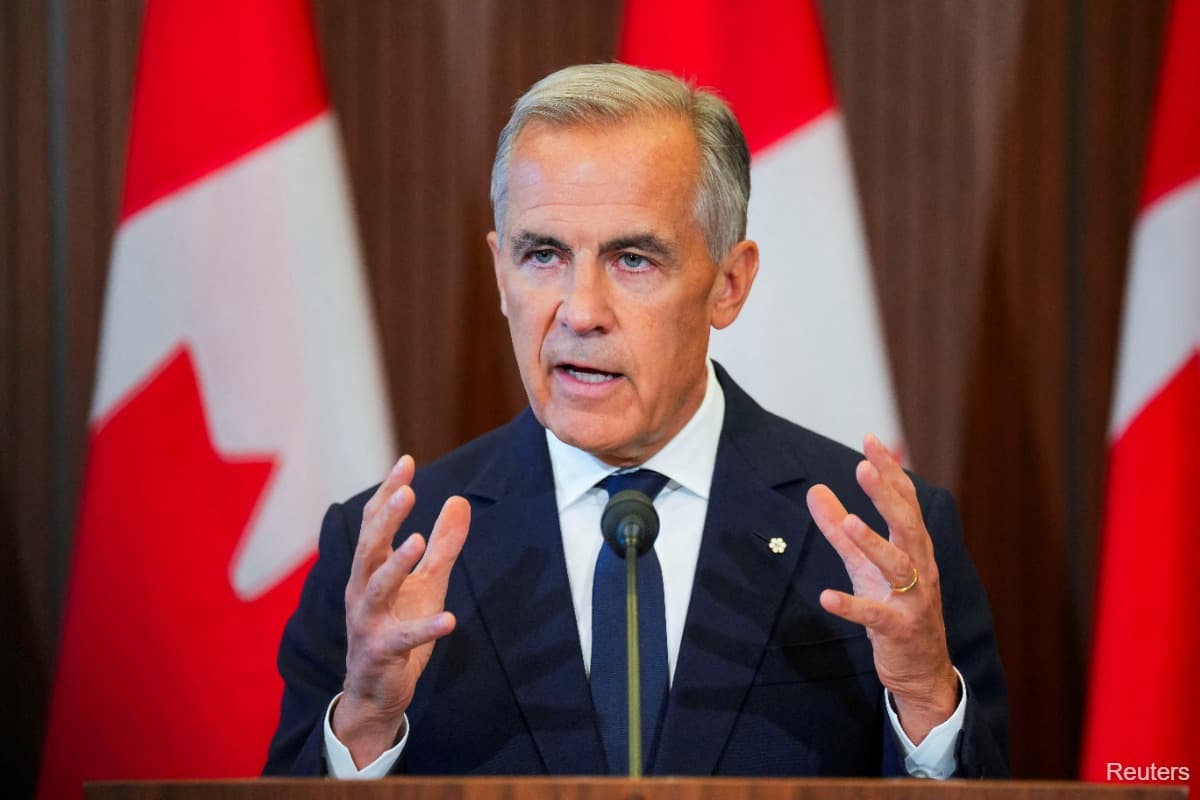
TORONTO (Sept 16): Canada will let businesses immediately write off the cost of most new capital investments for tax purposes, Prime Minister Mark Carney said on Tuesday, unveiling a measure aimed at strengthening the economy and drawing more foreign investment.
Carney is welcoming dozens of global investors to Toronto this week, hoping to lure investments for more than 160 projects that he says are key to steering Canada's economy through a trade war with the United States.
Carney said two-thirds of all assets would now qualify for the benefit, citing sectors such as mining, oil and gas pipelines, and software.
"The effect is straightforward. When you invest in Canada, you can deduct substantially more of that investment immediately," he said at the summit.
As a result, Canada’s marginal effective tax rate on new business investment will fall from roughly 13% to 6.4%, the lowest of any major economy in the world and less than half the rate in the United States, the government said in a statement.
Permanent incentive
The new measure, called the Productivity Mega Deduction, expands a previous tax incentive introduced in the budget a year ago and makes it permanent.
The Canadian Association of Petroleum Producers said the measure “closes a significant competitive gap” with the United States on expensing capital costs.
“Canada is taking another major step forward in improving the competitiveness of the oil and natural gas industry and towards becoming one of the best places in the world to invest in energy,” CAPP CEO Lisa Baiton said in a statement.
Carney has pledged to attract C$1 trillion (US$718 billion or RM2.9 trillion) in investment in the next five years by cutting red tape and developing mining, energy, technology and infrastructure projects.
"If anything, if the Canadian government follows through with the plans that have been presented today, with the structure that was being described today, I think we're going to have asymmetry of having more money invested in Canada," said BlackRock CEO Larry Fink at the summit.
Carney has tried to address past concerns about a time-consuming regulatory environment and lack of large-scale investment-grade projects in the country.
"Canada will remain a country of high standards. But high standards do not require slow decisions," Carney said, reiterating a promise to cut the review period for major projects.
Private investment in airports
Carney also said Canada was seeking private investment through long-term concessions to operate the nation's four largest airports — in Toronto, Montreal, Calgary and Vancouver.
"(We) will retain ownership of the underlying land and assets, but we will unlock their true value by bringing in new capital and expertise into their operations and growth."
Speaking on the sidelines of the summit, two asset managers told Reuters they would be interested in investing in airports.
Canadian labour groups have said they oppose privatisation, saying it would raise costs for travellers.
The Carney government's priorities mark a departure from those of his predecessor Justin Trudeau, a fellow Liberal who focused more on human rights, climate change and Indigenous issues. Hundreds of protesters demonstrated against the summit on Monday evening.
The summit drew senior investors and executives from across North America, Europe, Asia and the Middle East, including from Blackstone, Apollo and JPMorgan in the United States, from Norway’s Norges Bank Investment Management, Singapore’s GIC and Temasek, and the Qatar Investment Authority.
China International Capital Corporation, a major Chinese investment bank and securities firm, and China Investment Corporation, China’s sovereign wealth fund, were also present, as Ottawa seeks deeper ties with China.
Uploaded by Magessan Varatharaja