

(Sept 14): China’s credit expansion fell well short of expectations in August from a year ago, as subdued borrowing by households and businesses outweighed the support from government bond sales.
Aggregate financing, a broad measure of credit, increased 1.66 trillion yuan (RM1.01 billion) last month, according to Bloomberg calculations based on data released by the People’s Bank of China on Monday. That compares with the median forecast of 2.1 trillion yuan by economists.
Weak bank lending was the main culprit of the slowdown. Financial institutions extended just 60 billion yuan of new yuan loans in the month, less than a sixth of the median forecast of 404 billion yuan.
Credit activity typically rebounds in August after a lull in July, as banks ramp up lending to meet their quarterly targets. That makes the latest reading particularly weak following a rare contraction in loans in the previous month.
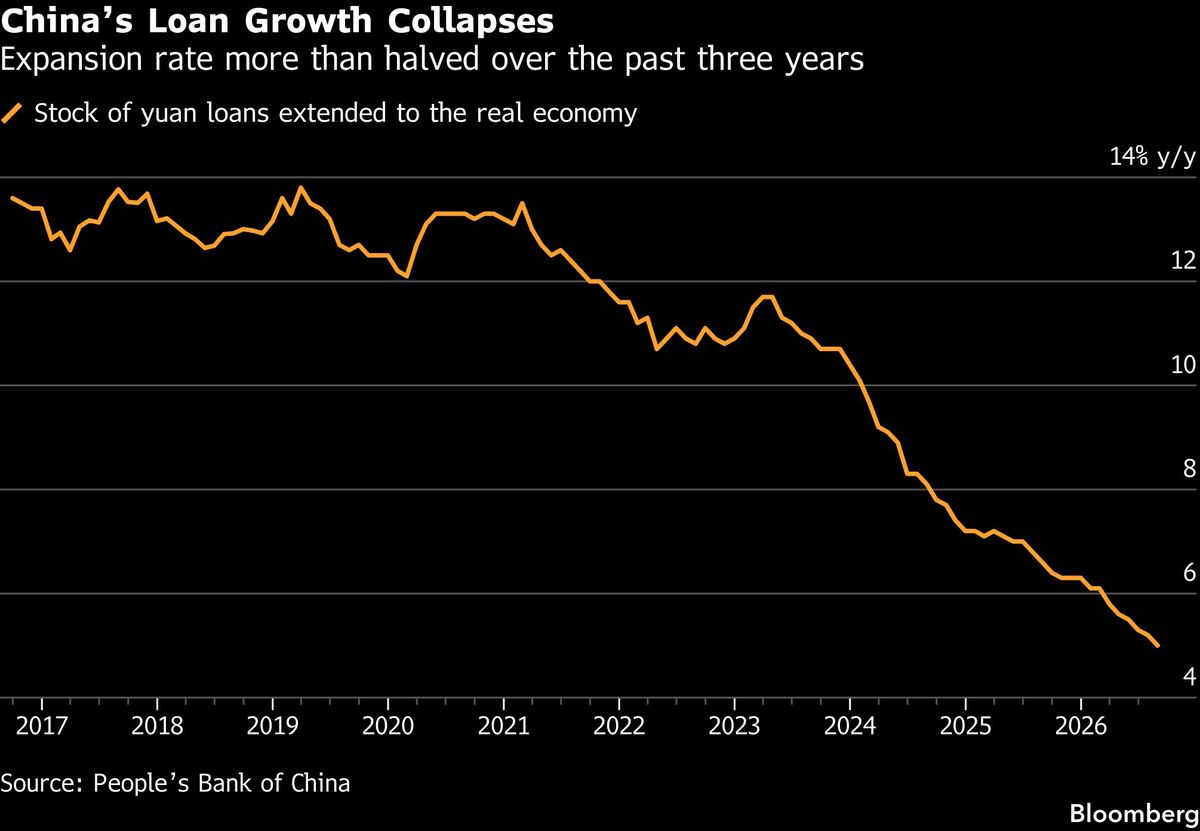
Loan growth has slowed sharply since 2023 as households and companies have become less willing to borrow. The stock of loans to the real economy grew only 5% in August from a year ago, the slowest pace on record and down from nearly 12% three years ago.
The central bank has called on markets to stop fixating on loans to gauge its support for the economy, citing a structural transition from property to high-tech industries that has naturally reduced demand for bank lending.
Even so, the reluctance of consumers and businesses to take on debt points to weak confidence in the economic outlook. Earlier this year, borrowings held by Chinese households contracted for the first time since 1995.
“The PBOC does not appear overly concerned about the continued weakness in credit growth,” Nguyen Hoang Nam, China economist at Capital Economics, said in a note. “But growing financial pressures in China’s highly indebted corporate sector mean that the PBOC will eventually come under pressure to resume monetary easing.”
Household mid- and long-term loans, which largely reflect mortgages, shrank for the fifth time this year. That suggests households repaid more debt than they took on. Comparable loans to companies, an indication of their willingness to invest, were less than half the amount recorded three years ago.
Government borrowing, meanwhile, has played an increasingly important role in supporting overall credit growth. Government bond sales added about one trillion yuan to the August total, although their contribution was slightly smaller than in July.
Central and local governments had used about 68% of their annual bond issuance quota through August, trailing the 76% pace recorded a year earlier. With authorities pledging to act faster in implementing budget plans, stronger expenditure and bond sales could potentially support credit growth in the rest of this year.
Uploaded by Arion Yeow