

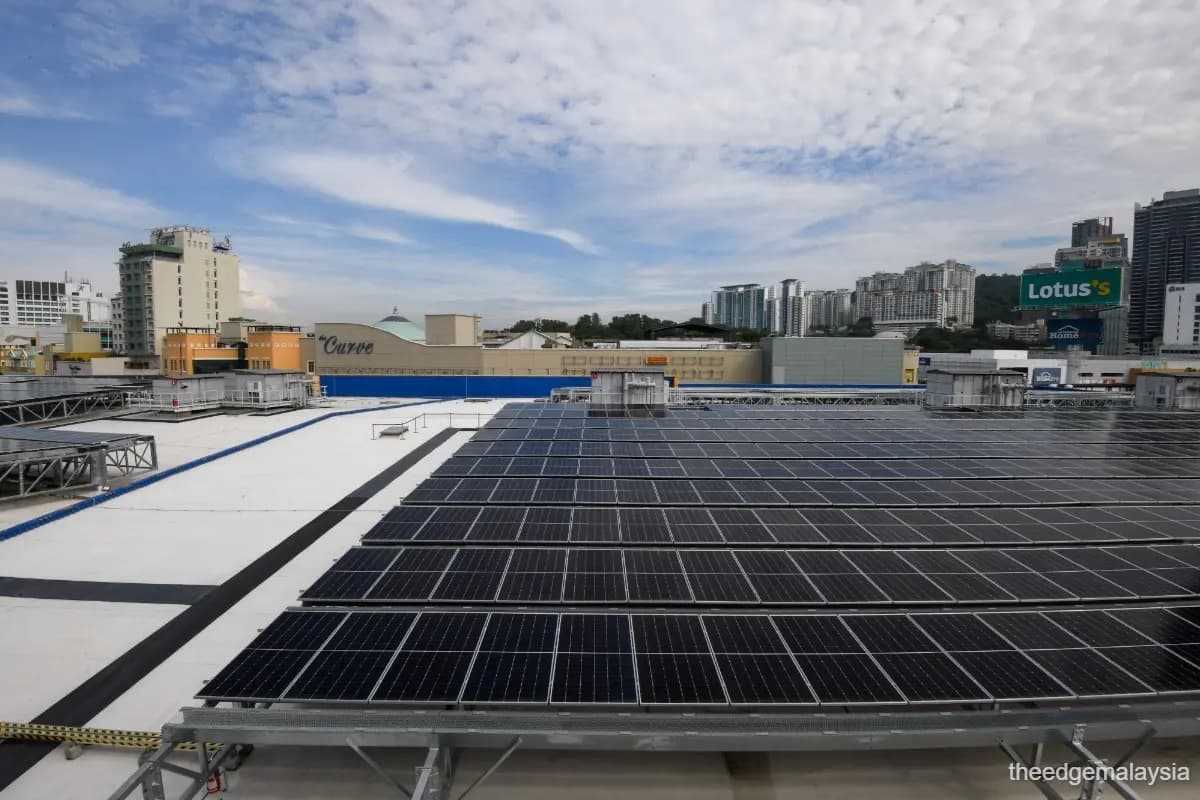
A war in the Middle East has suddenly made rooftop solar more valuable in Thailand.
Last week, Thailand announced plans to accelerate 5GW of rooftop solar across one million households, supported by a 200 billion baht (RM24.48 billion) energy-transition emergency fund. The immediate motivation was not simply decarbonisation. Thailand generates more than 60% of its electricity from natural gas, with a significant share of that gas imported. Rising LNG prices and disruption linked to the conflict involving Iran have therefore turned a geopolitical event thousands of kilometres away into a domestic energy-security problem.
Malaysia is not Thailand. Our resource base, electricity mix and exposure to imported fuel are different, so copying its response would make little sense.
But the episode is worth studying because it reveals how quickly the value of an energy technology can change.
A solar panel can be discussed one year as a climate investment, the next as a way of reducing electricity costs and suddenly as insurance against geopolitical disruption.
That should broaden the way we think about Malaysia’s own energy transition.
For decades, energy security was primarily a question of supply: Where does our oil come from? How secure are our gas contracts? What happens if a shipping route closes or prices suddenly rise?
Renewable energy changes part of that equation. Sunlight does not have to pass through the Strait of Hormuz.
Unfortunately, the sun does not negotiate with our electricity demand either. That is where the next problem begins.
A megawatt is not a moment
Malaysia’s energy transition is often described through quantities: renewable-energy percentages, gigawatts of new capacity and megawatts of storage.
Those numbers matter but they can also conceal what an electricity system is actually required to do.
It does not have to produce enough electricity on average.
It has to balance supply and demand continuously.
Consider a solar plant producing strongly at 1pm. By 8pm, the same panels may be producing virtually nothing, even though households, commercial buildings and industrial facilities still require power.
Nothing is “wrong” with the solar plant. The problem is simply that electricity has a time dimension.
This is also why two storage numbers that look similar in a news headline can mean very different things.
Malaysia’s Energy Commission is procuring 400MW/1,600MWh of utility-scale battery storage through the MyBeST programme.
The distinction between MW and MWh is important.
Megawatts describe power: how quickly electricity can be delivered at a particular moment. Megawatt-hours describe energy: how much electricity can be delivered over time. For the MyBeST system, the arithmetic is revealing:
1,600MWh ÷ 400MW = four hours.
In simplified terms, if the system were fully charged and discharged continuously at its full rated power of 400MW, it would contain roughly four hours of energy.
That does not make four hours either good or bad. It tells us what sort of problem the asset is suited to solving.
A four-hour battery can be extremely useful for taking electricity produced during a sunny afternoon and shifting some of it towards the evening. It is a very different tool from something intended to sustain electricity supply through a prolonged multi-day disruption.
This is why saying that a country has “400MW of batteries” tells only half the story. Storage is fundamentally about power, energy and time together.
Batteries help. They do not make physics disappear.
Battery storage will be essential in electricity systems with increasing shares of variable renewable generation.
But it should not become another technology onto which we project unrealistic expectations.
Every time electricity passes through storage, there are losses. If, for illustration, a battery has a round-trip efficiency of 90%, storing 100MWh of electricity does not mean that 100MWh later returns to the grid. Approximately 90MWh does.
Likewise, batteries degrade as they are cycled. Their economics depend on how frequently they are used, how deeply they discharge, the value of the electricity being shifted and what other infrastructure they allow us to avoid building.
The engineering question is therefore not simply: How many batteries should Malaysia install? It is: What exactly are we asking those batteries to do?
If every mismatch between renewable generation and consumption is solved by installing more storage, we may eventually discover that we have used expensive hardware to compensate for poor coordination.
Because storage is not the only way to move energy through time.
Sometimes we can move the activity that consumes it.
This is one of the less intuitive ideas in the energy transition.
An office building needs cooling at 4pm but that does not necessarily mean every unit of cooling energy must be produced at 4pm. Thermal energy storage can allow cooling to be produced earlier and used later.
An electric vehicle owner may care greatly that the battery is charged before leaving for work while caring very little whether charging occurred at midnight or 3am.
Some industrial processes have scheduling windows. Some commercial loads have thermal inertia. Some computing workloads can be postponed.
Others cannot.
A hospital cannot move critical care to lunchtime because solar generation happens to be abundant. Semiconductor manufacturing cannot casually interrupt sensitive processes. Data centres operate under strict reliability requirements.
That is why “demand flexibility” should not be understood as asking people to switch things off whenever the grid becomes uncomfortable.
It means identifying what can move, how far it can move and what it costs to move it. This is where engineering becomes economics.
Malaysia is adding not only more demand but also a different kind of demand
The timing question becomes more important because Malaysia’s electricity demand is changing rapidly.
Peak demand in Peninsular Malaysia is projected to rise from 21.3GW in 2026 to 33.5GW by 2035.
That is an increase of 12.2GW — roughly 57% in nine years.
Data centres are one major driver, alongside advanced manufacturing and broader electrification. Government projections suggest that data centres could eventually account for nearly a third of national electricity consumption.
The obvious question is where all of that additional electricity will come from. But I think there is another question that deserves equal attention:
What will the demand actually look like hour by hour?
This is not a semantic distinction.
Imagine two industrial facilities that each consume 100MWh over a day.
Facility A requires almost all of its electricity during a narrow period of already high system demand.
Facility B consumes the same 100MWh but part of its workload can move several hours without affecting production.
On an annual energy chart, both facilities appear identical.
To the electricity system, they are not.
Facility B potentially gives the grid another resource: flexibility.
That is why Malaysia’s future energy planning should look not only at how many kilowatt-hours new industries consume but at the shape of that consumption.
The shape determines how much generation, grid capacity and storage may ultimately be required to serve it.
This is where AI becomes useful — and difficult
Artificial intelligence enters this discussion for reasons that have little to do with the current obsession with generative AI.
Imagine an energy-management system looking several hours ahead.
It has a forecast of tomorrow’s solar generation and expected electricity demand. It knows that a battery is 65% charged. It knows one process must run immediately, another can be shifted by two hours and a third must be completed before the following morning.
Now it can make decisions.
Should the battery charge while solar output is high?
Should some stored electricity be reserved because evening demand is expected to rise? Could a flexible load be moved forward rather than drawing from the battery later? What if tomorrow’s solar forecast is wrong?
These are the kinds of decisions where forecasting, optimisation and AI can become genuinely useful.
The application is not “AI-powered energy” in the vague way the phrase is often used. It is decision-making under uncertainty.
That distinction matters because optimisation can also fail in very sophisticated ways.
A controller instructed only to minimise electricity cost may produce a solution that violates operational requirements. A battery dispatched aggressively to reduce today’s bill may experience degradation that weakens the lifetime business case. A forecasting model can perform extremely well on average and still be wrong on the particular afternoon when its prediction matters most.
One of the most important lessons in applied AI is that optimisation is only as intelligent as the objective and constraints we give it.
For energy systems, that means the next generation of intelligence needs to account for physical limits, uncertainty, degradation, commercial priorities and the consequences of being wrong.
That is a much harder problem than adding an AI label to the grid.
It is also a much more useful one.
Energy security is really about having another move
This brings us back to Thailand.
The most useful lesson from its rooftop-solar response is not that Malaysia should install exactly the same technology at the same scale.
It is that a shock can change the value of an energy option almost overnight. Malaysia therefore needs resilience that extends beyond securing another source of fuel. A resilient electricity system has choices.
It can draw from a diversified generation mix. It can move electricity through storage. It can move some consumption through flexibility. It can transfer power through stronger networks and regional interconnections. It can use forecasts to prepare before a constraint becomes a crisis.
Malaysia’s policy conversation is already moving in this direction. Last week, Economy Minister Akmal Nasrullah Mohd Nasir argued that energy security and energy transition should not be treated as competing objectives while highlighting the need for greater storage, a more flexible electricity grid and stronger integration between energy, industrial and digital infrastructure.
The difficult part is now translating that principle into investment and system design. Installed renewable capacity should remain an important measure of progress. But I would add another question:
When Malaysia actually needs clean electricity, how much of it can the system make available?
That question forces us to consider more than generation.
It includes storage duration, network capacity, the shape of demand, forecast uncertainty and the degree of flexibility already hidden inside the economy.
The next energy shock may originate in geopolitics. The one after that may come from extreme weather, an unexpected surge in industrial demand or a technology that changes electricity consumption faster than infrastructure can be built.
We cannot know which one arrives next.
We can decide how many options Malaysia has when it does.
That is ultimately what energy security should mean.
Mirza Rayana Sanzana is a lecturer (teaching and research) at the School of Information Technology, Monash University Malaysia. Her research spans AI-enabled energy management, energy storage, forecasting and sustainable energy systems.