

This article first appeared in The Edge Malaysia Weekly on September 14, 2026 - September 20, 2026
WHEN the semiconductor cycle turned sharply lower after its 2022 peak, UWC Bhd (KL:UWC) could have taken the conventional route: preserve cash, defer investment and wait for demand to recover.
Instead, the Penang-based integrated engineering solutions provider did the opposite. It invested aggressively during the downcycle to enhance its capabilities and capacity.
Since 2023, the group has invested RM257.8 million in capital expenditure on state-of-the-art machinery, including five-axis milling machines and specialised welding equipment, as well as costly clean rooms, paving the way for its expansion into front-end semiconductor equipment.
On why UWC was willing to spend heavily during the 2023 and 2024 downturn, founder and group CEO Datuk Seri Ng Chai Eng says: “Normally, in the semiconductor industry, every downturn is followed by a stronger upcycle. That has been the history.”
These machines and infrastructure typically have long lead times, making early investment crucial as global multinational corporations scramble for capacity amid the artificial intelligence (AI) boom. That bet is now starting to pay off.
UWC’s order book has risen steadily from about RM200 million four quarters ago to RM270 million in its third quarter ended April 30, 2026 (3QFY2026) — an all-time high for the group.
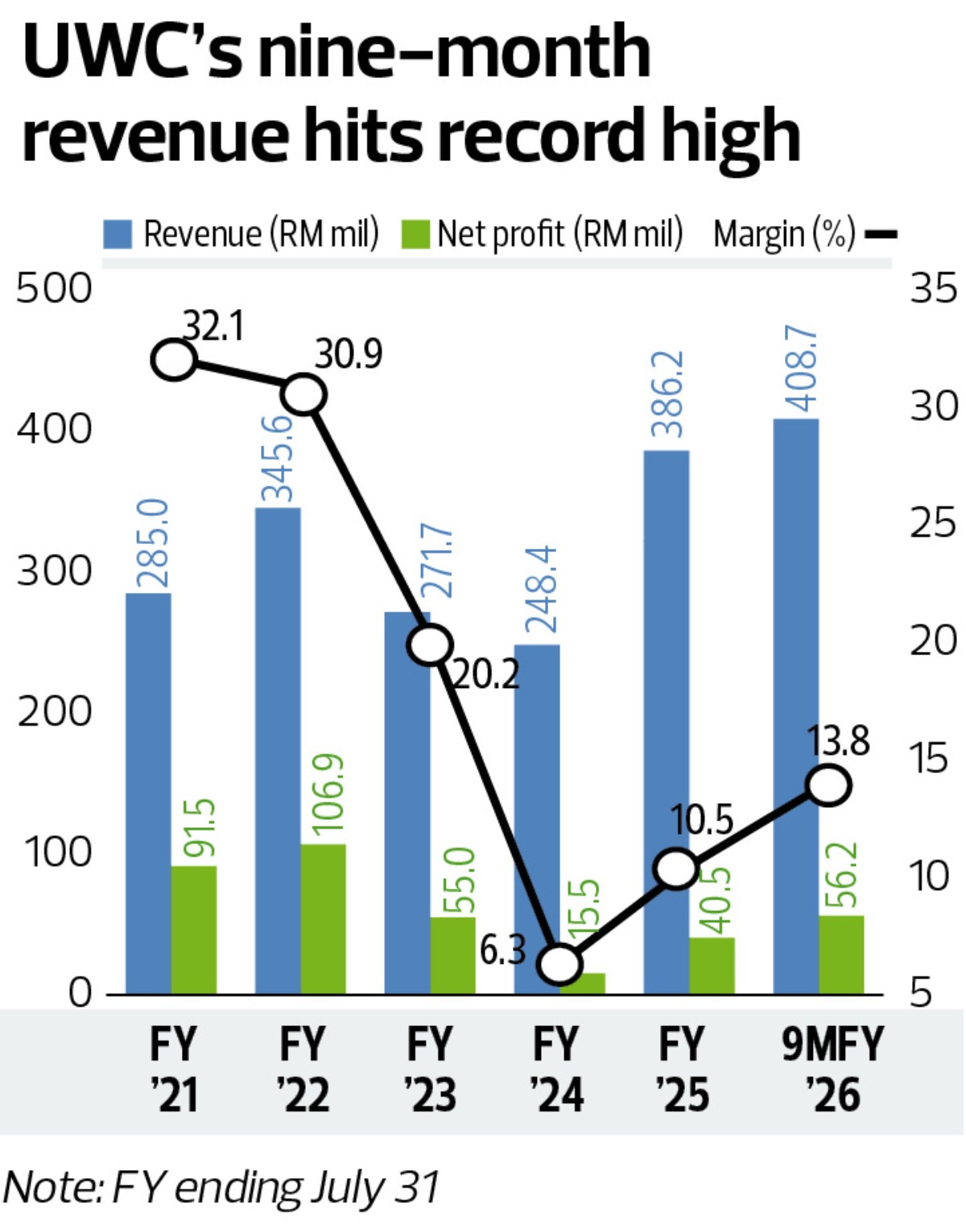
Revenue has also surpassed its previous quarterly peak in 2022 since 4QFY2025, rising for four consecutive quarters to a record RM151.46 million in 3QFY2026.
For the nine months ended April 30, UWC’s revenue reached a record RM408.72 million, while net profit stood at RM56.24 million. Its net profit margin improved to 13.7%, from 6.1% in FY2024 and 10.5% in FY2025, although it remains well below the 31% and 32% recorded in FY2022 and FY2021 respectively.
The lower margin compared with its previous peak is partly due to foreign exchange and higher depreciation following the group’s heavy capex. Annual depreciation has nearly doubled to about RM30 million from RM14.4 million in FY2022. UWC generates most of its revenue in US dollars, while its costs are largely ringgit-denominated, making its earnings more susceptible to a stronger ringgit than during FY2021-FY2022, when the local currency was at historic lows.
More importantly, management has visibility on strong demand through 2027 and 2028, with the current AI-led investment cycle potentially extending towards 2030.
UWC’s roots are firmly in the back-end semiconductor industry, where it has the capabilities to assemble complete systems. In 2019, the group made a strategic decision to move beyond its traditional back-end semiconductor and automated test equipment (ATE) business into wafer fab equipment (WFE), which serves the front end of semiconductor production.
The rationale is simple: exposure to front-end components gives UWC access to a much larger pool of semiconductor spending, where front-end accounts for about 90% of overall semiconductor equipment spending.
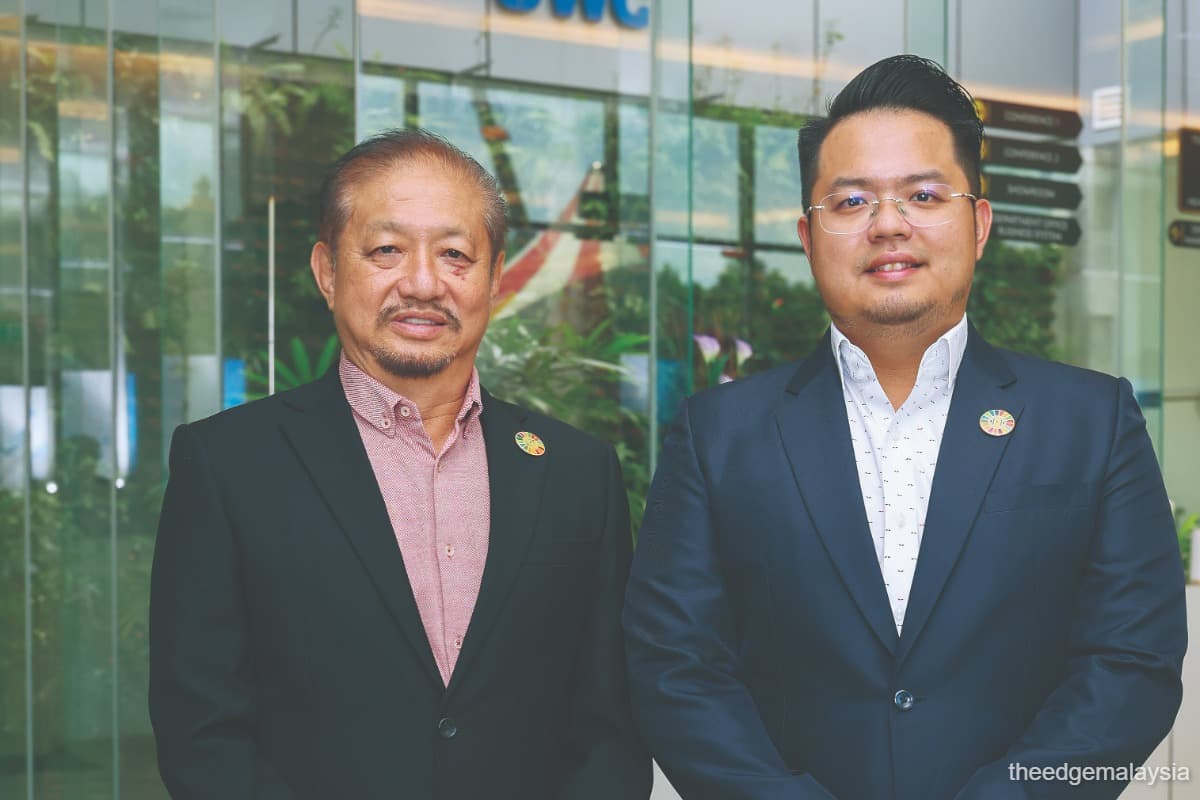
While demand is currently strongest at the front end, it should eventually spill over into the back end, says deputy group CEO and Chai Eng’s son Matin Ng Chin Liang. Both were interviewed by The Edge recently.
As at April 30, 2026, Chai Eng had total direct and indirect interests of 27.09% and 3.22% in UWC while executive director and group chief operating officer Datuk Lau Chee Kheong had a direct interest of 30.22%, making them the largest shareholders.
A different UWC is emerging
UWC now has exposure to several WFE processes whose markets are dominated by a handful of global equipment makers, creating significant qualification barriers for suppliers.
Front-end customers can take about a year to qualify a new supplier, giving UWC an advantage from having invested in capacity ahead of the current upcycle. “Whoever’s got capacity will get the big orders [now],” Chai Eng comments on the current situation.
UWC estimates that WFE currently contributes less than 25% of group revenue, but management expects this mix to change rapidly. “Three years from now, we believe 60% to 70%, or even 80%, of our top line could come from wafer-fab-equipment customers,” says Chin Liang.
He estimates that the WFE segments covered by UWC’s portfolio account for up to 9% of the overall WFE market, underscoring the group’s optimism as it expands its front-end exposure. “We strongly believe that we are a local pioneer in the wafer-fab-equipment ecosystem,” says Chin Liang.
Riding the AI waterfall
UWC deals directly with major ATE and WFE equipment makers rather than through contract manufacturers. Several of its key customers have strong exposure to the memory market, where demand for DRAM and high-bandwidth memory (HBM) is being fuelled by AI servers and data centres.
Chin Liang describes the resulting demand transmission as a “waterfall effect”.
Hyperscalers invest in data centres and AI infrastructure. That spending flows to semiconductor manufacturers and foundries, which invest in manufacturing equipment. Equipment makers then place orders with suppliers such as UWC.
“So we are eventually the beneficiaries of this geopolitical tension and hyperscaler investment,” he says.
The strength is not confined to WFE. UWC’s back-end ATE customers also have exposure to memory and GPUs, giving the group exposure to both ends of the semiconductor manufacturing chain.
“At this point in time, I do see that both sides are also going quite aggressively,” says Chin Liang.
This is also reflected in customer purchasing behaviour. UWC is introducing tiered rebate programmes for strategic clients, offering better pricing at higher order volumes while strengthening customer stickiness.
Larger volumes also allow the group to spread setup and programming costs across a bigger production base.
Nevertheless, for UWC, the challenge now is increasingly not about securing demand but expanding capacity quickly enough to capture it.
Regionalisation adds another tailwind
The restructuring of global semiconductor supply chains provides another structural opportunity.
UWC says it has no exposure to China customers, while its customer base is heavily weighted towards multinational semiconductor companies.
The shift from globalisation towards more regionalised supply chains is prompting semiconductor equipment makers to diversify manufacturing locations and suppliers. Malaysia, and Penang in particular, stands to benefit from this trend.
For UWC, the opportunity lies in winning new programmes as customers seek additional capacity outside China. The company says several potential new customers are in its pipeline.
This complements the AI-driven demand cycle: while AI is increasing semiconductor content and capacity requirements, geopolitical tensions are encouraging customers to build more resilient and geographically diversified supply chains.
Beyond conventional WFE, UWC is also positioning itself for advanced packaging, which is becoming increasingly important as chip architectures grow more complex.
Management says some customers are already incorporating UWC-related equipment into their advanced-packaging roadmaps, although it cautions that the market remains at an early stage.
“Definitely, advanced packaging is part of the roadmap,” says Chin Liang. For now, however, advanced packaging remains an emerging opportunity rather than a major revenue driver for UWC.
At the same time, the group is retaining its life sciences and medical technology business as a hedge against semiconductor cyclicality. UWC has continued expanding its life sciences customer base because the segment provides a more predictable stream of business when semiconductor demand weakens.
“Life sciences is the one to pay my bills; my upside would be the semiconductors,” Chin Liang says.
The strategy proved useful during the recent downturn, when the group remained profitable despite weaker semiconductor conditions.
Investment ahead of the cycle
The decision to invest RM257.8 million during the downturn was a longer-term effort to reposition UWC. About 65% of the investment went into machinery and equipment, while 23% was spent on buildings, clean rooms and infrastructure. The balance went towards land acquisition.
The group has had to invest heavily because front-end semiconductor manufacturing requires higher specifications, including clean rooms, specialised welding and advanced machining capabilities.
Even now, UWC has about RM50 million worth of equipment due to arrive over the next six to nine months. Management estimates this could lift production capacity by roughly 20% to 25%, although machine capacity does not translate directly into revenue because the group increasingly integrates components into higher-value modules.
UWC is already operating at full capacity and needs more space but securing industrial land in Penang takes time. To bridge the gap, the group is developing a five-storey building about 2km from its headquarters, replacing its current car park and providing additional production space. It is also pursuing additional industrial land in Penang.
The longer-term goal is to double the organisation’s overall capacity within three years. “We can’t afford to be limited because we are at a very aggressive position in investment,” says Chin Liang.
The next phase of expansion will require another sizeable investment. UWC expects to spend RM300 million to RM500 million over the next three years, according to customer project timelines, rather than deploying the entire amount all at once.
The spending is likely to comprise a mix of capacity and capability investments. This differs from the previous phase, when a greater proportion of spending was directed towards building capabilities for WFE customers.
The group will also need more people. UWC currently has more than 2,000 employees, including over 800 engineers, and expects to add roughly 500 to 600 employees over the next two years. Management hopes greater use of AI can improve productivity and reduce the eventual headcount requirement.
On the balance sheet, UWC had cash holdings of RM53.28 million against total borrowings of RM86.97 million, resulting in net debt of RM32.85 million. Net gearing remained modest at 6.3%.
From downturn investment to RM1 bil revenue
Chai Eng has set an ambitious target of reaching RM1 billion in annual revenue within two years, although he stresses that this is an aspiration rather than formal guidance.
The target illustrates how far UWC has evolved — from a predominantly back-end-focused precision engineering player into a key Malaysian supplier to a global WFE ecosystem being reshaped by AI, advanced packaging and supply chain regionalisation.
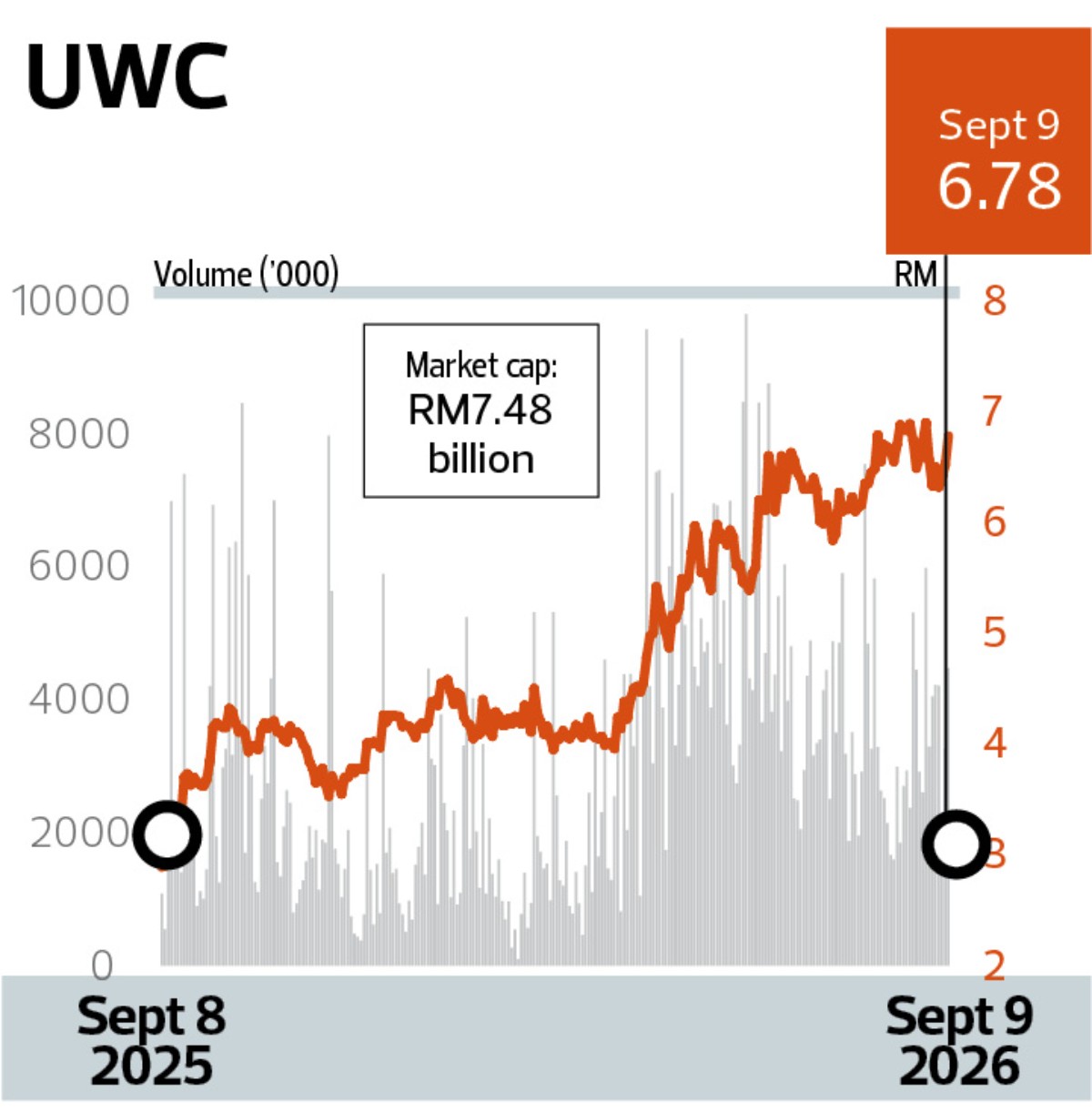
UWC’s share price has performed strongly, rising 131.7% to RM6.78 as at last Wednesday. At this price, the stock has a market capitalisation of RM7.48 billion and trades at a trailing price-earnings ratio (PER) of 102 times, while its forward PER stands at 72.6 times.
Analysts remain bullish on the stock, with seven “buy” ratings and one “hold”. Target prices range from Philip Capital’s RM6.30 to CGS International’s RM9.13, while the consensus target price of RM7.70 implies a 14.6% upside.
CGS International, which has the highest target price, expects UWC’s FY2026 net profit to reach RM95.9 million on revenue of RM580.9 million. For FY2028, it forecasts net profit of RM223.7 million on revenue of RM1.03 billion, implying compound annual growth rates of 33.2% for revenue and 52.7% for net profit over FY2026-FY2028.
CGS derives its fair value from a forward PER of 45 times — which it says is UWC’s mean valuation since 2019 — on projected earnings for FY2028.
Save by subscribing to us for your print and/or digital copy.
P/S: The Edge is also available on Apple's App Store and Android's Google Play.