


This article first appeared in The Edge Malaysia Weekly on September 14, 2026 - September 20, 2026
THE semiconductor industry in Penang is facing shortages in several areas, including engineering talent, factory floor space and production capacity. However, a lack of client orders is not one of them.
In fact, global customers are working closely with local manufacturers to ensure there are sufficient capacities to fulfil their orders and to minimise disruption in the supply chain.
For the newly listed companies in the recent two to three years, fresh capital was raised just in time for capacity building to ride the current upcycle driven by the deployment of artificial intelligence (AI).
One manufacturer describes what we see now as just the tip of an iceberg, although there would be speed bumps along the upcycle.
UWC Bhd’s (KL:UWC) co-founder Datuk Seri Ng Chai Eng believes the current cycle is similar to the time when the late Steve Jobs launched the first Apple smartphone, lifting the global semiconductor industry from the downturn after the bust of the dot-com bubble.
“Who has the capacity will [get] big orders [now],” Ng tells The Edge in the recent visit to UWC at Batu Kawan.
The trend has gained further momentum from the “China Plus One” strategy as global manufacturers seek to diversify their supply chains and reduce their reliance on China.
Trade diversion isn’t a phenomenon but a reality.
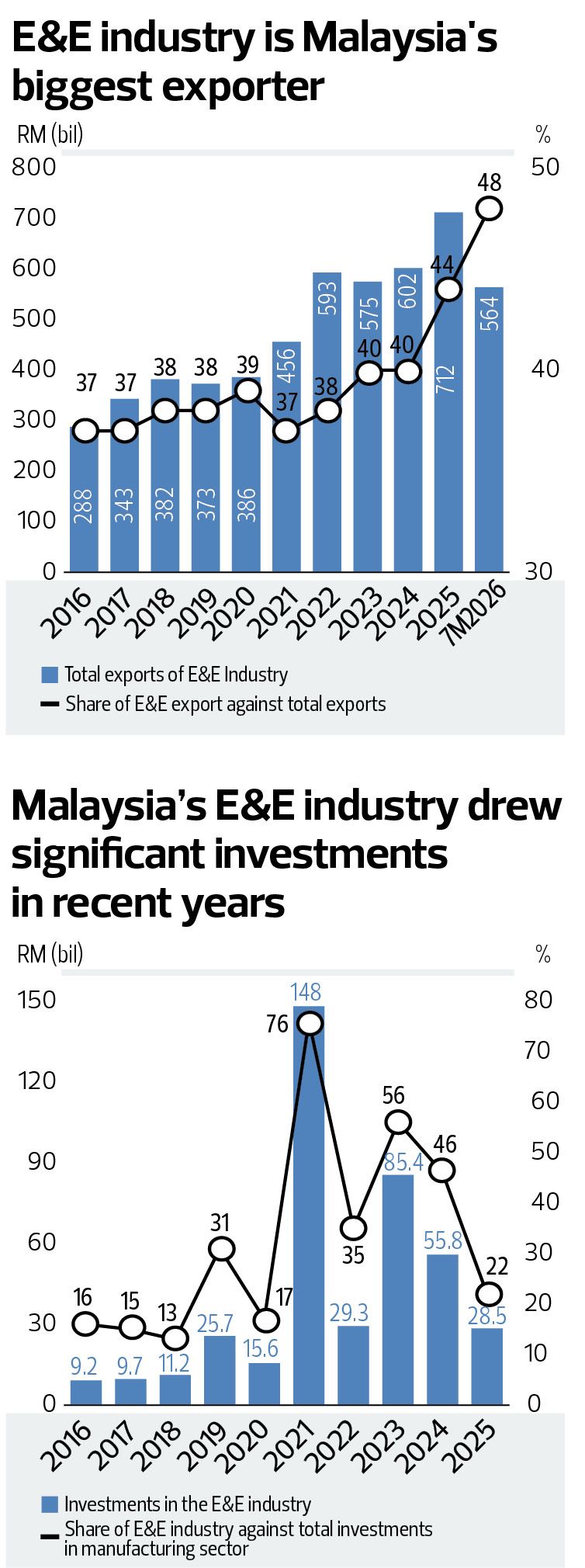
Malaysia, and Penang in particular, has emerged as one of the beneficiaries of the supply-chain reconfiguration, given its established semiconductor ecosystem, infrastructure, manufacturing track record and pool of technical talent.
More importantly, the ripple effects cascade along the domestic supply chain.
“Our capacity is now maxed out, no more floor space,” says AMS Advanced Material Bhd (KL:AMS) managing director Keith Keh Teng Yang, describing the extent of the capacity constraints faced by the company. If rules allow, Keh would have already made use of mezzanine floor space. “We can’t do that, we got to adhere to compliance.”
For automated test solutions firm THMY Holdings Bhd (KL:THMY), even its new factory, which houses its integrated operations and was completed in January last year, is now fully occupied. The company is investing in a larger factory with higher utility capabilities, which is targeted for completion by the first half of 2028.
In short, many manufacturers there are racing against time to get the latest machinery and equipment to secure new customers, diversify their clientele and gain more orders from existing clients.
Walk the talk to move up value chain
A key takeaway from the recent visit to Penang is that the local semiconductor-related companies have progressively moved up the value chain through years of investment in technology, machinery, engineering capabilities and production capacity.
The transformation did not happen overnight and it would not have happened without great appetite for investments in new technologies and tools.
Many started as relatively small suppliers before gradually taking on orders for increasingly complex components, processes and equipment, thereby moving up the value chain. This requires a willingness to invest continuously in the latest technologies and, ideally, to undertake their own research and development (R&D).
Their ability to invest ahead of demand has enabled them to build strong customer stickiness, making it difficult for clients to replace local manufacturers.
Given the global shortage of capacity, customers are placing a premium not only on price but also on availability, reliability and the ability to ramp up production.
For Penang’s local players, having capacity and capabilities available would be the extra mile to cultivate stronger customer relationships and greater customer stickiness.
The capital market has played an important role in this evolution. Access to funding has enabled local companies to expand capacity, automate production and acquire increasingly sophisticated machinery.
Invest during downturn
Interestingly, some of the major investment decisions were made when the outlook wasn’t that rosy yet.
“Every time there’s a downturn, after the downturn, business will come back stronger, that has always been the case. The key is what you have done during the downturn,” ViTrox Corp Bhd’s (KL:VITROX) managing director and group CEO Datuk Chu Jenn Weng tells The Edge in the campus at Batu Kawan Industrial Park.
UWC’s Ng, another industry veteran, shares the same view, saying every downturn is followed by a stronger upcycle in the semiconductor industry. “That has been the history.”
The logic is simple but difficult to execute. Semiconductor equipment, particularly specialised or advanced machinery, can take six months and sometimes longer to arrive. Factory expansions take even longer when they involve substantial infrastructure such as cleanrooms, utilities and other specialised facilities.
Engineering talents and know-how technologies, meanwhile, can take years to build. By the time demand becomes visible, it may already be too late to invest to ride the upcycle.
Penang is evolving from a collection of individual semiconductor companies into a more integrated ecosystem — one that is increasingly capable of functioning as an extension of the customer’s supply chain.
This was most evident in the way companies are responding to the current capacity crunch.
With orders running at full tilt and factories operating close to capacity, some local players have begun passing portions of their orders to suppliers within the ecosystem.
Rather than turning customers away when their own production lines are full, they tap nearby partners and even rivals with the capabilities and capacity to take on additional work.
The clustering of companies, particularly in Bayan Lepas and Batu Kawan, further strengthens this proposition. Component manufacturers, precision engineering firms, automation players and semiconductor equipment makers are located in close proximity to one another, allowing work to be transferred between companies as capacity constraints or technical requirements evolve.
This creates a powerful network effect.
As one company moves into higher-value manufacturing, it creates opportunities along the local supply chain. When some players succeed in getting higher value jobs, this will nudge their suppliers and partners to also grow to keep up with them.
The challenges beyond the upcycle
The outlook, however, is not without risks.
One issue that warrants close attention is the growing ambition of Chinese companies to gain a foothold in the global supply chain.
At present, Chinese players are generally not entrusted with critical orders. However, their ambitions should not be underestimated, according to feedback from the ground. One potential avenue of entry is through the upstream supply of materials.
This is an area that warrants attention from policymakers and industry stakeholders. While an individual supplier may appear relatively insignificant, gaining an initial foothold in an upstream segment could provide a pathway for Chinese companies to deepen their presence in the broader ecosystem over time.
The concern is not simply competition from another group of suppliers. China’s manufacturing scale and ability to compete aggressively on price could create pressure on margins if its players gain a meaningful presence in the supply chain.
For Malaysia, therefore, the issue goes beyond encouraging local companies to move further up the value chain. There is also a need to remain mindful of how the supply chain is evolving and where new entrants are establishing themselves, particularly in upstream segments.
This does not mean competition should be shut out. Rather, as Penang’s semiconductor ecosystem continues to deepen, it will be important to preserve the resilience and breadth of the local supply chain that has been built over decades.
For local players, continuing to strengthen their technological capabilities, engineering expertise and customer relationships remains an important defence.
At the same time, keeping a close eye on developments in the upstream supply chain could help ensure that Malaysia remains competitive as the global semiconductor landscape continues to evolve.
Save by subscribing to us for your print and/or digital copy.
P/S: The Edge is also available on Apple's App Store and Android's Google Play.