

This article first appeared in The Edge Malaysia Weekly on September 14, 2026 - September 20, 2026
ON paper, everything appeared to be finally falling into place for Zetrix AI Bhd (KL:ZETRIX). It had even booked a RM3.7 billion expenditure as development cost to build out its blockchain platform for use beyond the cryptocurrency world.
The development cost stood at RM2.8 billion at the end of last year, meaning it had increased by RM900 million in just six months.
But the market seemed to have shrugged off the rising development expenditure until two weeks ago. This was probably due to the rapid growth in revenue from its blockchain and artificial intelligence-related services and the company getting a slew of contracts in the last two years.
Among the achievements is the growing acceptance of its blockchain technology in China and the Philippines. In the domestic market, Zetrix AI’s blockchain technology powers the MyDigital ID, which is the national digital identity management platform.
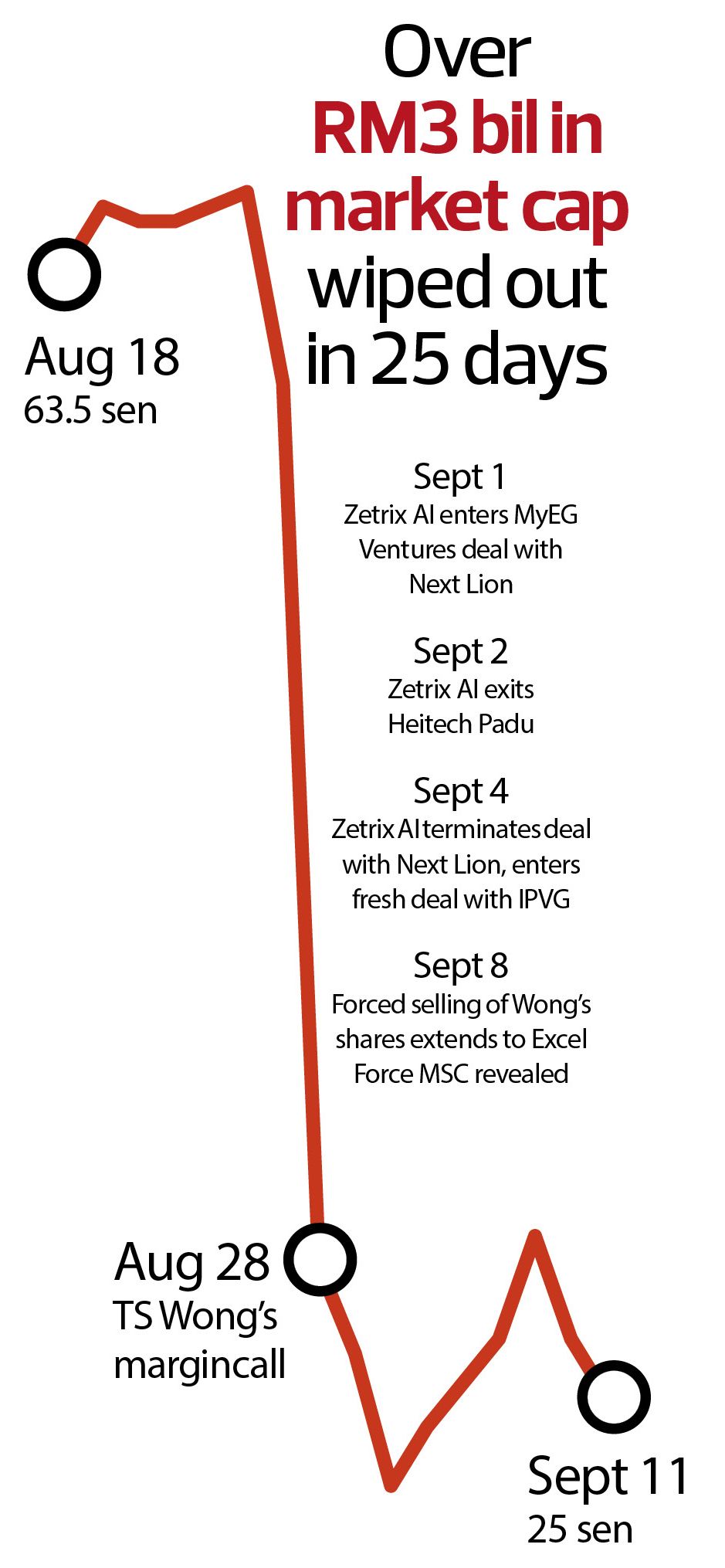
A huge endorsement of Zetrix AI’s cross-border technology prowess came in February this year when the World Bank’s International Finance Corporation (IFC) subscribed for 199.6 million new shares at 78 sen each. In hindsight, if IFC had waited six months, it would have got the same number of shares at a third of the price.
Two weeks ago, Zetrix AI’s share price came under heavy selling pressure after margin calls on the equity interest held by its major shareholder, Wong Thean Soon, who is better known as TS Wong. His total stake in the company, which was at the forefront of Malaysia’s transition to online payment for government services, had been reduced to less than 14% at the time of writing.
In a hastily arranged call with analysts and fund managers, the company apparently said the selldown was due to margin pressure faced by Wong. The company also dismissed any notion of the accounts being in question and stressed that a listing of its digital assets in the US via a reverse takeover remained on track.
The listing of Zetrix AI’s digital assets is crucial because it will see the spin-off of the AI-related assets taken off its books and injected into a special purpose acquisition company (SPAC) listed on the Nasdaq. The SPAC, in which Zetrix AI will have an 80% stake, is said to be valued at US$3 billion.
But based on the current share price movements, the market does not seem to have picked up on Zetrix AI and its SPAC proposition.
According to CLSA in a note last month, Zetrix AI’s valuation remains depressed due to the heavy capital expenditure (capex) cycle and rising borrowings. The research house wrote that the management had stated the high capex cycle was normal for a company in the AI industry to fund its expenditure.
Rising development cost and debt
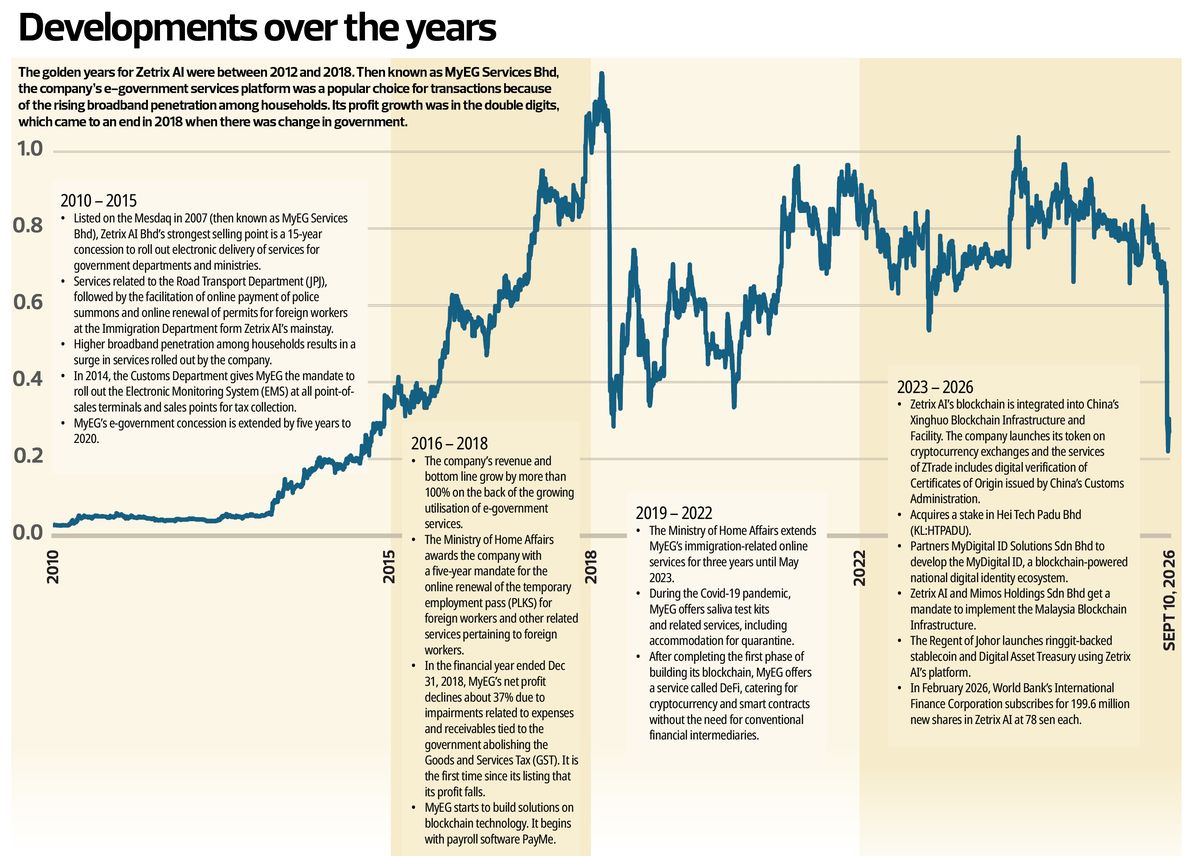
The rising development cost incurred by Zetrix AI caught the eye of the company’s external auditor as far back as 2021, which was highlighted among its “key audit matters”. In the latest report, the external auditor highlighted the development cost of RM2.8 billion, which is more than 50% of the company’s total assets.
According to an audit partner, when something is highlighted as a “key audit matter”, it shows the risk that a company is carrying. “It is not a qualification. It is a high-risk area that has warranted the attention of the external auditor. It shows that the auditor has taken the effort to look more closely into that area,” she explains.
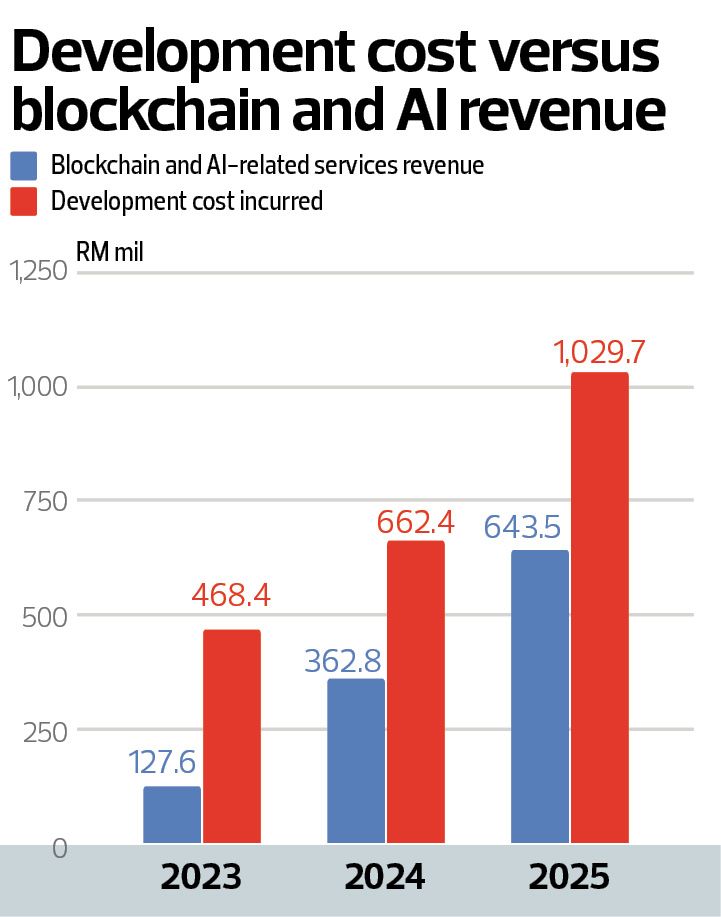
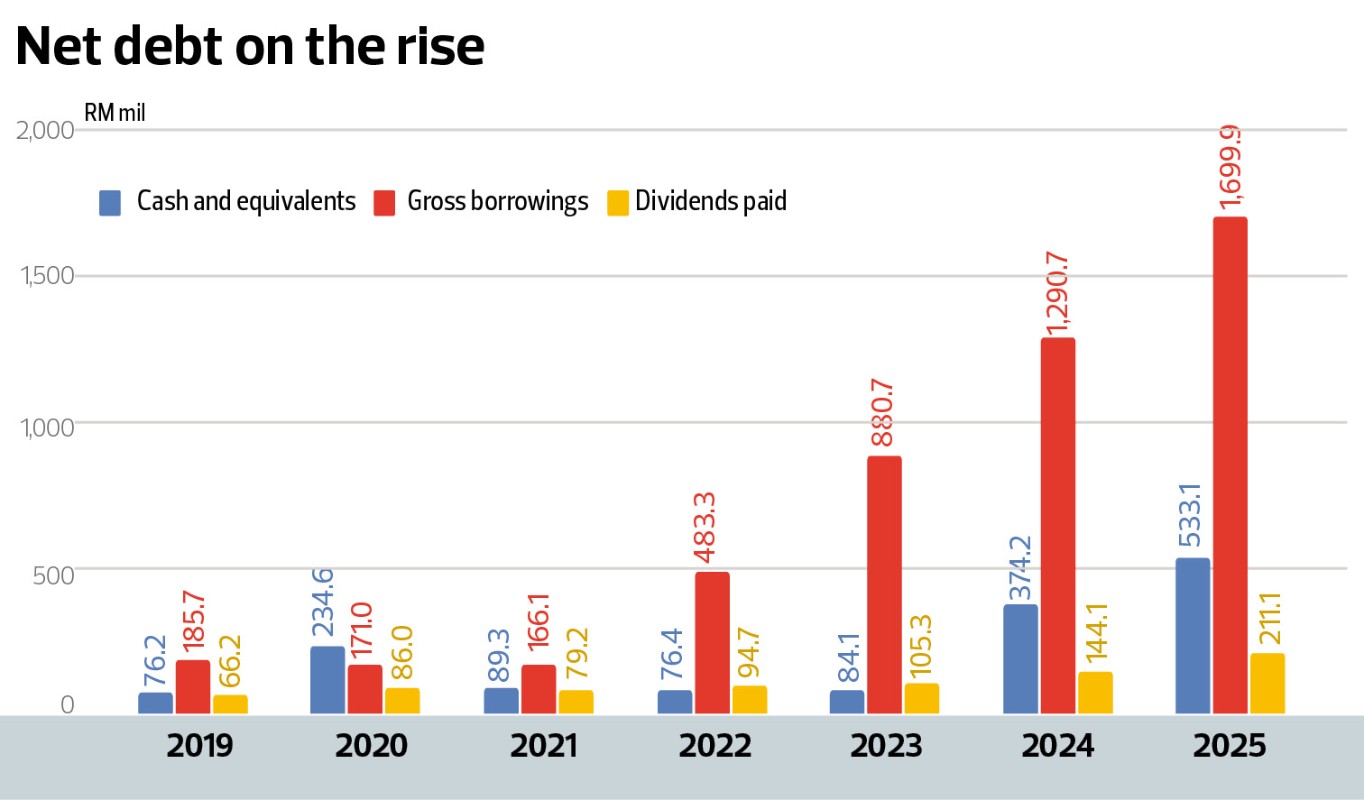
The development cost stood at only RM175.5 million in 2020. But it had risen to RM3.7 billion as at June 30, 2026. It was mainly funded by debt, turning Zetrix AI from a net cash position to net debt in just five years.
The company had a cash surplus of RM63.3 million in 2020. Last year, it had a net debt position of RM1.2 billion. Based on its latest audited full-year financials, its total debt stood at RM1.7 billion (see chart on net debt).
To a large extent, Zetrix AI has morphed from a company dependent on proceeds from the provision of electronic delivery of services to the public sector to a blockchain and AI company.
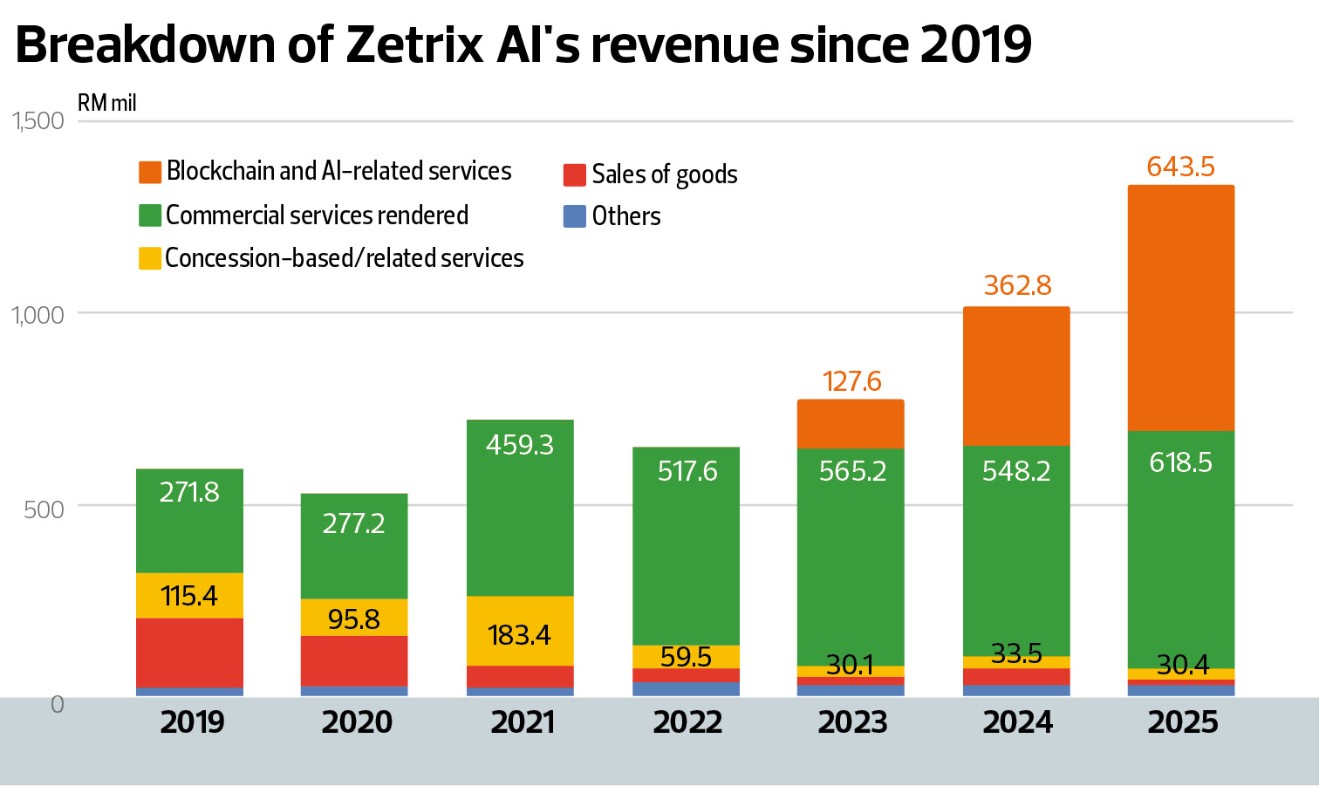
In 2025, revenue from the group’s blockchain and AI-related services was RM643.5 million, out of its total revenue of RM1.3 billion. In fact, it is the blockchain and AI-related services that have contributed to the jump in Zetrix AI’s turnover and bottom line since 2023 (see chart on revenue breakdown).
In 2023, the company’s net profit was RM487.6 million on a turnover of RM774.3 million — a profit margin of 63%. Last year, its net profit was RM870.7 million on a turnover of RM1.3 billion — a profit margin of 62%.
There are not many companies on Bursa Malaysia that are able to record a profit margin of more than 60% for three consecutive years. The market, however, has not given Zetrix AI’s shares a premium despite such a track record.
According to auditors, it is not unusual for a technology company still building its platforms to have the bulk of its assets in the form of “development cost”.
Baker Tilly Monteiro Heng PLT managing partner Datuk Lock Peng Kuan says a company that has the bulk of its assets as “development cost” owns very few physical things.
“The money goes to people, licences and cloud infrastructure. So, the development cost ends up being the biggest item it owns. That tells you where the company is in its life cycle,” he tells The Edge.
According to Lock, the accounting standards governing research and development draw a hard line.

“Research cost goes straight to the profit and loss account. Development cost goes to the balance sheet if the company can show six criteria of the accounting rules,” he says.
Among the six criteria are whether the project can be completed, the company will be able to sell the products, there is a viable business model and there is a reliable measurement of attributable expenditure.
“How much a company should be spending on development, given how mature its existing platforms are and how much cash it has left, is a business question. It is a different question from the accounting one, and the two should not be mixed up,” says Lock.
Lack of customer breakdown
Development cost is usually capitalised and amortised over a period of time. An impairment only kicks in if the project or technology does not have any meaningful economic benefit.
Over the last three years, there has been very little amortisation of the development cost, indicating that Zetrix AI’s projects are still in progress. Between 2020 and 2025, the total amortisation stood at RM139.9 million, against a development cost of RM2.8 billion at end-2025.
According to the company’s annual report, development cost with finite useful lives is amortised over a period of two to five years over the expected level of usage. “Certain development costs are not amortised as these assets are not available for use and are still under development as at the end of the financial year,” it said.
Which brings us to the questions: What proportion of assets that are being classified under “development cost” has actually gone live and has been amortised so far? And what are the underlying fundamentals backing the rest of the amount stated as development cost?
According to an auditor, such questions are normally based on the management’s projection of the feasibility of the projects being developed and its future cash flow. “It all depends on the management’s plans. As long as the company can fund the development and there are no financial issues, the development cost can take a long time before it is amortised.”
The bulk of Zetrix AI’s development cost is tied to its blockchain and AI-related business solutions. According to the breakdown, the revenue from its blockchain and AI-related services stood at RM127.6 million in 2023, RM362.8 million in 2024 and RM643.5 million in 2025.
However, what is not clear is this — who are Zetrix AI’s customers that are paying millions of ringgit for the blockchain and AI-related services? The company sells digital tokens every quarter but the number against the total revenue appears to be small.
According to the annual report, Zetrix AI’s revenue is classified geographically based on whether it is generated in Malaysia or overseas. It does not go into the segmental details.
What is interesting is that Zetrix AI’s revenue generated outside Malaysia is the same amount as the income from its blockchain and AI-related services.
For instance, in 2024 and 2025, the revenue from outside the country stood at RM362.8 million and RM643.5 million respectively, which is the same amount the company received for its blockchain and AI-related services. In 2023, the revenue from outside Malaysia was RM127.6 million, marginally lower than the RM126.6 million received for its blockchain and AI-related services.
So, would it be correct to assume that Zetrix AI’s revenue from blockchain and AI-related services are derived from abroad?
Net assets over market price
The recent fall in Zetrix AI’s share price has caused the company to trade way below its net asset value. According to the company’s latest financial statement, its net assets per share is 55 sen, whereas the market price is currently less than 26 sen apiece.
This means the market has not accorded fair value to the assets of Zetrix AI, which largely comprise the development cost of the technology.
Auditors say the market price trading below the net asset value is one of the signs that they pick up on when they look at the company’s books. But it does not result in any impairments because there are several tests in place.
According to Lock, there is a strict test attached every year when a module is being built and nothing is written down. “For an intangible asset that is not ready for use, the standard requires a test every single year, whether or not anything looks wrong,” he explains.
The test, among others, allows the auditors to determine whether the technology is outdated, the project is being cut back, the rollout is late or it is costing more to finish than anticipated.
“At the end of the day, the management works out what the assets are really worth and the auditor will check on the assumptions, cash-flow projections and other numbers. If required, the auditors will get a specialist to look at the numbers provided by the management,” says an auditor.
To reinvent itself, Zetrix AI went into blockchain and AI-related services, the development of which is costly. A listing of its SPAC is one of the catalysts that analysts are looking at to give the company a lift because it would take the cost off its books.
Nevertheless, it has left many wondering how the RM3.7 billion in development cost was spent and what percentage of the project has actually gone live? And why does the cost keep going up every year?
Read also:
Cover Story 1: Puzzling off-then-on Philippines deal
Cover Story 1: The role of Next Lion in Zetrix AI’s Nasdaq listing
Save by subscribing to us for your print and/or digital copy.
P/S: The Edge is also available on Apple's App Store and Android's Google Play.