

This article first appeared in Capital, The Edge Malaysia Weekly on September 14, 2026 - September 20, 2026
SEVENTEEN years after the FTSE Bursa Malaysia KLCI’s (FBM KLCI) launch in 2009, when the 30-stock index replaced the 100-stock Kuala Lumpur Composite Index, the benchmark is set for another overhaul, expanding to 50 constituents from this December.
The timing is significant given the changes the Malaysian economy has seen since 2009. The enhancement to the index aims to better reflect the country’s economic landscape and spotlight a wider range of companies.
Against this backdrop, we review 17 years of the FBM KLCI’s annual returns and constituent changes to trace how the index and the market have transformed.
In terms of annual returns for the 16 full years of the FBM KLCI, 2010 emerged as the best year at 19% as Malaysia’s economy rebounded from the global financial crisis and the government under then prime minister Datuk Seri Najib Razak rolled out the Economic Transformation Programme and New Economic Model. Both initiatives aimed to propel the country towards high-income status by 2020, spurring massive infrastructure developments and private investment enthusiasm. In 2009, foreign brokerage CLSA coined the term “Najibnomics” to describe the sixth prime minister’s brand of fiscal, government and structural reforms. The index’s official upgrade to FTSE global standards also helped attract greater interest from foreign investors.
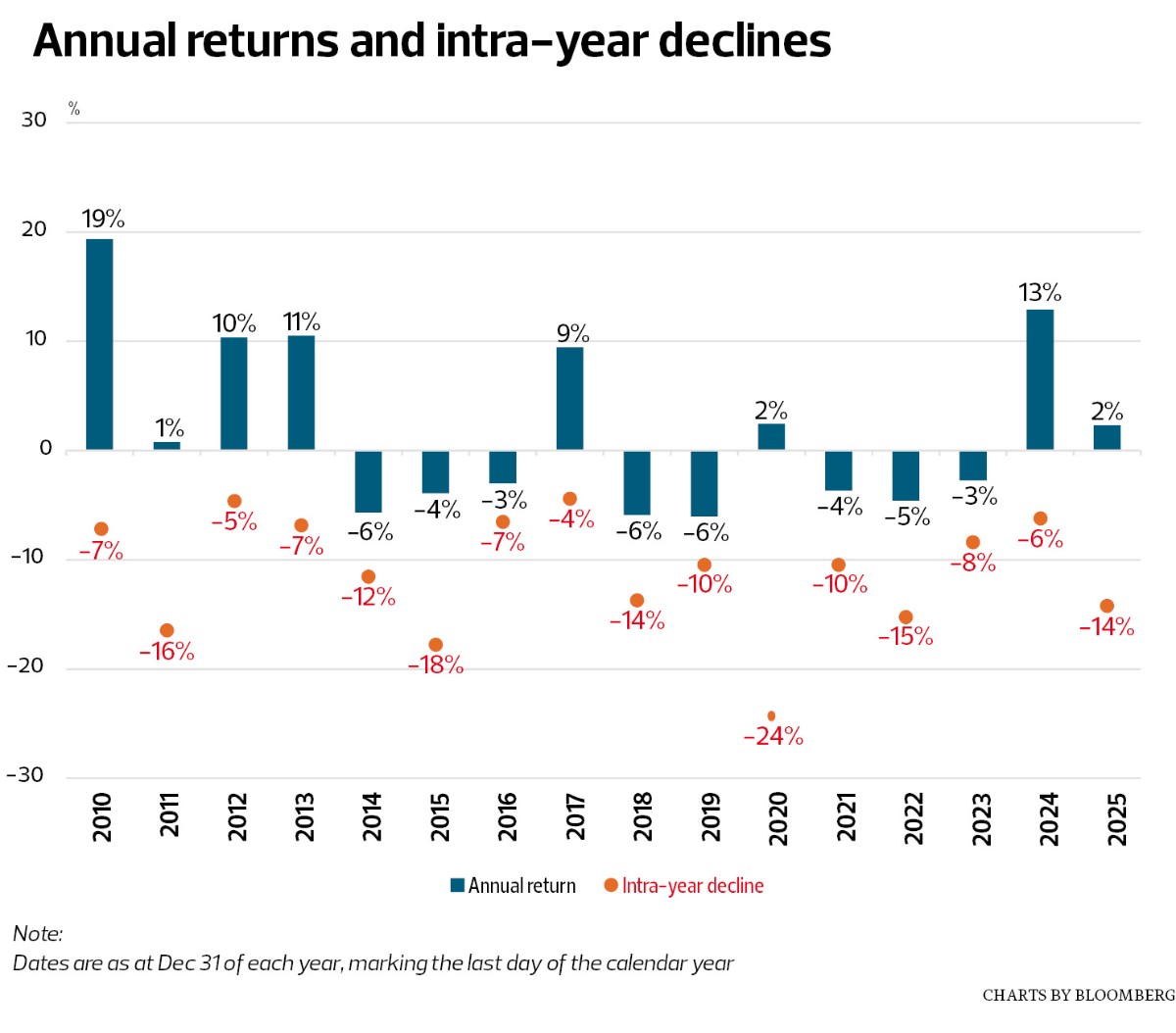
On July 8, 2014, the FBM KLCI hit an intra-day high of 1,896.23 points, a record that still stands today.
The period from that peak in 2014 to 2023 has been described by Permodalan Nasional Bhd’s former president and group chief executive Datuk Abdul Rahman Ahmad as Malaysia’s “lost decade”. Last year, he highlighted that the FBM KLCI’s share price returns on a three-, five- and 10-year basis up to end-2023 were flat to negative. From a total-return perspective — dividends plus share price — the numbers were best described as “anaemic”.
The explosive 1MDB exposé in 2015 was a defining event, reshaping Malaysia’s political and economic landscape for years. Five different prime ministers held power between 2018 and 2023. At the height of the 1MDB scandal, for which Najib would later be imprisoned, credit rating concerns and political risks prompted foreign fund managers to withdraw from Malaysian equities, causing the FBM KLCI to severely lag its regional peers.
Nevertheless, 2017 offered a brief reprieve. The surge was fuelled by a stronger ringgit, gains in crude palm oil prices and a global semiconductor “super cycle”, which supported recovery in Malaysia’s export-oriented manufacturing sector. Local chipmakers benefited from the upswing, with Malaysia accounting for roughly 13% of the world’s back-end chip assembly, testing and packaging. The market was also driven by expectations of the 14th general election but the optimism soon fizzled out as the year progressed with no signs of a poll taking place anytime soon.
Interestingly, the FBM KLCI closed at a record high of 1,895.18 on April 19, 2018, ahead of the May 9 general election that ended Barisan Nasional’s uninterrupted rule of the country of over six decades.
In terms of volatility, in 2020 — the year the global Covid-19 pandemic was declared — the FBM KLCI saw the sharpest intra-year decline of 24%. But despite surging investor interest in glove stocks — Top Glove Corp Bhd (KL:TOPGLOV) and Hartalega Holdings Bhd (KL:HARTA) were index constituents in 2020 before both fell off in late 2022 — along with a rise in retail participation, the market bellwether only registered a 2% increase during the year.
The year 2024 marked a turning point for the FBM KLCI. Malaysia’s economy expanded by 5.2% while annual returns from the index came in at 13% — the highest since 2011. Foreign investors returned to Malaysian equities and the ringgit became one of the best-performing currencies globally. Much of the recovery was driven by renewed political stability and international trust, a resurgence in the global semiconductor industry and Malaysia’s emergence as Southeast Asia’s premier hub for artificial intelligence (AI) data centres.
Yet, as technology and AI become increasingly central to Malaysia’s growth story, how much of this transformation is actually reflected in the FBM KLCI?
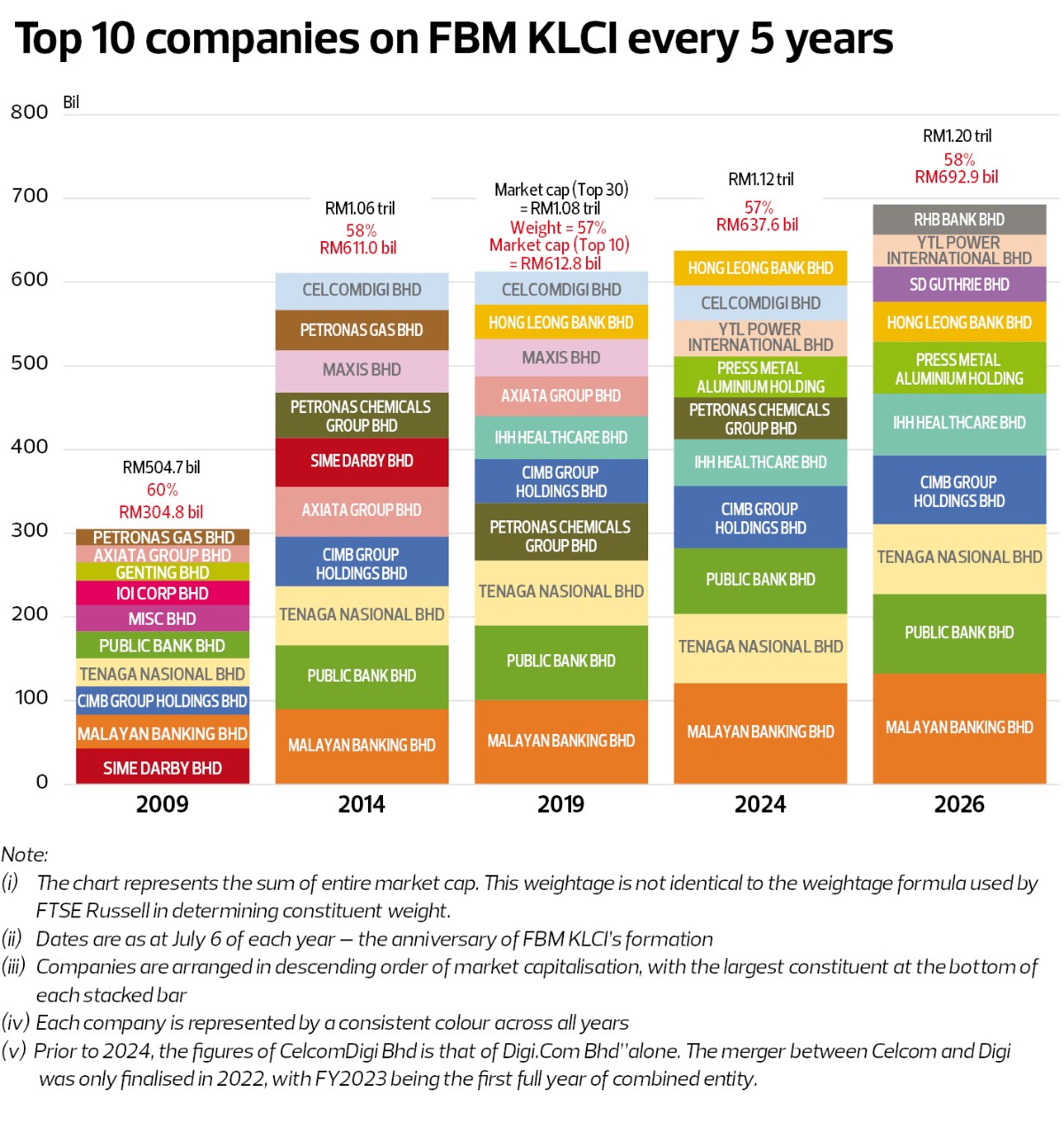
A look at the index’s largest constituents suggests that the shift has been limited. The largest companies are still largely from the banks, plantations and utility sectors, with no electrical and electronics (E&E) companies among the top 10. For an economy positioning itself as a key player in the global tech supply chain, the benchmark still looks rather “old economy”.
That said, the composition has not remained entirely static. Healthcare and industrial companies have gained prominence while companies such as Maxis Bhd (KL:MAXIS) and Genting Bhd (KL:GENTING) have dropped out of the top 10.
Banking stocks continue to dominate, consistently accounting for at least 30% of the top 10 since 2009 and reaching 50% this year. The persistent dominance highlights the defensive character of the Malaysian market, where investors favour stable cash flows, regular dividends and less vulnerability to unexpected disruptions.
YTL Power International Bhd’s (KL:YTLPOWR) rise, however, offers a glimpse of how the market could evolve. Its growing exposure to AI and data centres has attracted keen investor interest. Its partnership with Nvidia Corp in 2023 marked a major milestone, positioning YTL Power as a potential beneficiary of surging AI infrastructure demand. Its market capitalisation has risen about 147% since.
Listed in 2012, IHH Healthcare Bhd (KL:IHH), which operates hospitals including the Pantai and Gleneagles network of hospitals in Malaysia, has also gained traction, benefiting from rising chronic illnesses, an ageing population and medical tourism. Higher household incomes and greater healthcare awareness have further supported demand as Malaysians become more willing and able to spend on private healthcare.
Meanwhile, telecommunication companies such as Maxis and CelcomDigi Bhd (KL:CDB) have seen their market capitalisation come under significant downward pressure despite the sharp rise in everyday data consumption. This is due to heavy infrastructure investments, compounded by intense competition and limited pricing power, leading to declining returns on capital. At the same time, tech giants such as Meta Platforms have captured most of the value generated by high-speed internet as free calls and unlimited messages on platforms such as WhatsApp eroded revenue streams from voice and SMS.
Ultimately, expanding the FBM KLCI is more than a numerical change. By raising the coverage of Malaysia’s Main Market capitalisation from 60% to 70%, the wider index could reduce heavy banking conc entration while giving greater weight to under-represented growth sectors such as E&E or technology, energy and real estate investment trusts (REITs).
Tech companies, for instance, could see their representation increase from virtually zero to a simulated peak of 3.21%, according to MBSB Research. Mid-cap companies riding the AI infrastructure wave, such as Frontken Corp Bhd (KL:FRONTKN) and ViTrox Corp Bhd (KL:VITROX), would similarly gain greater visibility among global investors if they are added to the benchmark earlier. More importantly, the expansion could strengthen FBM KLCI’s ability to compete for international capital against regional benchmarks.
Save by subscribing to us for your print and/or digital copy.
P/S: The Edge is also available on Apple's App Store and Android's Google Play.