


This article first appeared in Capital, The Edge Malaysia Weekly on September 14, 2026 - September 20, 2026
PINDUODUO’s growing presence in Malaysia has yet to leave a big dent in the earnings of major bricks-and-mortar retailers, but signs that consumers are becoming increasingly price-conscious as the cost of living rises could point to a more subtle challenge ahead.
The Chinese e-commerce platform’s growing influence comes at a time when Malaysian shoppers are becoming more prudent with their spending, making fewer shopping trips, comparing prices more closely, opting for discounts and vouchers, buying more generic brands and turning to online platforms for lower-priced goods.
The country’s retail industry grew just 2.5% year on year (y-o-y) in the second quarter of 2026, slowing from the 3.7% growth recorded in the January to March quarter, and falling well short of the 4.8% growth previously projected by members of the Malaysia Retailers Association (MRA) and Malaysia Retail Chain Association (MRCA) in June.
For the January to June period, retail sales grew 3.1% y-o-y, according to the latest Malaysia Retail Industry Report.
Berjaya Bhd head of research Kenneth Leong says the shift towards more price-conscious consumption amid inflationary pressures is likely to benefit ultra-low-price cross-border e-commerce platforms such as Pinduoduo, particularly for generic and discretionary merchandise where product differentiation is limited.
“Comparable products offered at significantly lower prices could intensify competition for physical retailers and potentially weigh on mall footfall, with pressure likely to be more pronounced among retailers exposed to price-sensitive consumers and non-branded products,” he says.
The weakness has been particularly pronounced in some traditional retail segments, according to data from the Malaysia Retail Industry Report. Department-store sales fell 7.2% in the second quarter, while furniture, furnishing, home improvement, and electrical and electronics sales dipped 5.8%, and department store-cum-supermarket sales dropped 2.4%.
However, it is still too early to assess whether Pinduoduo has materially weakened the financial performance of Malaysia’s major retailers, according to experts contacted by The Edge. Nevertheless, a closer look at MR D.I.Y. Group (M) Bhd’s (KL:MRDIY) financial results does indicate a challenging operating environment, which may not necessarily be due to Pinduoduo alone as the platform was only launched in Malaysia late last year.
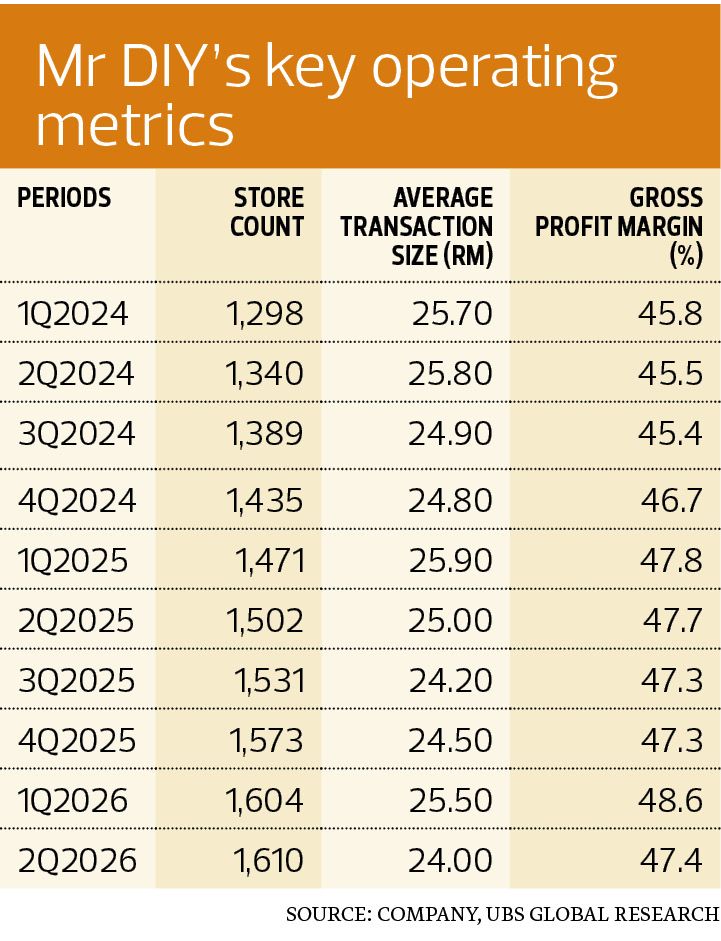
The home improvement retailer saw its revenue rise 6.5% y-o-y to RM2.63 billion in the first half ended June 30, 2026 (1HFY2026), supported by a 7.2% expansion in its store network to 1,610 outlets. Total transactions grew by 9.8% to 106.2 million, but average basket value declined 3%, which the group attributed mainly to lower average selling prices from targeted promotional campaigns.
Gross profit rose 7% to RM1.26 billion and gross margin edged up slightly to 48%, but net profit fell 1.9% to RM326.43 million, dragged down by higher administrative expenses and operating expenses.
The home improvement retailer showed a sharper sequential slowdown in 2QFY2026, with net profit falling 30% quarter on quarter (q-o-q) to RM134.4 million, its lowest in nearly two years, while revenue contracted 8.5% q-o-q to RM1.26 billion. Gross profit margin also weakened to 47.4% from 48.6% in the preceding quarter.
The group attributed the weaker quarter to the seasonally stronger first quarter, which benefited from Hari Raya and Chinese New Year festive spending.
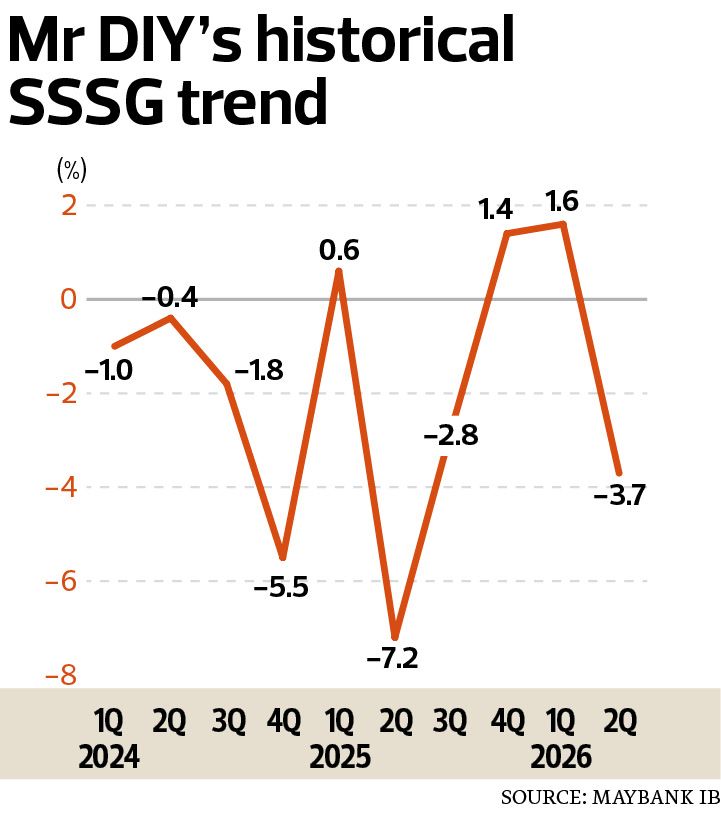
The weaker sequential performance was also reflected in its same-store sales growth (SSSG), which turned negative in 2QFY2026 to -3.7%, compared with positive growth of 1.6% in the preceding quarter. Its average transaction size also fell 5.9% to RM24 in 2QFY2026, from RM25.50 in 1QFY2026, research reports showed.
The group’s average transaction value has been declining from RM25.80 in 2QFY2024 to RM25 in 2QFY2025 and RM24 in 2QFY2026, while transaction volume per store per month fell from 11,676 to 10,667 over the same period, according to the reports.
Leong says it is still too early to determine whether recent weakness in retailers’ SSSG or basket sizes was directly linked to Pinduoduo, but notes that store expansion, changes in product mix and cost efficiencies from automation have so far helped cushion the impact on earnings and margins.
He adds that the earliest warning signals investors should watch for are the slowing SSSG and declining basket sizes, despite resilient total transaction growth.
“This suggests that consumers remain engaged with physical retailers but are becoming increasingly price-sensitive,” he says.
Leong expects Pinduoduo’s impact to become more visible over the next 12 to 24 months as consumer awareness and adoption build.
MBSB Research says other indicators to watch for early signs of disruption include transaction growth, gross margins and promotional intensity, while customer traffic could also provide a useful gauge where disclosed.
“The most concerning combination would be declining same-store sales despite positive transactions, shrinking baskets, rising promotional intensity and gross-margin compression. That would indicate retailers are retaining traffic but having to compete harder on price while customers spend less per visit.
“Inventory days could be another indicator. If online competition causes certain general-merchandise categories to turn more slowly, retailers could eventually face higher markdowns and working-capital pressure,” MBSB says.
Both Leong and MBSB rank Mr DIY as the most exposed to Pinduoduo, followed by dollar-store Eco-Shop Marketing Bhd (KL:ECOSHOP) and retail group AEON Co (M) Bhd (KL:AEON), citing Mr DIY’s broader overlap with household and furnishing products, hardware, electrical items, stationery, toys, accessories and other general merchandise.
He adds that Eco-Shop is also exposed to general merchandise and household products, but its very competitive price points and focus on high-turnover essentials provide some buffer.
Meanwhile, AEON’s broader mix of groceries, fresh food, apparel and lifestyle products means categories requiring proximity, convenience, physical inspection and shopping experience are relatively more protected.
The different consumer targets, product range and business models of the three retailers are factors that would determine the extent of the impact from Pinduoduo’s popularity.
MBSB Research says the competitive risk is likely to be more pronounced in non-urgent general merchandise such as household accessories, small electronics, storage products, décor and selected DIY items, while groceries, fresh food and other immediate-consumption categories should be more insulated.
Eco-Shop ended FY2026 on a strong note. Annual earnings jumped 29% to RM264.57 million for the financial year ended May 31, 2026 (FY2026), from RM205.03 million a year ago. Revenue rose 4.6% y-o-y to RM2.92 billion, from RM2.79 billion previously.
Sales transactions increased 8.1% to 124.1 million, while the group recorded 91 net new stores during the year. It had 462 stores as at end-May.
Gross profit margin also improved to 33.3% in FY2026, from 28.2% previously, supported by selling price adjustments, a more favourable product mix and a stronger ringgit.
However, its SSSG remained in negative territory, at -2.3% in 4QFY2026, although this marked a significant improvement from -12.9% in 3QFY2026, supported by normalisation of product supply, SKU (stock keeping unit) refreshes and promotional campaigns, according to a report from UBS Global Research.
Maybank Investment Bank expects Eco-Shop’s SSSG to return to positive territory in FY2027 as sales momentum normalises from the low base in FY2026, with its target of opening another 100 stores also expected to be a key driver of earnings growth. However, it cautioned that higher supplier-led cost pressures may begin to accelerate in FY2027 due to the US-Iran conflict.
AEON, which operates department stores and supermarkets, saw its revenue in the first half ended June 30, 2026 (1HFY2026) coming in broadly flat at RM2.24 billion, but net profit increased 21.8% to RM97.9 million, thanks to stronger contribution from its property management services segment and disciplined cost management.
Revenue for its retail business declined 1.1% to RM1.83 billion in 1HFY2026, as consumer spending remained cautious.
MBSB Research says the divergence in the retailers’ results showed that consumer spending was not uniformly weak, but becoming more selective and value-conscious. Eco-Shop’s stronger performance was consistent with consumers trading down towards very low-ticket essential and household products, while Mr DIY’s healthy transaction growth indicated that customer engagement remained intact despite the lower average basket. AEON, meanwhile, has broader exposure to discretionary categories and larger-ticket spending, making its retail business more exposed to a cautious consumer environment.
For investors, however, the longer-term question is whether the rise of ultra-low-price e-commerce could challenge the investment case of Malaysia’s value retailers, even if the impact is not yet evident in their earnings.
Fortress Capital Group CEO Datuk Thomas Yong said the emergence of Pinduoduo and other Chinese e-commerce players could gradually alter how investors view retailers such as Mr DIY and Eco-Shop.
The old thesis of traditional value retailers such as Mr DIY and Eco-Shop being regarded as “defensive, structural growth plays” is slowly being replaced by a new reality, Yong explains.
He says the combination of aggressive Chinese entrants and their “massive subsidies” could erode the moat enjoyed by traditional retailers, forcing investors to move away from viewing them as “aggressive, compound-expanding growth stories” and instead classifying them as “mature, cyclical entities that must fight a war of attrition over margins and customer traffic”.
On sales growth, Yong says it is still too early to assess the impact, but warned that long-term SSSG targets could eventually have to be revised lower if Pinduoduo continues to operate in Malaysia.
More importantly, he says local retailers could face a “ceiling” on price increases, limiting their ability to exercise pricing power.
“Operating margins could face a double whammy, with weaker pricing power on the top line colliding with rising domestic operating costs and cost inflation,” Yong adds.
Procurement scale and private labels, meanwhile, may not be enough for retailers to stay competitive, given the scale of China’s manufacturing ecosystem. But physical stores retain an advantage for fresh groceries, bulky goods and emergency purchases, he says.
Pinduoduo competes most directly in non-urgent, non-perishable and planned purchases, rather than immediate-need items.
For now, the investment community does not appear to be pricing in any threat from Pinduoduo. Bloomberg data shows no “sell” calls among analysts covering Mr DIY, Eco-Shop and AEON, with 14 “buy” and three “hold” calls for Mr DIY, eight “buy” and two “hold” calls for Eco-Shop, and nine “buy” and one “hold” call for AEON.
Mr DIY’s share price remains well below the Bloomberg consensus 12-month target of RM1.93, implying about 52% upside from its RM1.27 closing price on Sept 10. Year to date, it has fallen by 18%, and is trading below its initial public offering price of RM1.60. It listed on Bursa Malaysia in October 2020.
Eco-Shop’s share price has pulled back from its RM1.61 peak in January to RM1.45 last Thursday. YTD, its performance is broadly flat. The Bloomberg consensus average 12-month target price of RM1.74 implies an upside of about 20%.
AEON’s share price has also retreated from a recent high of RM1.28 on Feb 25, closing at 99.5 sen on Sept 10. Although the stock is broadly unchanged YTD, it has fallen about 22% from RM1.28 a year ago. The Bloomberg consensus average 12-month target price of RM1.50 implies about a 51% upside from its latest price.
Save by subscribing to us for your print and/or digital copy.
P/S: The Edge is also available on Apple's App Store and Android's Google Play.