

_3.jpg&w=1920&q=75)
(Sept 12): The US$32 trillion (RM130 trillion) US bond market ended a bruising week that pushed yields to multi-year highs, with investors more convinced the Federal Reserve (Fed) will raise interest rates next week to address sticky inflation.
Policy-sensitive US two-year notes fell and longer-term securities outperformed on Friday to leave the 10-year yield at 4.97% after data showed a bigger-than-expected increase in prices excluding food and energy. Investors now see the probability of a Fed move next week at about 86%, with two hikes fully priced in by year end.
Trading was subdued, capping a week of declines that saw the 10-year Treasury yield climb by the most since May and move within sight of 5%.
While a rate increase next week may help to support inflation-sensitive longer-term securities, the market remains shadowed by worries around ballooning government debt, as well as uncertainty fomented by a more activist Treasury Department and its moves to rein in debt costs.
“A Fed hike in September will help anchor the long end a bit here,” said John Briggs, the head of US rates strategy at Natixis Corporate & Investment Banking. “The problem is that sentiment is so bad,” which discourages buyers to come in even as inflation-adjusted yields are looking attractive, he said.
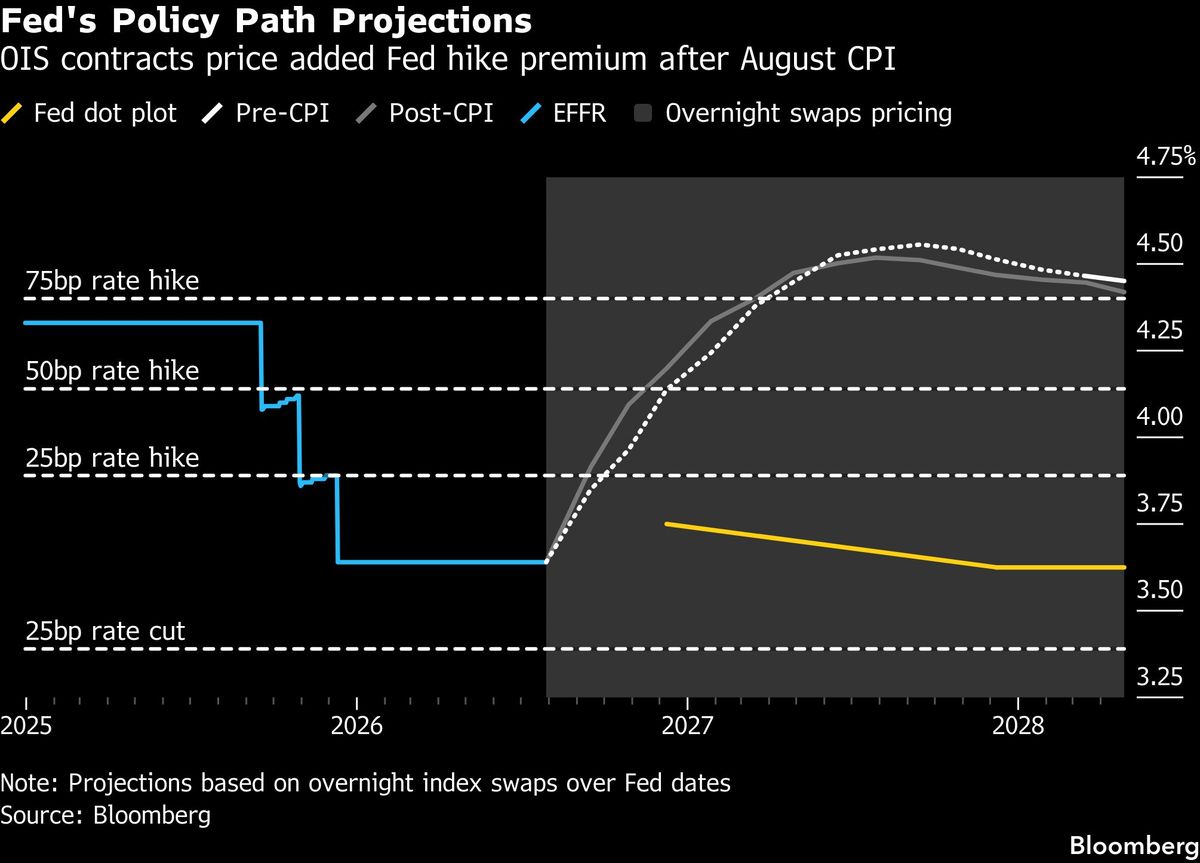
Following Friday’s report, which showed core inflation rose by a greater-than-expected 0.3% in August, yields on two-year notes rose as much as seven basis points to 4.66%, the highest since 2024. The two-year note later retraced some of that move. The 30-year yield fell one basis point to 5.35%.
The Treasury market’s relatively muted reaction follows its second-worst day this year, when a surge in oil prices helped drive yields higher. Traders said Thursday’s sell-off anticipated the prospect that the consumer price index data would cement the case for a September rate increase.
The Bloomberg US Treasury Index fell 0.6% Thursday, its worst day since March 20, when rising oil prices helped drive a rout in UK government bonds.
Friday’s trading “reflects how much rates have moved in recent days”, said Priya Misra, a portfolio manager at JPMorgan Asset Management. “Basically, we think that the market has already priced in a modest hiking cycle.”
Still above target
The consumer price report suggests inflation is making little progress towards the Fed’s goal amid soaring energy costs from the Iran war, tariffs and the data centre build-out. Fed chairman Kevin Warsh has been reluctant to tip his hand on the central bank’s next move, but in a speech at the Jackson Hole symposium last month, he said the Fed would “have work to do” if inflation doesn’t cool “at sufficient speed”.
Several Wall Street firms shifted their September Fed calls after the inflation report. Citibank Inc, which had been forecasting a rate cut by year end, pivoted and now expects an increase this month. TD Securities expects the Fed to deliver the first of three rate increases next week, after previously forecasting no change through 2026. JPMorgan Chase & Co now sees hikes in September and December.
“For the Fed, it is time to put up, or shut up,” Omair Sharif, the president of Inflation Insights, wrote in a client note. “You cannot give a speech like you did at Jackson Hole and not support a rate hike at the next meeting. You will either have to back up those words or end up as the boy who cried wolf.”
TIPS in focus
While longer-term conventional Treasuries stabilised on Friday, yields on Treasury inflation-protected securities climbed further. As investors’ conviction has grown that the Fed will hike rates to address price pressures, demand for such inflation hedges has waned. The yield on 10-year TIPS topped 2.6% for the first time since 2008, when demand collapsed during the financial crisis.
Treasuries, along with global bond markets, have been hit in recent months as renewed hostilities in the Middle East pushed Brent crude above US$100 a barrel and high debt levels remained a concern. Germany’s 10-year yield touched its highest since 2009 after the European Central Bank raised interest rates for the second time since the war broke out in late February.
After whipsawing on Friday, the 10-year Treasury yield remain within a shouting distance below the psychologically important 5% level, which it has reached only once — and briefly — since 2007.
This time, a resilient labour market has kept investors focused squarely on inflation and the prospect that borrowing costs will remain higher for longer. Governor Christopher Waller said last week that his decision at the Sept 15-16 policy meeting would be “heavily influenced” by this week’s inflation data.
“The report clears the path for the FOMC (Federal Open Market Committee) to hike next week — a move that we expect will be followed by at least an additional quarter-point by year end,” wrote Ian Lyngen, the head of US rates strategy at BMO Capital Markets. “The front end cheapened while duration has rallied in outright terms. The price action makes sense — Fed credibility is compressing forward inflation expectations.”
Long-end relief
Friday’s stability in longer-dated Treasuries offered some relief for Treasury Secretary Scott Bessent, who has struggled to contain the broader bond sell-off ahead of the midterm elections. Expanded Treasury bond buy-backs this week did little to counteract the trend.
Bessent has sought to downplay concerns about the rise in yields, saying the Treasury market is in “very good shape”, pointing to robust demand at recent auctions and highlighting US bonds’ performance relative to their global peers. On Thursday, a US$22 billion sale of 30-year bonds drew historically strong demand, a sign that higher yields are attracting some buyers.
Keeping long bonds in check may depend, in part, on whether Warsh — who has abandoned the Fed’s long-standing practice of signalling policy moves well in advance — delivers the rate hikes traders are anticipating, investors said. At the July Fed meeting, Warsh’s second since taking the helm — his ambiguity over how he planned to contain inflation helped trigger a sharp sell-off in long-term bonds.
“If the Fed were to refrain from hiking after today’s data, it would risk a significant sell-off,” Bank of America Corp strategists including Meghan Swiber wrote in a note. “We suspect policymakers have learned that lesson.”
Uploaded by Tham Yek Lee