

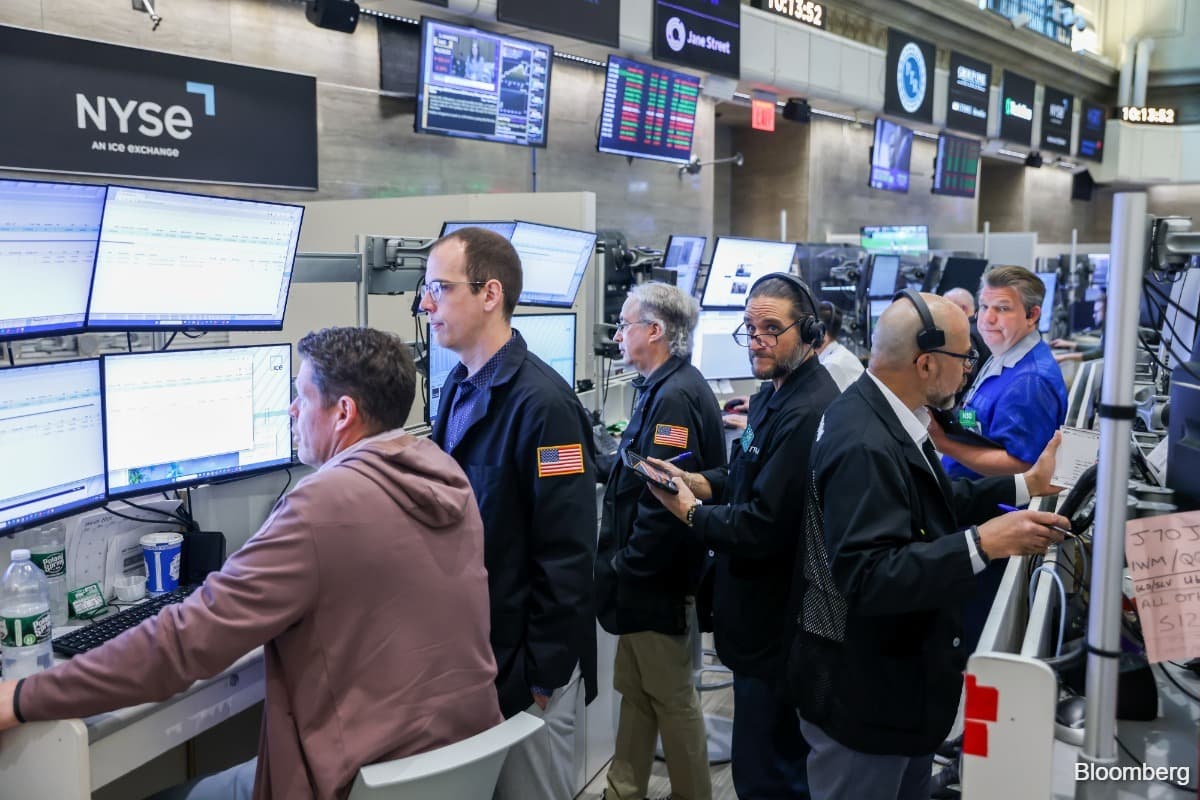
(Sept 11): Wall Street's main indices fell on Thursday after producer prices data for August raised expectations of an interest rate hike this month, while an escalating conflict in the Middle East kept oil prices above US$100 (RM406.61) a barrel.
At 12.11pm ET, the Dow Jones Industrial Average fell 350.24 points, or 0.67%, to 52,030.42, the S&P 500 fell 44.48 points, or 0.58%, to 7,591.88 and the Nasdaq Composite fell 159.02 points, or 0.61%, to 26,094.32.
Brent crude advanced over 4% to more than US$100 a barrel, clouding the outlook for equities and reinforcing expectations that interest rates could be raised this month, as supply routes through both the Strait of Hormuz and the Red Sea remained heavily disrupted by the six-month-old war that has shown little sign of easing.
Echoing that costs were on the rise, a Labor Department report showed that the producer price index (PPI) rose 5.4% in August on an annualised basis, a touch higher than the 5.3% economists polled by Reuters had expected.
Although the PPI report typically gets less attention than the consumer price index, which will be published on Friday, all economic indicators are under greater scrutiny ever since the central bank stopped issuing guidance on monetary policy.
"We were looking for data to come in softer than expectations. It wasn't soft enough," said Jim Lebenthal, chief equity strategist at Cerity Partners.
"We're now kind of hoping for a Hail Mary from the CPI tomorrow."
Traders now see a 70% chance the Federal Reserve will hike interest rates by at least 25 basis points next week, up from about 64% before Thursday's report, the CME FedWatch tool showed.
The S&P 500 materials and technology indices led losses with declines of 1.45% and 0.6%, respectively. Consumer staples .SPLRCS was higher.
High treasury yields bite
Equities have also come under pressure from elevated yields on risk-free US treasuries. The Treasury Department said on Wednesday it would buy up to US$6 billion in longer-dated treasury bonds as part of an effort to keep yields under control.
However, the yield on the benchmark 10-year US treasury was at 4.9198%, its highest since 2023. "It's early days. But markets may be telegraphing to [Treasury Secretary Scott] Bessent that it will be tough for him to have meaningful control over long-end rates," ING strategists wrote.
Two-year treasury yields, which move in lockstep with interest rate expectations, jumped to 4.5287%, their highest since 2024.
Developments in the bond market have implications for stocks, as higher yields on risk-free US treasuries can make equities relatively less attractive.
Among other movers, Macy's was volatile and was last down 2.4%. The department-store operator raised its annual forecasts after stronger performance at its upmarket Bloomingdale's and Bluemercury chains.
American Eagle Outfitters fell 14.57% to its lowest since October as the company stuck to its annual comparable sales forecast and said gross margins in the current quarter could be unchanged from a year earlier.
Apple gained 2.77% a day after it launched a folding US$1,999 iPhone.
Declining issues outnumbered advancers by a 3.07-to-1 ratio on the NYSE and by a 2.45-to-1 ratio on the Nasdaq.
The S&P 500 posted seven new 52-week highs and 20 new lows, while the Nasdaq Composite recorded 18 new highs and 132 new lows.
Uploaded by Felyx Teoh