

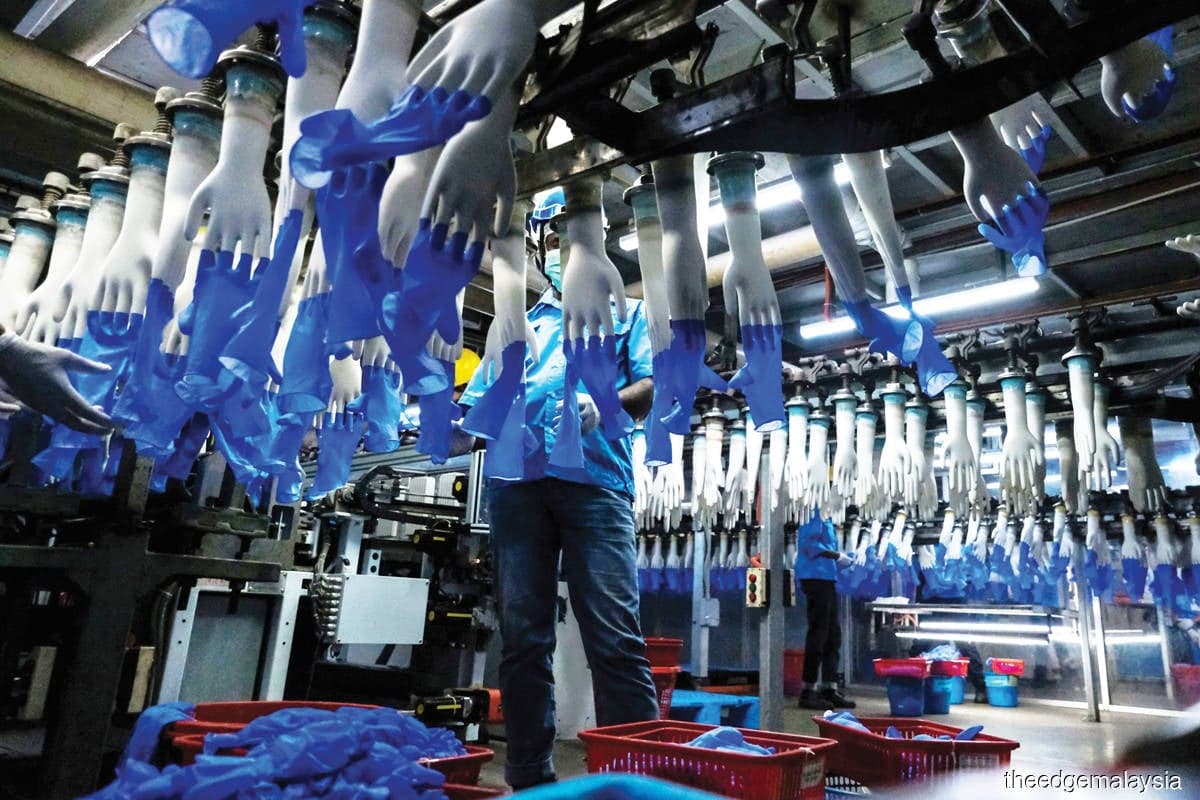
KUALA LUMPUR (Sept 10): Rubber glove counters on Bursa Malaysia rallied on Thursday as investors expected customers to place more orders ahead of anticipated price increases, driven by higher crude oil prices and a recent price hike by China’s market leader Intco Medical Technology Co Ltd.
Higher oil prices raise the cost of nitrile, a key raw material input for glove manufacturers, and analysts said the market was pricing in the prospect of downstream customers placing larger orders ahead of anticipated price increases. Brent crude was trading at US$102.69 (RM417.55) per barrel at the time of writing, after it broke above the US$100 level earlier in the week
At market close on Thursday, Top Glove Corp Bhd (KL:TOPGLOV) was up 13.5 sen or 21.4% at 76.5 sen, while Kossan Rubber Industries Bhd (KL:KOSSAN) gained 16 sen or 15.5% to RM1.19.

Hartalega Holdings Bhd (KL:HARTA) climbed 18 sen or 19.4% to RM1.11, and Supermax Corp Bhd (KL:SUPERMX) rose eight sen or 22.9% to 43 sen.
Affin Hwang Investment Bank in its note on Tuesday said it is more upbeat on the glove sector’s ability to maintain healthy margins, as pricing competition has been less aggressive than expected despite recent volatility.
The price gap between Malaysian and Chinese glove makers has narrowed to about US$0.50 per 1,000 pieces from nearly US$4 in 2022-23, while limited capacity expansion in China could support more stable prices.
Top Glove is targeting a 10% pre-tax margin for FY27, with higher selling prices expected to help offset rising natural gas costs. Affin Hwang has therefore raised its earnings forecasts for Hartalega, Top Glove and Kossan, with the revised estimates now 10% to 70% above consensus. It upgraded the sector from underweight to overweight, citing low valuations and signs that earnings have bottomed out.
An analyst, who declined to be named, told The Edge that Intco Medical’s raised prices are now at levels similar to Malaysia's. He described the development as a pivot to market share and profit-eating, noting that the Chinese manufacturer had struggled to cut prices for three years.
As at Sept 9, Intco Medical, the world's largest disposable glove manufacturer, raised prices for its nitrile gloves by 15-40 yuan (RM9-RM36) per carton, dependent on type and weight.
The natural gas tariff adjustment from October could also be a reason why average selling prices are higher, said the analyst. The revision is expected to raise production costs for major industrial users in Malaysia.

The analyst views Thursday’s share price movements as “fair value”, estimating a two-year forward price-earnings multiple of 17-18 times based on Top Glove's price moves.
A second analyst, who has a "sell" call on Top Glove, said that while China dictates glove prices due to its large market share, this spells a good outlook in the near term for Malaysian glove players.
However, longer-term risks remain due to Intco Medical's expansion into Vietnam and Indonesia, and the possibility that a future removal of US tariffs, should Donald Trump no longer be in office, could weigh on Malaysian players.
The analyst maintained its "sell" call on Top Glove, citing a weaker balance sheet relative to peers, and pegged Hartalega and Kossan as top picks due to their strengths in net cash position.
The rubber glove counters rally led to the Bursa Malaysia Healthcare Index rising 103.97 points or 7.02% to 1,584.29 on Thursday, but the broader market moved in the opposite direction with the FBM KLCI falling 8.82 points or 0.51% to 1,705.52.

Asian stocks slid on Thursday as the biggest wave of attacks on shipping in the widening war in the Middle East kept oil prices above US$100 a barrel, leaving investors nervous ahead of US inflation data that will influence near-term monetary policy, according to a report by Reuters.
RHB Investment Bank Bhd head of regional equity research Alexander Chia said risks to the market are skewed to the downside amid weakness in bond markets and a broader negative shift in global monetary policy as central banks meet this week.
“There are no real positive catalysts in the short term,” said Chia.
He said Thursday's decline largely reflected market pricing in these developments rather than any new shock, and described the intraday moves as profit taking rather than a change in trend.
"Fundamentally, locally, Malaysia is doing okay due to net export gas position, it is relatively positive," he said.
On healthcare, Chia said it is a defensive sector with fundamentals intact, as even if economic conditions worsen, topline for healthcare providers does quite well.
RHB's strategy and investment themes hinge on external uncertainties, with institutional funds needing to build their portfolios on a defensive background, buying on weakness and selling into strength, he said.