

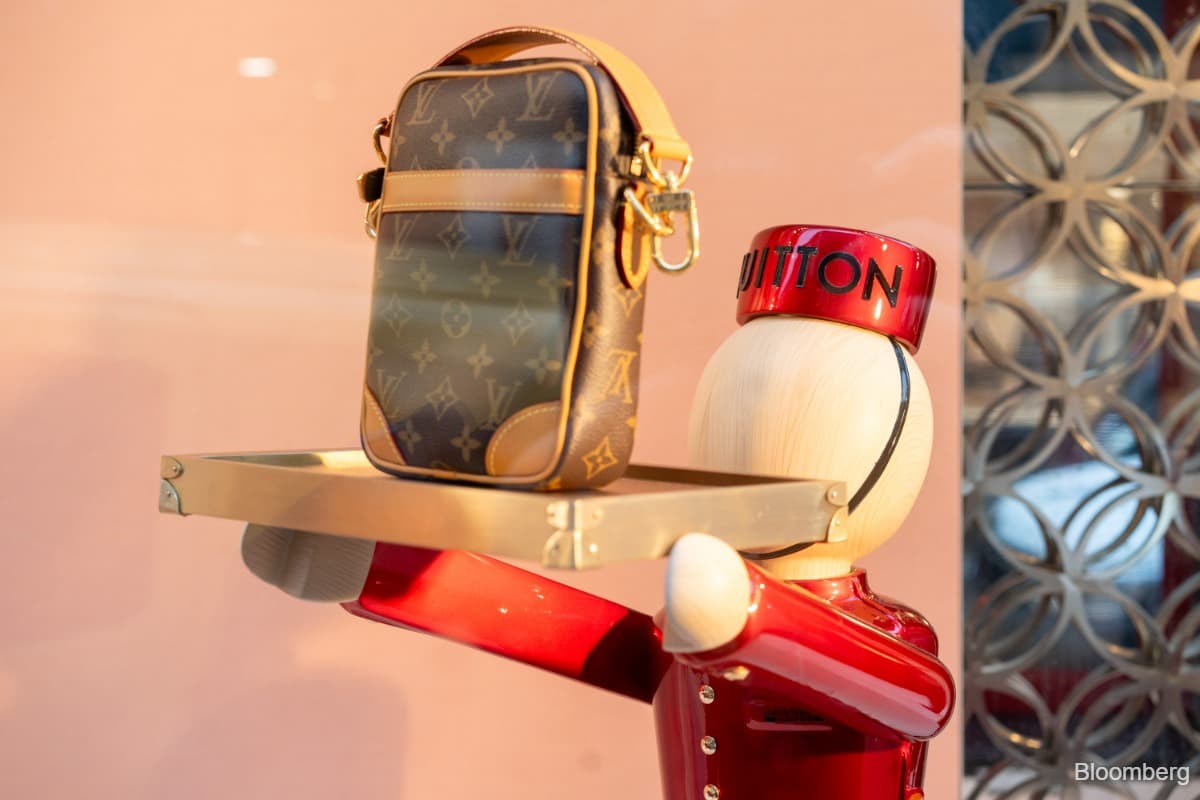
(Sept 10): In June last year, Louis Vuitton opened a huge cruise ship-shaped store in the swanky Jing’an neighbourhood of Shanghai. The inauguration drew crowds, with the star-studded invitee list including popular actors like Lin Yi and Gong Jun, the brand’s ambassadors.
A little over a year on a very different kind of buzz has engulfed the French luxury brand. A trademark fight with a local tea maker sparked a patriotic backlash that exacerbated a demand slump for LVMH’s most profitable label. While the broader downturn in the Asian powerhouse has slammed all luxury brands, LVMH Moët Hennessy Louis Vuitton SE’s flagship label was the worst hit in July and August, people familiar with the matter said.
Social media fury over the case against Molly Tea, whose four-petal floral design was found to be too similar to the French brand’s famous monogram, drove customers away. While Louis Vuitton won the case, the controversy drew internet outrage and an impassioned defence of Molly Tea, with some claiming its logo is akin to a Tang Dynasty baoxiang flower pattern. The backlash began showing up in the brand’s sales, according to research firm JL Warren Capital.
“We have continued to observe double-digit sales declines in August albeit the decline narrowed from approximately 30% in July to an estimated 20-25%,” Junheng Li, chief executive officer and head of research at JL Warren, said this month. In early August she said the “lawsuit in July triggered an escalating cultural-ownership controversy that appears to have materially affected the brand’s performance”.
LVMH declined to comment for this article.
For quite some years, China was the main sales driver for luxury goods as growing wealth and disposable incomes drove aspirational consumers to lap up everything from Louis Vuitton handbags and Hermès scarves to Gucci shoes. Demand there helped drive LVMH sales and shares to record highs in 2023. Now, an economic slump and the added Molly Tea backlash seem to have dashed hopes of sales growth for the brand in the country anytime soon.
Asia excluding Japan accounted for about 29% of LVMH’s total revenue in the first half. Chinese consumers make up around 30% of its total sales, UBS estimates. LVMH doesn’t break down performance by brand but Louis Vuitton generates about a quarter of group sales and around 60% of earnings before interest and taxes, according to UBS.
Granted, any comparisons for Louis Vuitton with the year-earlier period are made harder by the Shanghai megastore’s opening. But things weren’t looking great in China for Louis Vuitton, like for its peers including Gucci-owner Kering SA, and Hermès International SCA, even before the controversy. JL Warren estimates Gucci’s China sales slid 20% in July and 10% in August, while those of Hermès’ dropped by about 5% in July and by around 13% last month. Kering and Hermès declined to comment.
Amid a wider luxury slump, shares of LVMH — a conglomerate controlled by billionaire Bernard Arnault — have plunged more than 36% this year, bringing them back to pandemic-era levels when lockdowns shut down many stores across the world. Hermès has fallen by about a third, while Kering is down almost 23% this year.
A slowing Chinese economy and a government crackdown on conspicuous consumption has hit the sector hard. Luxury brands additionally suffered from efforts by local authorities to reclaim tax revenues.
Louis Vuitton’s picture was rendered gloomier by the controversy surrounding Molly Tea, which plans to appeal the court ruling ordering it to pay the French brand 10.3 million yuan (US$1.5 million or RM6.21 million), Global Times reported.
The case hit a social-media nerve, with some online posts noting that it was “cheap” of a luxury giant like Louis Vuitton to sue a small, local tea chain that it doesn’t compete against.
At the peak of the controversy, Louis Vuitton’s social media accounts on Chinese platforms like Douyin, Weibo — where it has more than 11 million followers — and the Instagram-like Xiaohongshu fell silent, with no official announcement of an event in Shanghai in late July.
“For foreign brands, the Chinese market is a complex, multi-stakeholder market,” said Robert Wu, CEO of Shanghai-based market data and research firm Baiguan. “You may win in a court, and you may have the government’s seal of approval, but the court of public opinion is also strong and may deviate from the official line.”
Chinese patriotic fervour has in the past hit other Western retailers like Nike Inc, Adidas AG and H&M AB. It also won’t be the first time a luxury brand has suffered a strong backlash from Chinese consumers. Dolce & Gabbana was hit hard by a boycott that hurt sales for years after its ad campaign in 2018 was considered insensitive and racist by local shoppers.
Intellectual property “is an absolute key asset for us, and we diligently protect our brands”, Cecile Cabanis, LVMH’s chief financial officer, told analysts on a call on July 27 when asked about the Molly Tea case.
Louis Vuitton CEO Pietro Beccari and Deputy CEO Damien Bertrand travelled to China to assess the situation at the end of July, people familiar with the matter told Bloomberg News, asking not to be named discussing non-public information. While it’s not uncommon for top executives to visit their most important markets, the trip was seen as an attempt to get a better handle on the situation on the ground, the people said.
The trouble at the label known for its monogrammed Neverfull canvas bags means the planned handover from Beccari to Bertrand as sole CEO of LVMH’s largest brand will likely be delayed, people familiar with the matter said. Bertrand was named Louis Vuitton’s deputy CEO last year. Earlier this year, Beccari added the role of CEO of the LVMH fashion group, which includes brands like Celine, Loewe and Fendi.
The online uproar against Louis Vuitton seems to have cooled a bit, with Taiwanese singer Ouyang Nana and Chinese Olympic snowboard champion Su Yiming attending a new store opening in northeast China’s Changchun city this month, according to the brand’s social media posts. JL Warren sees China sales for Louis Vuitton showing further improvement this month, estimating a 13% drop.
The impact of the negative social-media reaction “we believe will be short term in nature”, HSBC Holdings Plc analysts led by Anne-Laure Bismuth said in a note, downgrading LVMH to hold this week. “While this is temporary, it is likely to have had a negative impact on the brand’s sales in the China market for Q3 2026.”
While July is seasonally weak in China, August is more significant commercially since Chinese Valentine’s Day falls in the month, said JL Warren’s Li, whose firm bases its estimates on what it calls “visuals” collected by its people monitoring boutiques in about 15 shopping malls in the country, rather than actual sales data. The Greenwich, Connecticut-based firm, whose clients include hedge funds, focuses on international consumer brands with a large footprint in China.
“China’s Valentine’s Day on August 19 was quieter than usual, with a visible contraction in gifting demand” for Louis Vuitton, Li said. “For luxury brands, Chinese Valentine’s Day is the second-largest retail moment after the Chinese New Year.”
Uploaded by Chng Shear Lane