

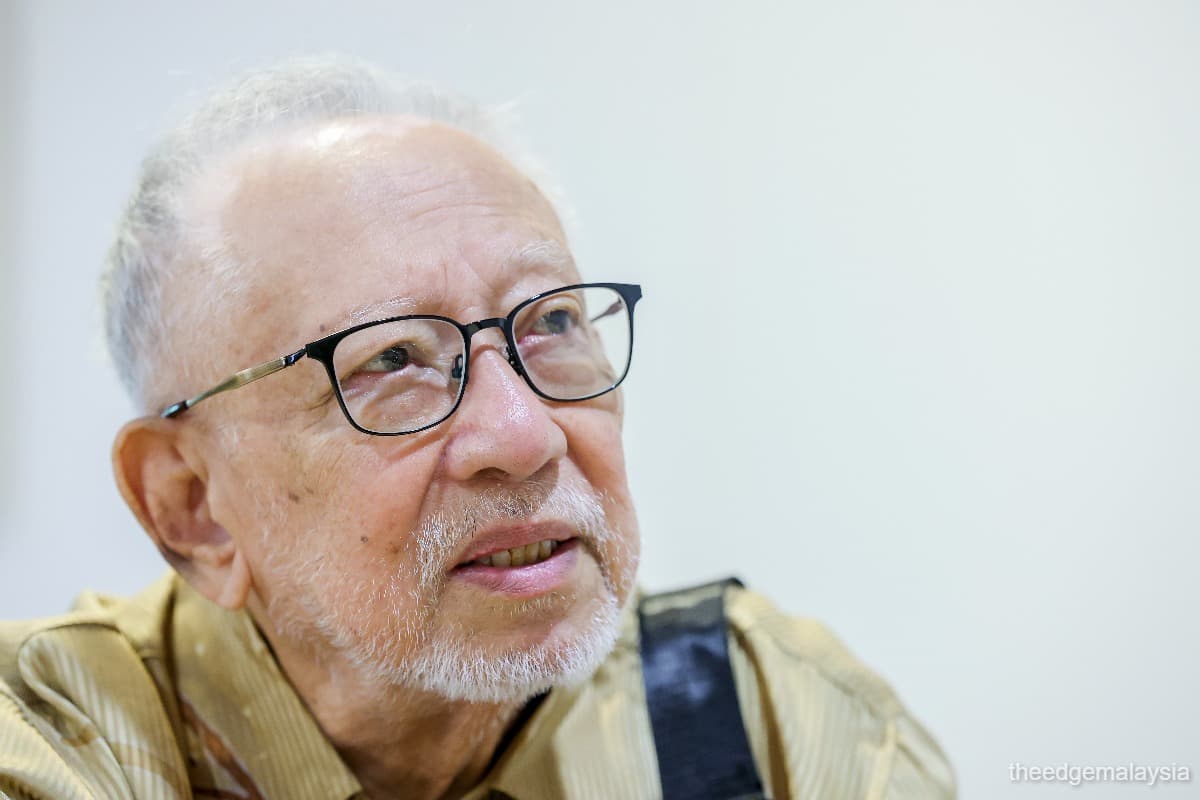
KUALA LUMPUR (Sept 10): Former de facto law minister Datuk Zaid Ibrahim has suggested for Prime Minister Datuk Seri Anwar Ibrahim to give former High Court judge Datuk Syed Ahmad Idid Syed Abdullah his pension, which he lost when he was forced to resign in 1996.
Zaid, a former Kota Bharu member of Parliament who is now with PAS, has also suggested that Anwar should also amend the Whistleblowers Protection Act 2010.
In a Facebook post on Thursday, Zaid said he knew Syed Ahmad Idid as a friend. Syed Ahmad Idid was asked to resign following an open letter he had written telling the public about corruption in the judiciary.
“He told his tragic story to The Edge recently, and how he wished he could get his pension.
“When I [as the then law minister] was arranging the ex-gratia payment to the (senior Supreme Court) judges sacked in the 1988 judicial crisis, I suggested to the then PM, Pak Lah (the late Tun Abdullah Ahmad Badawi), that the Syed Ahmad Idid case should be considered as well.

“PM (Pak Lah) correctly pointed out that Syed Ahmad Idid’s case must be taken up separately; he resigned (was forced to resign) and was not dismissed by a tribunal. Unfortunately, I left the Cabinet soon after that and had no time to look at Syed Ahmad Idid’s case,” Zaid said in his post.
Zaid was minister in the Prime Minister’s Department in charge of Law for several months in 2008.
Zaid added that perhaps Anwar could make a quick decision to give Syed Ahmad Idid his pension.
“Better still, if he (Anwar) can amend the Whistleblowers (Protection) Act to be more friendly to the whistleblower than to the government in power. This is the sort of reform that the rakyat can relate to,” Zaid added.
In the recent interview with The Edge Weekly, Syed Ahmad Idid, 88, said that Malaysia has paid the price for not protecting whistleblowers like him 30 years ago through the rise in corruption cases in the nation.
“I hope the people can see if the judiciary has improved since then, and the sum total of each judge’s performance spells its standing in our country.
“The nation is paying the price. When they ‘killed’ me as a whistleblower, they frightened every other honest Malaysian. As a result, others are now afraid to come forward and expose secrets like 1Malaysia Development Bhd (1MDB), Tabung Haji, and other scandals that have resulted in billions of losses.
“For 50 honest people, 49 will keep quiet; and even if we have one, that person is muzzled. People are using my exposé as an example to look at what happened to the judge. This frightened honest people, and, as a result of this, they do not want to expose any wrongdoing for fear of prosecution.
“The result [is that], all these honest people do not want to speak out and now we are paying the price [with the many cases of corruption and abuse of power]. This problem [corruption and abuse of power] will not go away. We have lost a generation of honest people who are willing to come forward, [but] not wanting to expose wrongdoing due to my removal.
“If whistleblowing had been encouraged and treated as respectable, then 1MDB could have been stopped at an early stage,” the former judge said.
Syed Ahmad Idid reacts to The Edge Weekly article
On the publication of the interview with him in The Edge Weekly titled Court: Syed Ahmad Idid stresses need to protect whistleblowers, seeks return of pension, Syed Ahmad Idid said he does not believe that he fell into the same category of former Supreme Court judges who received RM10.5 million compensation.
“I have never demanded any particular sum or sought to prescribe what the government should do. Whether anything should be done, and what form any remedy should take, is ultimately a matter for the government to consider in accordance with law, justice, and the circumstances of the case.
“My position concerning my resignation is, however, fundamentally a matter of law. The circumstances surrounding the resignation letter also raises constitutional considerations which, I believe, cannot simply be regarded as an ordinary matter of employment or pension.”
He added that he has confidence that the government’s legal advisers understand the constitutional and legal implications involved.
“I therefore prefer to leave these questions to their considered judgement, guided not merely by legal technicalities but, I hope, also by fairness, conscience, and the spirit of justice.
“After all, the judiciary is founded upon the principle that justice must not only be done, but must be seen to be done. That principle should apply no less when the issue concerns a former member of the judiciary,” he said, adding that he makes these observations not in a spirit of demand or grievance, but simply to place the record in its proper legal and constitutional perspective.
On the recent Merdeka month and incoming Malaysia Day celebration next week, he wished the government, and particularly the prime minister and his Madani administration, every success in strengthening the institutions of the country and upholding the values of justice, integrity, and constitutional government.
The judge had in the article commented on his resignation where he pointed out that he wrote his resignation on a plain white piece of paper without any official judge’s letterhead and addressed it to the then Chief Justice Tun Eusoff Chin.
Syed Ahmad Idid said he resignation did not follow procedure as required under Article 125(2) of the Federal Constitution, as the law stipulates that a judge may resign by handing a letter to the Yang di-Pertuan Agong or be removed from office via a tribunal.