


(Sept 10): Sluggish demand at Southeast Asian bond auctions is creating entry points for fund managers drawn to the region’s economic resilience.
Western Asset Management and Aberdeen Investments are among institutional investors maintaining an upbeat view on the region, citing domestic demand and robust fundamentals. They’re largely looking past depressed bid-to-cover ratios at recent government debt sales — down to multi-month or multi-year lows — as global yields, high oil prices and heavy issuance weigh on longer-dated bonds.
“The region benefits from strong domestic sponsorship, but longer-dated bonds remain exposed to global term-premium shocks and heavy issuance,” said Desmond Fu, head of investment management at Western Asset Management. “We prefer short- to intermediate-maturity bonds and would use weak auctions as opportunities to enter at better yields.”
Investor interest highlights how a disconnect between relatively strong regional economic performance and short‑term sentiment is creating opportunities for fund managers to lock in higher yields.
Malaysia’s auction of 2046 notes at end-August drew a bid-to-cover of 1.63 times, the second lowest for this year. Thailand’s sale of 2036 securities on Sept 2 drew a cover of 1.13 times, the lowest for the 10-year benchmark bond since May. Philippine 5-year auction last week drew the weakest cover since 2013. Indonesia’s conventional auction last week drew aggregate bids of 66 trillion rupiah (RM15.33 billion), the lowest since the July 7 sale.
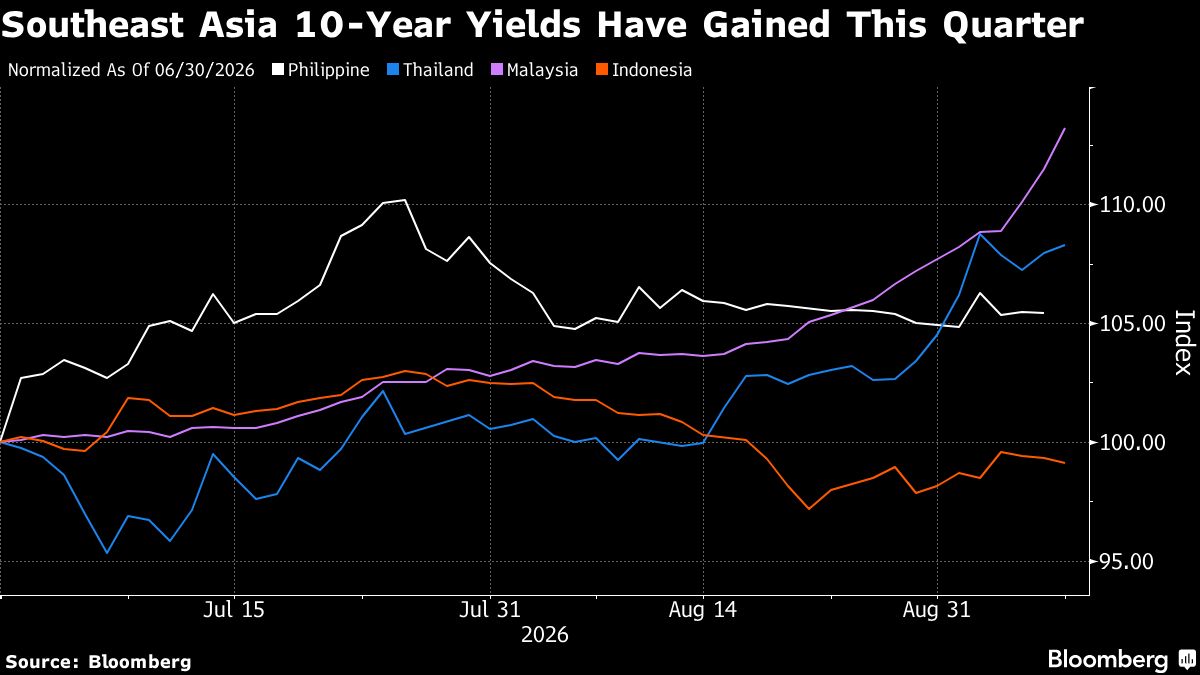
Yields across most Southeast Asian economies have climbed this quarter amid rising global rates and persistent inflation pressures. In Malaysia, the 10-year benchmark has jumped by over 50 basis points, also driven by concerns over long-dated supply and expectations of Bank Negara Malaysia rate hikes on the back of robust growth.
Brent crude has risen above US$100 (RM406.94) a barrel, with concerns over higher energy costs for net importers like Thailand and the Philippines weighing on bond demand. Yields on 10‑year bonds in both economies have risen around 20 basis points and over 40 basis points, respectively, this quarter.
August inflation data from regional economies also signal risks of underpriced inflation, potentially lifting yields as investors pare back easing expectations and demand premiums. Thailand’s inflation in August rose by 2.53% from the previous year, beating economist estimates for the first time in four months. Inflation in Indonesia similarly came in hotter than expected for August, accelerating by 3.19% year-on-year.
“Recent weakness primarily reflects a more challenging external environment rather than a broad deterioration in Southeast Asian fundamentals,” said Fesa Wibawa, investment manager at Aberdeen Investments, adding he is constructive on the region’s assets over the medium to longer term.
“Current volatility should ultimately create more attractive opportunities within Southeast Asian rates and currencies,” he added.
Uploaded by Syed Azahedi