

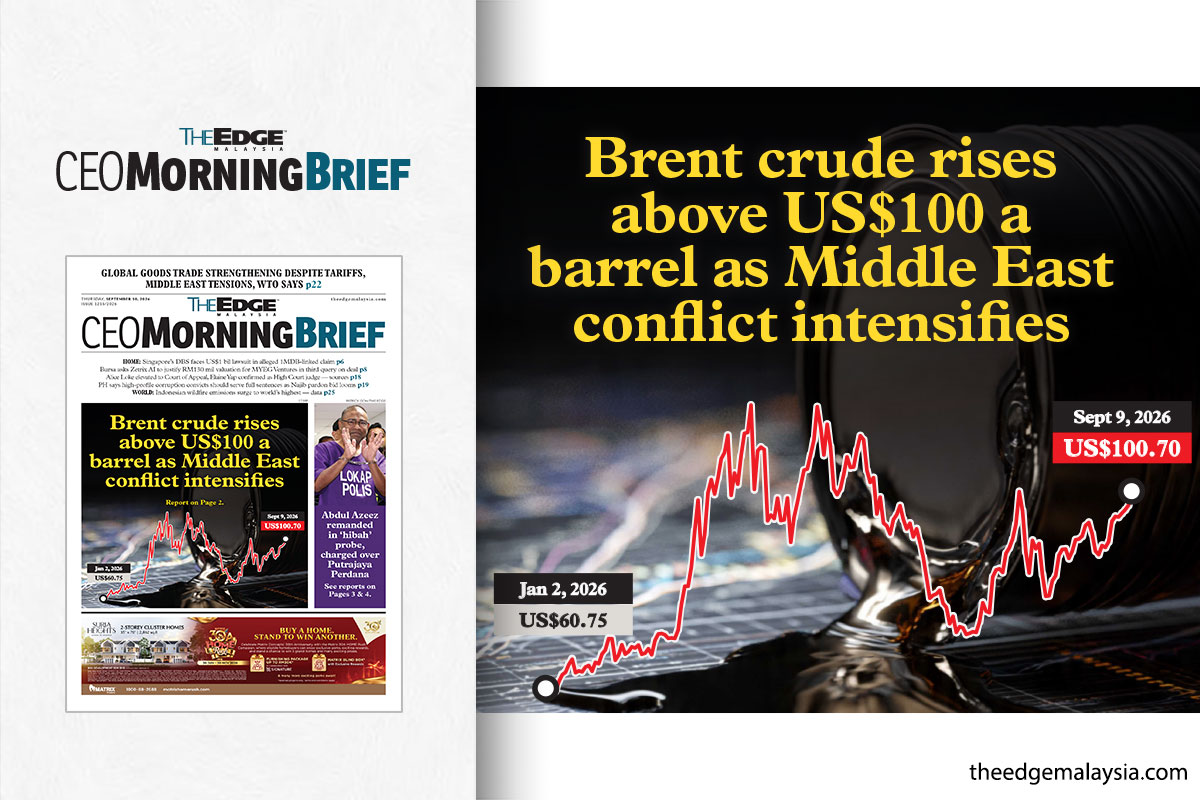
BENGALURU/LONDON (Sept 9): Brent crude futures breached US$100 a barrel on Wednesday for the first time since July 24 as escalating attacks in the Middle East, including on tankers, stifled hopes of a normalisation of oil shipping in the region.
The move brought futures prices into line with physical crude and fuel markets, where prices have already been trading above the psychological threshold.
Front-month Brent crude futures were up US$2.74, or 2.8%, at US$100.66 (RM409.44) a barrel by 1315 GMT, after earlier touching US$100.95. US West Texas Intermediate crude was up US$2.74, or 3%, at US$95.77 a barrel, its highest level since early June.
The contracts were headed for their biggest daily rises in percentage terms since Sept 1.
Since the Iran war began on Feb 28, Brent has surged as high as US$126.41 a barrel, a peak reached on April 30.
"The move towards and back above US$100 Brent is reflecting a market that increasingly has to change its view on how long the Middle East crisis will continue to curb supply from the region," said Ole Hansen, the head of commodity strategy at Saxo Bank.
_20260909200523_mo2cui.jpg)
In a sharp escalation of the six-month-old war in recent days, US forces hit multiple Iranian oil tankers and Iran targeted a US base in Jordan and attacked ships.
A seafarer was killed in an incident involving the Gibraltar-flagged oil products tanker Hercules Star while at anchorage off Dubai, the vessel’s charterer Peninsula said on Wednesday.
This week, attacks by Iran-backed Houthis on Saudi energy facilities set oil installations ablaze, threatening a significant expansion of the conflict.
The attacks also threaten crude shipments via the Red Sea, which has been a key alternative route to the crucial Strait of Hormuz, where oil flows have been severely curtailed.
Supply risks mount
"Market participants appear to be pricing in a more prolonged conflict in the Middle East as well as the risk that the latest escalation in military strikes disrupts oil flows from the Middle East," said Hamad Hussain, a senior climate and commodities economist at Capital Economics.
"The key risk is whether the recent attacks on oil tankers lead to fewer ship-to-ship transfers taking place in the Gulf of Oman, which have so far played a key role in providing oil to global markets and keeping a lid on prices."
A tanker carrying about two million barrels of Iraqi fuel oil was struck by a drone in Iraqi territorial waters on Wednesday, port officials said, while UKMTO, a British navy-linked agency, reported that several merchant vessels in the Gulf had been hit by disabling fire overnight.
In the week before a resumption in fighting on Aug 30, roughly eight million to nine million barrels per day had flowed through Hormuz, double the previous week's volume, according to Rystad Energy's chief economist Claudio Galimberti. More recently, flows have fallen below two million barrels per day.
Six commodity vessels passed through the strait on Tuesday, down from nine a day earlier and below the 10-day average of about 12, preliminary Kpler shipping data showed.
Fuels, physical crude oil already above US$100
In the physical crude oil market, the dated Brent oil benchmark, against which roughly two-thirds of supply is priced, has been above US$100 per barrel since Sept 3, according to LSEG data.
Physical oil markets react quickly to supply disruptions as buyers need to go into the market to seek alternative cargoes.
Meanwhile, consumers have been paying over US$100 for their oil in the form of refined fuels such as gasoline and diesel for most of this year, as conflicts created a global refining crunch which sent fuel prices soaring even relative to crude.
European diesel futures were trading at around US$199 per barrel on Wednesday, and have not been below US$100 per barrel since the start of the Iran war.
Diesel refining margins, or the fuel's premium to crude, have been at all-time highs since August as fuel shortages gripped markets, touching US$78.90 per barrel on Sept 1.
By contrast, the margin averaged US$21 per barrel in 2025 and US$19.52 in 2024.
"We’re in a situation where actually, if we had normal refining margins, crude would be the equivalent of about US$150," said Alan Gelder, a senior vice-president for refining, chemicals and oil markets at Wood Mackenzie.
Refining is tight globally because of lower exports from the Strait of Hormuz and Russia, and restrained throughputs in Asia, he added.
European gasoline has also been above US$100 since March, and its premium to crude neared all-time highs of above US$60 per barrel at the start of the month.
In the US, consumers faced record gasoline prices over the Labor Day holiday weekend, while diesel prices hit all-time highs last week as supply concerns continued to tighten fuel markets.
"It complicates the picture because central banks around the world are trying to grapple with high inflation," said Nitesh Shah, a commodity strategist at WisdomTree.
Uploaded by Tham Yek Lee