

This article first appeared in The Edge Malaysia Weekly on September 7, 2026 - September 13, 2026
OVER the past decade or so, a new crop of third-generation family members has been moving into management roles and boardrooms at Bursa Malaysia-listed companies.
Some are still being nurtured while others have accumulated years of operating experience and are moving into the top jobs. In at least one company — United Malacca Bhd (KL:UMCCA), founded in 1910 — the fourth generation has arrived.
Corporate advisers observe that the arrival of the third generation can mark a critical turning point, where family conglomerates “either reinvent themselves or begin a slow institutional decline”. And as with all conglomerates, they face increasing pressure to reinvent their business models or risk sliding behind more focused rivals.
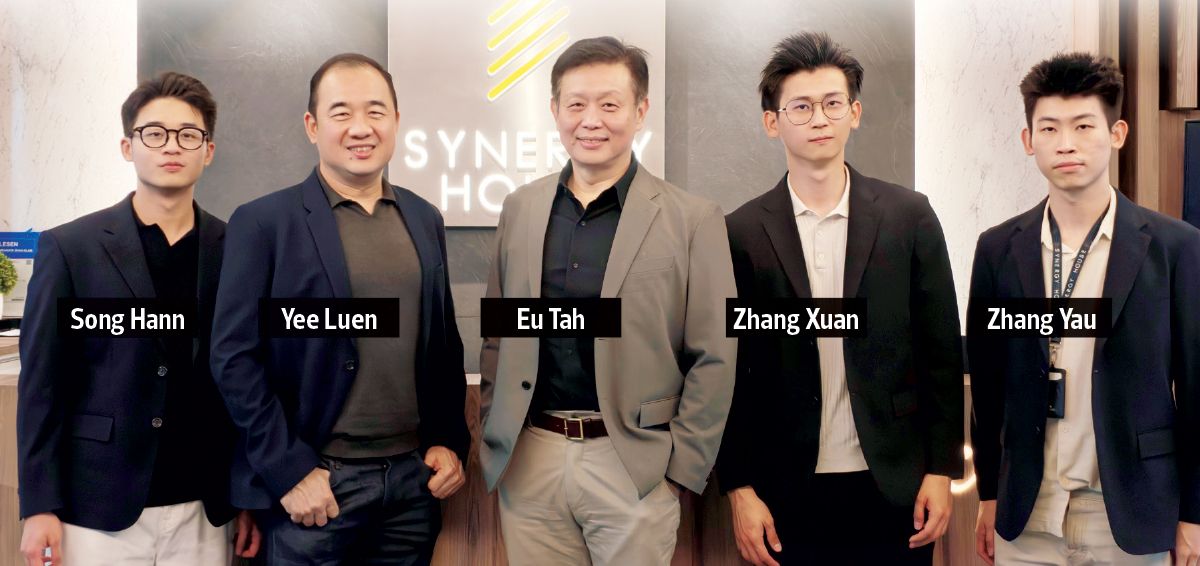
At ACE Market-listed Synergy House Bhd (KL:SYNERGY), the sons of executive directors Tan Eu Tah (Tan Zhang Yau, 25, and Tan Zhang Xuan, 23) and Teh Yee Luen (Teh Song Hann, 23) have entered the family business through the group’s e-commerce-enabled business via a subsidiary of Synergy House.
The original manufacturing business, Malgames Industries Sdn Bhd, was a family-owned operation involving seven first-generation family members and relatives as shareholders. In fact, the second generation — Eu Tah and Yee Luen — acquired the entire equity interest in Synergy House Furniture Sdn Bhd from the seven first-generation shareholders and moved away from manufacturing to focus on designing ready-to-assemble furniture — relying on third-party manufacturers — to be exported. And now, the third generation will learn the ropes.
In a recent interview with The Edge, Tan and Teh declare they are glad their sons are interested in the family business.
“But we have never told them that because they are our sons, one day the company will automatically be theirs to run. Our generation spent many years planting the tree, growing it and strengthening its roots. We don’t want the next generation simply to come back and enjoy the fruits. They need to learn how to take care of the tree, grow new branches and hopefully make it even stronger for the generation after them,” asserts Yee Luen.
Eu Tah adds, “That is also why we tried to give them some real business exposure even before they formally joined us — starting from selling old showroom samples online during the Covid-19 pandemic and later personally funding the US e-commerce venture while they were studying.”
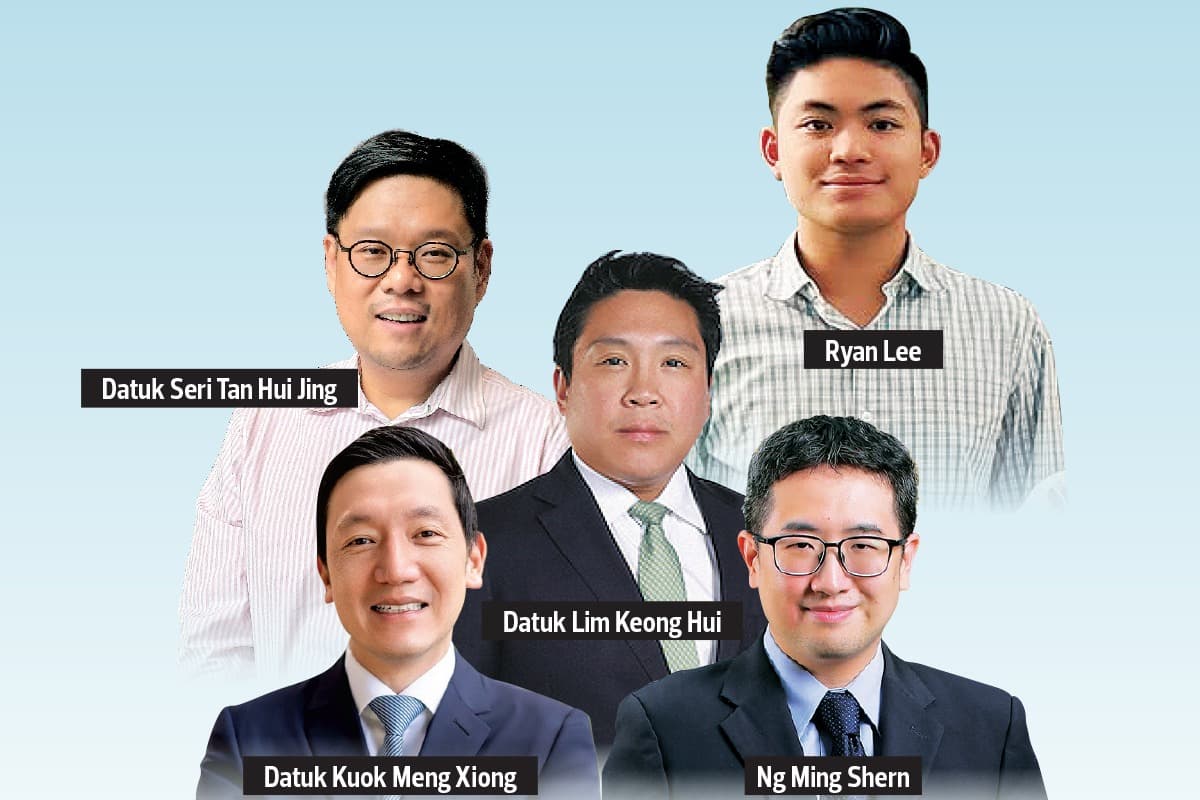
At Oriental Holdings Bhd (KL:ORIENT), Datuk Seri Tan Hui Jing, a grandson of the patriarch, the late Tan Sri Loh Boon Siew, is already deeply immersed in the group’s businesses. What began with Boon Siew’s automotive interest has become a diversified group spanning automotive, plantations, healthcare, property and other businesses over the decades.
Hui Jing, who is the son of Datuk Dr Tan Chong Siang and the late Datin Loh Gim Ean (Boon Siew’s youngest daughter), began his career at Boon Siew Sdn Bhd in 2004 and 10 years later, joined Oriental’s board. A year later, in 2015, he was made an executive director and, subsequently, deputy group managing director — a post he currently holds.
45-year-old Hui Jing tells The Edge there was no pressure from the elders to take a role in the family business. In fact, he had made known in an earlier interview that there were varied aspirations in the six families of Oriental Group. One group wanted to exit the business, the second group wanted it to remain status quo while the third wanted to grow the business.
“After graduating, I had job offers from the Big Four [accounting firms] in Australia but I did not take them up. My family said there were certain business divisions [within Oriental Group] without members of the family, so I decided to go into the motorcycle business as a sales executive. I was guided by the group’s former executive chairman [Datuk Seri Loh] Cheng Yean,” says Hui Jing, who graduated from Monash University with a bachelor’s degree in business IT.
“People tend to think being in the family’s business means an easy [life] but there is actually a great deal of responsibility that comes [with the role]. We’ve never been pressured [to work in the group] but it is important to expose our children to the group’s work to see if they develop a sense of passion or connection with the business,” says the deputy group managing director, whose responsibilities include automotive-related businesses, automotive parts manufacturing and healthcare operations.
At PPB Group Bhd (KL:PPB), a transition at the diversified agribusiness group is just beginning. Datuk Kuok Meng Xiong (or MX, as he is known to close associates), grandson of Robert Kuok Hock Nien, joined PPB’s board on March 2 and assumed the position of group managing director on Sept 1, succeeding professional manager Lim Soon Huat, who in turn succeeded Tan Gee Sooi. Both had no disclosed family relationship with the Kuoks. This makes Meng Xiong’s appointment notable because, although PPB has remained under Kuok family control, the managing director’s post has been held by professional executives outside the family since at least 2008.
Meng Xiong, 45, who was appointed as PPB’s non-independent, non-executive director on March 2 this year, has considerable experience after a career of more than 20 years running the family’s operations across the globe. Beyond those roles, he founded Asean-focused venture capital firm K3 Ventures to back start-ups such as China-based Bytedance Inc and Singapore-based Grab Holdings Inc.
Meanwhile, at Glomac Bhd (KL:GLOMAC), Fateh Idzham Fateh Iskandar — better known as FD Idzham — joined the board as group executive director in February, marking the third generation’s entry into the property developer’s leadership.
Idzham is the grandson of founder and chairman Tan Sri Mohamed Mansor Fateh Din and son of group managing director and CEO Datuk Seri Fateh Iskandar. As the elders still run the business, this is a case where all three generations overlap. Before joining Glomac’s board, Idzham had already taken on senior roles in the group, including as executive director of subsidiary Glomac Bina Sdn Bhd.
Succession can be an opportunity to reinvent
For Bain & Co partner Amanda Chin, the arrival of the third generation can mark a critical turning point. “The third generation is often where family conglomerates either reinvent themselves or begin a slow institutional decline,” she tells The Edge.
“One potential advantage is that successors may be less emotionally attached to the businesses built by the founder, giving them greater objectivity to question whether legacy assets still belong in the portfolio or whether capital could be better deployed elsewhere,” says Chin, although she cautions that later generations also bring complications.
As the family tree expands, authority can become dispersed among the different branches with different interests and financial needs. “Preserving family harmony can make decisions difficult, particularly exits from businesses closely associated with the founder,” she notes.
What separates the successful transitions in part is whether the successors are given “real mandates with genuine accountability — not just titles”, she adds.
Board renewal is another factor, Chin stresses. “A true changing of the guard at the board is the most telling leading indicator,” she says, pointing to the importance of independent directors who can challenge rather than merely “peacekeep” as well as clear strategic mandates and performance measures.
For a broader context, Bain & Co found that Southeast Asia’s conglomerates are facing mounting pressure to reinvent their business models or risk falling further behind more focused competitors. Its report, titled Southeast Asia Conglomerates: It’s Time for Reinvention, found that while conglomerates continue to lag pure-play companies on average, a distinct group of high performers has surged ahead by delivering annual shareholder returns of about 20% between 2016 and 2025.
“Family ownership amplifies the outcomes in both directions. The top quartile of family-controlled listed companies in Southeast Asia has generated total shareholder returns of around 21% versus 14% for non-family-controlled peers. But the bottom quartile performs worse than its non-family equivalent too,” points out Chin.
At Genting Plantations Bhd (KL:GENP), Datuk Lim Keong Hui has already moved into the top executive position. The grandson of the late Genting founder Tan Sri Lim Goh Tong and son of Tan Sri Lim Kok Thay became chief executive in March 2025 after serving as its deputy chief executive since 2019.
Beyond overseeing the replanting of ageing estates in Malaysia and bringing more Indonesian acreage into higher-yielding maturity, Keong Hui is also leading the group’s push into new areas. Its AgTech division is deploying artificial intelligence (AI), data analytics and genomic research to improve crop yields and operating efficiency. At the same time, the property arm is seeking to unlock its Johor land bank through projects such as the 2,300-acre Johor Tech Smart City in the Johor-Singapore Special Economic Zone.
Keong Hui had joined Genting Bhd (KL:GENTING) as senior vice president of business development in March 2013. He was made chief information officer at Genting, Genting Malaysia Bhd (KL:GENM) and Genting Plantations in 2015 and also served on the boards of all three companies.
He was also senior vice president of business development at Genting Hong Kong Ltd (wound up in 2022) until he was redesignated as the executive director in the chairman’s office of the company. Prior to joining Genting Hong Kong in 2009, Keong Hui had embarked on an investment banking career with The Hongkong and Shanghai Banking Corp Ltd.
At another plantation company, the fourth generation has already emerged. Ng Ming Shern, 40, joined the board of United Malacca as alternate director to chairman Datin Paduka Tan Siok Choo, his aunt, in October 2024. Siok Choo is the granddaughter of Tun Tan Cheng Lock, who was the founder and the first president of the Malayan Chinese Association (now Malaysian Chinese Association). He founded the company in 1910.
Interestingly, members of the Tan family are no longer major shareholders in the company, which is now controlled by Prosper Group’s Tee family with equity interest of at least 25%.
“In many cases, it is helpful for next-generation family leaders to have broader exposure, including experience outside the family business, because it builds perspective and credibility. It is also healthy to have a structured progression into leadership, rather than treating succession as an automatic transfer,” says PwC Malaysia private business leader Fung Mei Lin.
Over at IOI Corp Bhd (KL:IOICORP), Ryan Lee Jia Teck, son of group managing director and CEO Datuk Lee Yeow Chor and grandson of the late founder Tan Sri Lee Shin Cheng, is starting further down the organisation as deputy general manager of group operations.
The arrangement reflects what PwC’s Fung describes as the need for “structured progression into leadership, rather than treating succession as an automatic transfer”, alongside a clearer separation between management, ownership and family governance.
Managing the family’s expectations
PwC’s Fung says that by the third generation, the family’s involvement in a listed company can become considerably more complex.
Where leadership, ownership and family coordination might once have been concentrated in a founder, later generations can involve several family branches with different liquidity needs, private investments and levels of participation in the business. If these interests are not properly separated, they can spill over into the listed company through dividend pressure, succession disputes, informal influence over strategy or weaker capital allocation discipline.
For Fung, the answer is not necessarily less family involvement but a more institutional model around it. “The strongest family-controlled groups are often those that retain the benefits of family ownership and leadership while building the structures, functional alignment and governance discipline typically associated with more institutionalised organisations.”
Save by subscribing to us for your print and/or digital copy.
P/S: The Edge is also available on Apple's App Store and Android's Google Play.