

This article first appeared in The Edge Malaysia Weekly on September 7, 2026 - September 13, 2026
MECHANICAL and electrical (M&E) player West River Bhd (KL:WESTRVR) is leveraging Malaysia’s power infrastructure boom to move up the value chain, shifting its focus towards specialised projects where technical capabilities and execution track record command higher margins.
The group, which provides end-to-end electrical engineering and air conditioning and mechanical ventilation (ACMV) solutions, is increasingly targeting data centres, high-voltage electrical work and high-tech industrial projects.
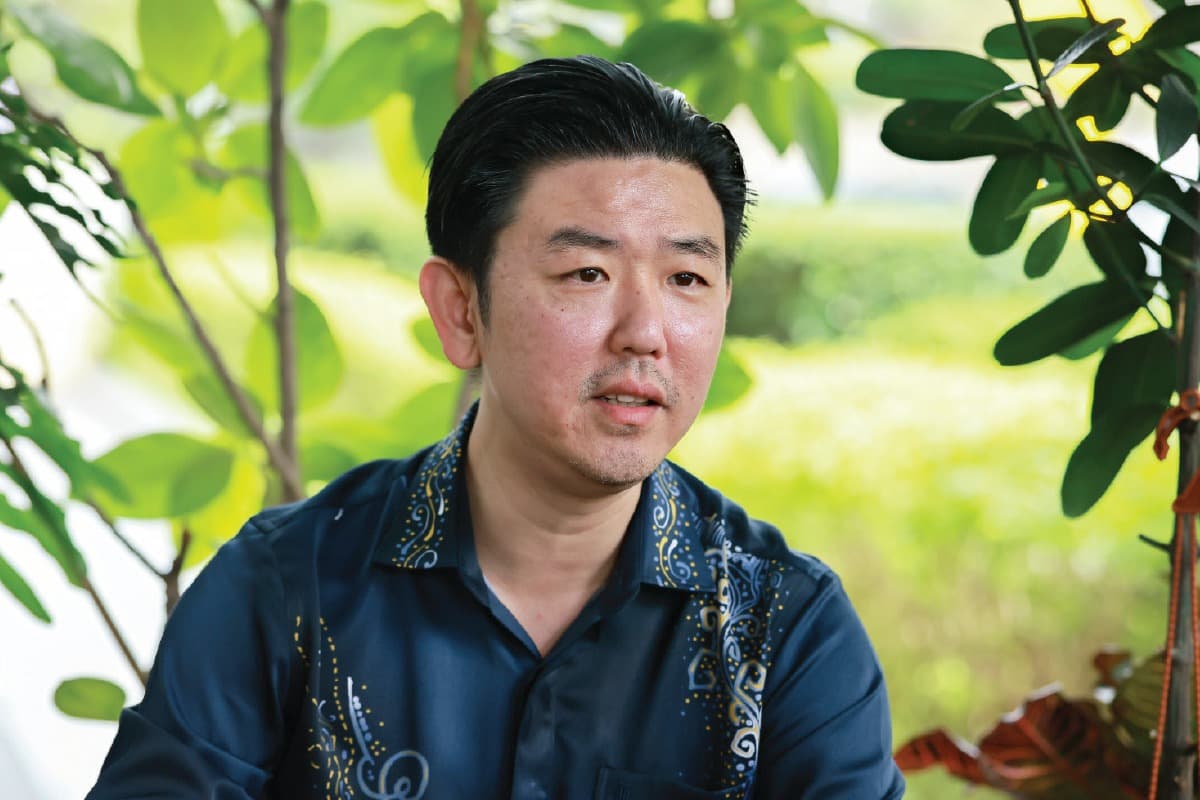
Managing director Stanley Lim Yong Lai says the strategy is aimed at improving the quality of West River’s order book rather than simply pursuing project volume.
“Basically, we are shifting to more high-margin work,” Lim says in an interview.
Opportunities are particularly apparent in data centres, where West River estimates net margins can reach 12%, compared with about 5%-6% for its traditional projects.
Lim says the difference reflects the more specialised nature of data centre M&E work and the smaller pool of contractors with the technical capabilities and experience required.
“Data centre projects are different. The requirements are higher and there are fewer players,” he says.
West River has secured two data centre projects so far this year worth a combined RM47.76 million, accounting for about 20% of its outstanding order book of RM200 million.
The group also has a tender book of about RM600 million. Lim puts its historical average success rate at about 8%.
Larger projects, however, come with higher performance bond requirements. Lim says West River typically needs to provide a performance bond equivalent to about 10% of the contract value, making funding capacity an important consideration as the group scales up its order book.
As at end-March, West River had RM4.68 million in cash and RM22.33 million in money market funds, against total borrowings of RM5.01 million, leaving it with net cash of about RM22 million.
Lim believes the current data-centre boom cycle may last another two to three years.
The company is, however, not looking to become overly dependent on data centre projects. Instead, it is using the current boom to build capabilities in other areas of the power and M&E ecosystem.
Lifting margins through high-voltage jobs
One of the more significant developments at West River is certification from Tenaga Nasional Bhd (KL:TENAGA) for high-voltage work, which allows it to pursue substation-related projects.
Lim says the group is looking to participate in 132kV and 275kV work, which he believes offers attractive opportunities given the higher barriers to entry.
Contractors need to meet requirements, including Tenaga qualification, ISO standards, and competency tests for engineers and safety personnel before they can participate in the segment.
The qualification could prove particularly timely as Malaysia expands its power infrastructure to support data centres, renewable energy and industrial activity. The rollout of renewable energy projects will also require substations and other grid infrastructure to connect new generation capacity to the electricity network.
For West River, this creates a potential second leg of growth alongside data centre M&E work.
Lim expects the group’s overall net profit margin to progressively improve over the coming years, compared with around 5% to 6% currently, as higher-margin projects account for a greater share of its business.
Another margin-accretive initiative is the group’s move to manufacture its own electrical panels and distribution boards.
The manufacturing operation currently supplies only to West River’s own engineering projects. The group also plans to expand production as its project portfolio grows.
The move is intended not only to improve gross margins but also to give the company greater control over procurement and project execution.
Lim estimates that its in-house manufacturing capability could improve gross margins by about two to three percentage points from the current level of around 12%.
“The first is margin, and the second is that we can control [the supply],” he says.
Greater control over equipment supply could become increasingly important as West River takes on larger and more technically demanding projects, where delivery schedules are critical.
Raw material costs remain a potential headwind, with copper prices being a key factor for the group. Lim says the sharp movement in material prices had affected margins, but the impact has become more manageable.
West River’s changing project mix is also reflected in its business exposure.
Residential projects currently account for about 44% of its business, while commercial and industrial projects account for about 19% and 36%, respectively.
The group is gradually moving away from conventional residential work and directing resources towards commercial and industrial jobs with higher technical requirements such as hospitals, semiconductor facilities and other high-tech industrial projects.
The semiconductor market remains a relatively new area for West River, with Lim describing its current projects as a step towards gaining a foothold in the sector.
“We are still not a main player,” he says. “But we are penetrating in, and there are a lot of opportunities.”
West River is also becoming more selective in the projects it bids for as it seeks to improve the profitability of its order book. While the group continues to pursue projects from existing customers where returns are attractive, it is prioritising new projects that offer better margins and align with its technical capabilities.
The approach underlines the group’s focus on improving the quality of its order book rather than simply growing its size.
Another differentiator for West River is its proprietary Internet of Things system, which focuses on energy management, particularly for air conditioning systems. As air conditioning is one of the largest energy consumers in many commercial buildings, the technology has the potential to help customers reduce electricity consumption.
Lim says the system serves as a value-added offering alongside West River’s M&E services, allowing the group to provide customers with more than just installation work.
The business is still at an early stage, however, and the immediate focus is on deploying the technology and building customer adoption rather than generating recurring fees.
Beyond its core M&E business, West River is developing two mini-hydropower projects with a capacity of about 7.2MW and 4.5MW.
The group has secured Feed-in Tariff (FiT) approval under the Sustainable Energy Development Authority Malaysia (SEDA) framework, with the projects eligible for 21-year power purchase arrangements at tariffs of nearly 34 sen per kWh from August 2031.
The projects could eventually provide West River with a recurring earnings stream while allowing it to capture a portion of the M&E work involved in their development.
Lim estimates M&E could account for up to 40% of the cost of a mini-hydropower project.
From post-IPO disappointment to recovery
The shift in strategy comes after a difficult financial year ended Dec 31, 2025 (FY2025) for West River, during which weaker project activity and margin compression weighed on its earnings and share price.
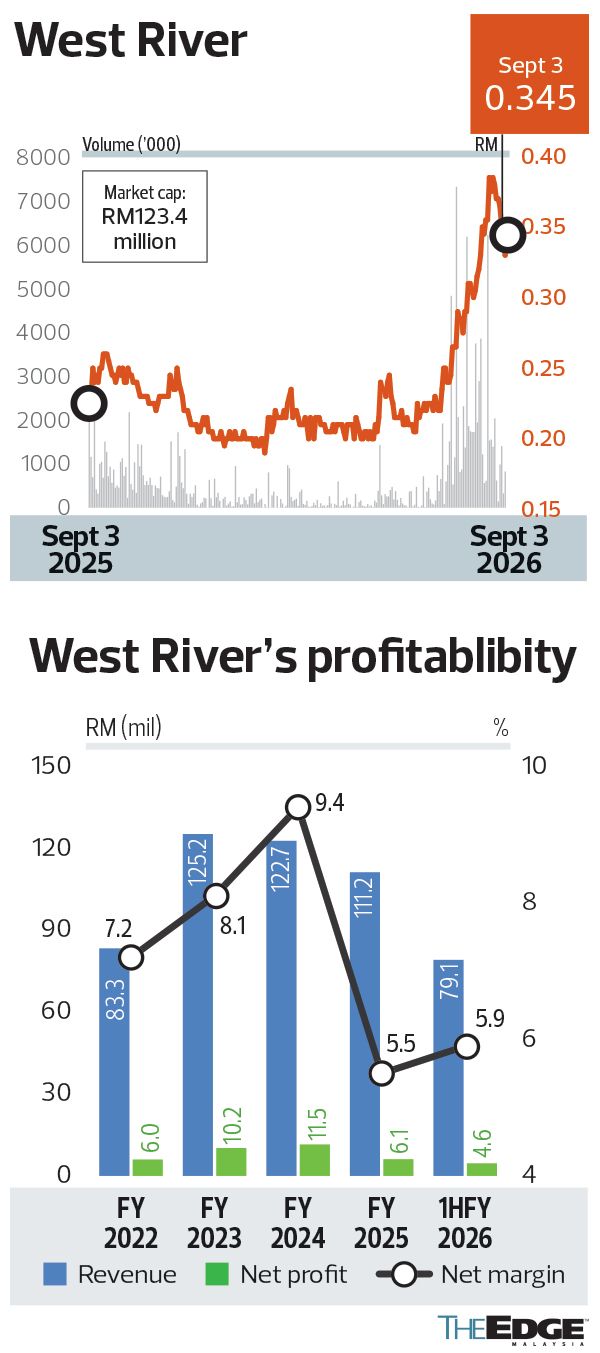
The company, which debuted on Bursa Malaysia in April 2025 at 39 sen per share, saw its share price hit a low of 19 sen following the announcement of the weaker financial results.
Revenue fell 9.4% to RM111.2 million in FY2025 from RM122.7 million a year earlier, as several major M&E projects moved into the final stages of installation, testing and commissioning.
Gross profit declined 25.9% to RM13.9 million, with gross margin narrowing to 12.6% from 15.3%, amid higher material and subcontractor costs, and a less favourable project mix.
Net profit fell 47.1% to RM6.1 million, while net profit margin shrank to 5.5% from 9.3%. The decline was also partly due to RM600,000 in non-recurring initial public offering (IPO)-related expenses.
The weaker FY2025 performance stands in contrast to West River’s strong growth between FY2021 and FY2024. Revenue more than doubled from RM55.3 million in FY2021 to RM122.7 million in FY2024, while net profit rose from RM3.7 million to RM11.5 million. Net profit margin improved steadily from 6.6% to 9.3% over the same period.
The earnings decline subsequently weighed on investor sentiment, but the company appears to be turning a corner.
For 1HFY2026, West River reported a 56% increase in revenue to RM79.07 million from RM50.67 million a year earlier, while net profit jumped 81.6% to RM4.63 million from RM2.55 million.
Its shares have also staged a sharp recovery, rising nearly 80% over the past month from around 22 sen to 39 sen, its IPO price. The shares closed at 34.5 sen last Thursday, valuing the company at RM123.4 million.
In a non-rated report published on July 23, RHB Investment Bank pegged West River’s fair value at 45 sen, based on a forward price-earnings ratio of 13 times.
The brokerage estimates that the company could generate RM12.3 million in net profit on RM160 million revenue in FY2027, implying a net profit margin of 7.7%.
With a workforce of about 90 people, West River believes it can accommodate a 30% to 40% increase in revenue with its existing resources, providing room to scale without a corresponding increase in overheads.
Its current earnings visibility stands at around two to three years, but Lim acknowledges that the data centre boom will eventually moderate.
For now, the group is focused on making the most of the current investment cycle while maintaining the financial flexibility to pursue opportunities beyond it.
It is also keeping an eye on capital returns. While capital is likely to remain focused on growth for now, Lim says West River could consider dividends once its cash reserves reach about 25% of revenue.
Lim remains West River’s largest shareholder, with a 63.97% stake comprising a 21% direct equity interest and 42.97% held through investment vehicle Neutron Capital Sdn Bhd.
Save by subscribing to us for your print and/or digital copy.
P/S: The Edge is also available on Apple's App Store and Android's Google Play.