


This article first appeared in The Edge Malaysia Weekly on September 7, 2026 - September 13, 2026
MAIN Market-listed Techbond Group Bhd (KL:TECHBND) is trying to do more, with less. Over the past three years, the adhesive manufacturer has cut loose the low-margin, high-volume lines that once padded its top line. Instead, the group is now betting that its packaging and polymer business will carry growth into the future.
Techbond manufactures adhesives for industries that include woodworking and paper and packaging. Woodworking has been its largest segment since it was founded in the mid-1990s, followed by paper and packaging, which it diversified into in 2007.
Group CEO Lee Seh Meng attributes the focus on paper and packaging to the segment’s resilience compared to Techbond’s other end-markets that include woodworking, automotive, building and construction, personal care and tobacco. “Especially during the MCO (Movement Control Order) Covid-19 period, we realised that this particular segment is quite recession-proof compared to the other segments,” he says.
Paper and packaging is expected to be one of Techbond’s key growth drivers for its financial year ending June 30, 2027 (FY2027).
MAC restructuring
Techbond’s most significant portfolio move in recent years was its complete exit from urea-formaldehyde adhesives at its wholly-owned subsidiary Malayan Adhesives and Chemicals Sdn Bhd (MAC).
In 2022, Techbond agreed to acquire MAC for RM57 million cash from ChemQuest Sdn Bhd in a deal that was completed in February 2023. ChemQuest is majority-owned by PPB Group Bhd (55%), with the remaining 45% held by Kuok Brothers Sdn Bhd. Separately, PPB currently holds about 15.4% of Techbond.
MAC’s legacy urea-formaldehyde-based adhesives are used as binding agents in the production of particle boards and medium-density fibreboards for the woodworking industry.
This line had once contributed more than RM20 million in annual sales, but Lee calls it “a very high risk, low margin arena”. The end product has a shelf life of only three weeks, so any drop in customer orders would leave Techbond holding obsolete stocks.
The market was thinning even as Techbond stepped away from it: two of Malaysia’s large urea-formaldehyde producers shut down their plants last year alone.
The exit ahead of the Iran-Israel conflict also proved timely as it spared the company from the ensuing spike in urea prices. Bloomberg data shows that urea prices rose nearly threefold over the period, although the prices have since come down. Urea prices were lifted not only by demand from adhesive producers, but also by its much broader use as a nitrogen fertiliser.
At the time of its acquisition, MAC was generating about RM2 million-plus in profit on RM47 million in sales, yielding a margin of less than 5%.
Lee says that excluding a write-off in FY2026, MAC’s margin has improved into higher single digits. A heavy capex cycle has also weighed on MAC’s margins since its acquisition as the group refurbished some 60-year-old plant equipment and installed solar panels.
Talking about what’s next, Lee says MAC has new production equipment sourced from China that is expected to start contributing to revenue in November. He believes double-digit MAC margins are achievable once the equipment is running efficiently, as the lower margin lines have been cut.
A record year by design
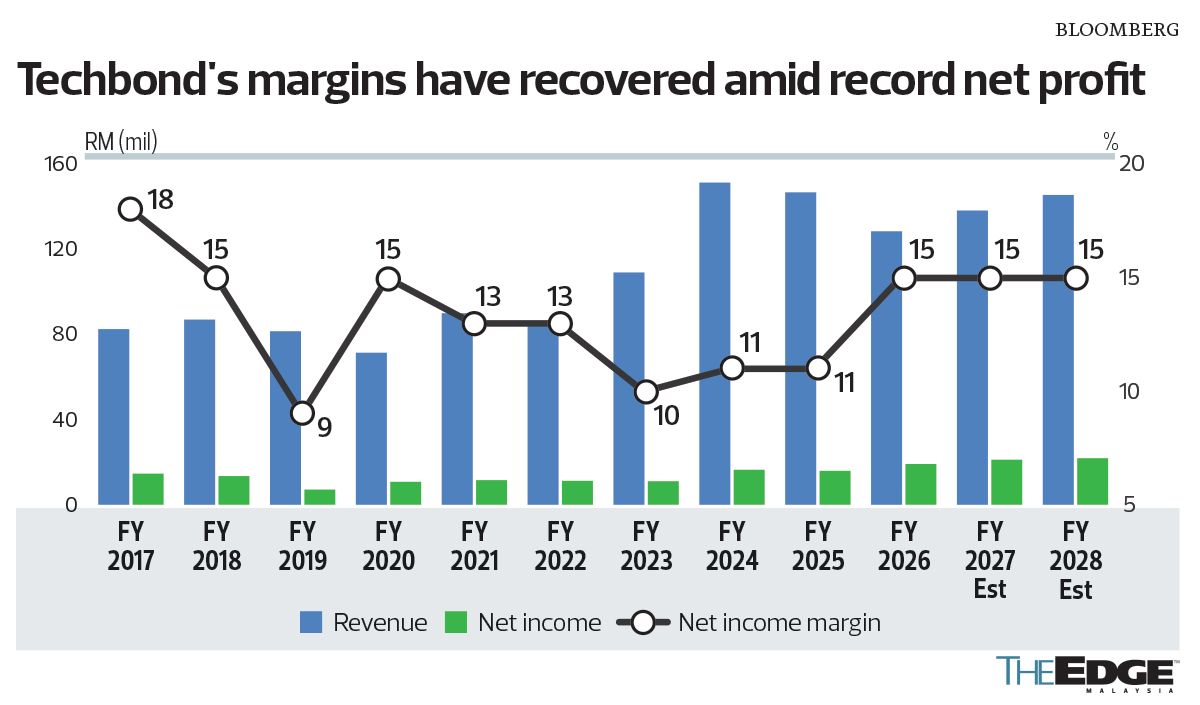
In FY2026, Techbond’s revenue fell 12.4% to RM128.3 million from RM146.5 million in FY2025, although net profit attributable to owners rose to about RM19.1 million in FY2026 from RM15.9 million in FY2025.
Lee is direct about the trade-off. “We are not planning to bring back the volume we cut. That was a deliberate decision and it is the reason FY2026 delivered a record net profit of RM19.1 million even though revenue was lower,” he explains.
Lee attributes the decline in revenue specifically to the chemical business, not the group at large: “For FY2026, it was the chemical business that pulled the top line down. Our adhesive business grew during the year.” Export sales also grew, he says, though this was masked at the reported level by the translation of foreign currency-denominated revenue. On a constant-currency basis, revenue was higher year on year.
Gross margins, meanwhile, expanded to 30.3% in FY2026 from 26.7% a year earlier, even as gross profit in absolute terms looked roughly flat on paper. Lee ascribes that to the same MAC write-off mentioned above, tied to old, inefficient equipment being phased out. Stripping out the write-off, underlying gross profit actually rose.
Elsewhere, of the group’s roughly RM4 million rise in pre-tax profit this year, finance income increased by RM2.4 million. Lee says this is a sustainable contributor, not a one-off gain flattering the numbers. “If we are not putting the cash in the bank, we will put it into investment that probably [is] higher than this income,” he says.
On plant utilisation, that of the group’s polymer plant in Vietnam currently stands at 40% to 50% while that of its hot-melt plant in Shah Alam is 70% to 80%, based on a single-shift calculation.
Capital allocation
Listed in late 2018, Techbond has paid dividends consistently since FY2020, having formalised a policy to distribute up to 30% of its net profit in 2019. Techbond’s dividend payout ratio stood at about 48% of net profit in FY2025, based on declared dividend per share against earnings per share, higher than the roughly 30% payout in FY2026. Techbond ended FY2026 in a net cash position of about RM121.8 million, according to Bloomberg data.
Much of that cash is earmarked for the group’s newly acquired industrial land at Eco Business Park 7 in Negeri Sembilan, which was bought in November 2025 for a total of RM27.76 million. Three parcels of industrial land were acquired, spanning nine acres. The first phase of expansion will only be using three acres. Techbond is awaiting the Malaysian Investment Development Authority’s approval before committing to the scale of investment there.
For FY2027, as highlighted by analysts covering Techbond, management has guided for 10% to 15% growth in net profit attributable to owners. However, street estimates are pricing a more conservative outlook of around 10.5% to 11.5% in FY2027.
Lee singles out packaging and polymer as the “easier and faster” growth levers since both are ready-commercial products. The friction here is that qualifying new customers can take six months to a year under international ASTM testing standards. Once won over though, these customers are hard to dislodge since competitors face the same rigid qualification cycle.
Packaging made up 27% of group revenue, up from 20% in FY2025.
The group’s export reach has also broadened materially, with the countries it exports to rising to more than 30 today from 14 in 2018. Domestically, Techbond’s woodworking-linked sales have been squeezed by rising costs and a stronger ringgit. Lee says overseas growth, particularly in Indonesia and Vietnam, where Techbond is also well established, has more than offset domestic softness.
Despite the portfolio optimisation and record profit, Techbond’s share price has yet to respond.
At its close of 28.5 sen last Friday, the stock was down 8% year to date and about 17% below its Bloomberg-adjusted price at its listing of 34.5 sen, giving the group a market capitalisation of about RM216.3 million.
Part of the disconnect may be structural: At 27%, Techbond’s free float sits only narrowly above Bursa Malaysia’s minimum 25% public shareholding spread requirement for Main Market-listed companies. That is thin enough that the stock may struggle to draw sustained institutional interest, record profit or not.
Further risk lies in unfavourable foreign exchange movements. According to Lee, Techbond deals in US dollars in Indonesia and in Vietnamese dong in Vietnam, exposing the group to two separate currency dynamics rather than one.
Still, coverage of the counter remains positive, with three active “buy” calls and a 12-month consensus target price of 37 sen.
Save by subscribing to us for your print and/or digital copy.
P/S: The Edge is also available on Apple's App Store and Android's Google Play.