

This article first appeared in The Edge Malaysia Weekly on August 31, 2026 - September 6, 2026

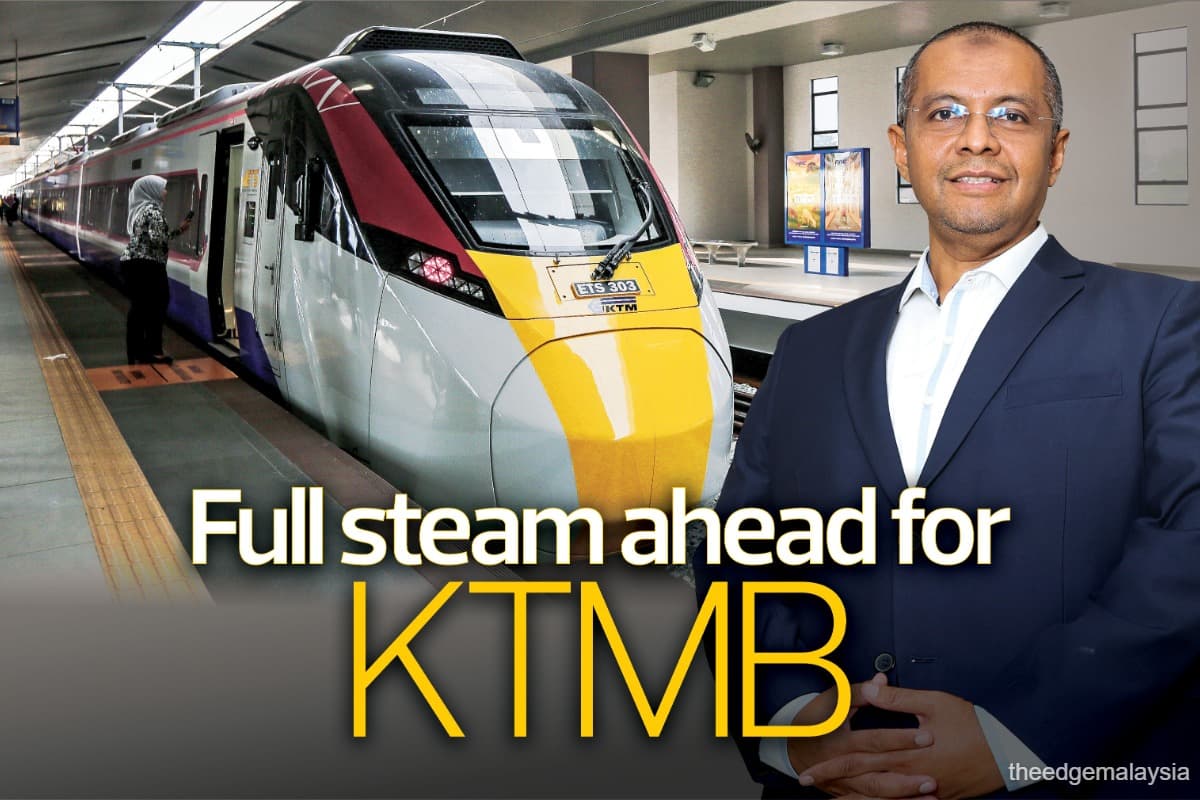
DATUK Azlan Shah Al Bakri is a man in a hurry. The new group CEO of Keretapi Tanah Melayu Bhd (KTMB) has given himself two years to turn around the loss-making national railway operator and put it on a firmer financial footing.
His targets are ambitious: achieve positive free cash flow this year and return the company to operating profit within two years.
The challenge comes after a sharp reversal in the company’s financial performance. For the financial year ended Dec 31, 2025 (FY2025), before Azlan began his two-year tenure on Jan 12, KTMB swung to a net loss of RM24.62 million versus a net profit of RM300.83 million a year earlier.
The deterioration was largely due to finance costs of RM51.37 million and a RM49.82 million penalty for late payment to the Minister of Finance Inc (MOF Inc). Income tax expense also jumped to RM20.13 million from RM1.77 million previously.
As at Dec 31, 2025, KTMB had a deficit in shareholders’ funds of RM1.4 billion. Its current liabilities exceeded its current assets by RM1.55 billion as a result of losses incurred in the current and prior financial years.

One of KTMB’s most immediate goals is to increase revenue. It is aiming for a revenue of RM1.05 billion, a 54% increase from RM680.96 million recorded in FY2025.
The company’s first-half 2026 results show early signs that turnaround efforts under Azlan are starting to bear fruit. Passenger revenue jumped 44% to RM294 million from RM206 million a year earlier.
“What we want is for KTMB to make money. That’s number one. I’m working very hard to increase revenue. But higher revenue does not necessarily translate into profitability at the moment. I think it is doable within two years. I believe we can achieve an operating profit within the next two years,” he tells The Edge in an interview.
“The first six months have shown some positive signs, particularly in terms of cash flow. When I came in, we were running a negative cash flow.”
Azlan, 54, succeeded Datuk Mohd Rani Hisham Samsudin, who was at the helm from 2017 to 2019 and then again from December 2020 to August 2025. Before joining KTMB, Azlan spent six years as director-general of the Land Public Transport Agency (APAD) under the Ministry of Transport (MOT).
His turnaround plan rests on three broad priorities: getting more out of KTMB’s existing assets, expanding revenue beyond passenger fares and cutting costs that he considers non-essential.
Non-fare revenue reached RM32 million in the first half of 2026, up 45% from RM22 million a year earlier.
Azlan wants to push that contribution much higher. KTMB’s target is for non-fare businesses to contribute about 6% of revenue this year and as much as 25% by 2030, driven by cargo, Tenang Capital Bhd and maintenance, repair and overhaul (MRO).
“Plans are being put in place for this year so that we’ll be able to increase our non-fare income,” he says.
Since arriving, Azlan has moved quickly to rein in spending. “We did a lot of cost control when I came in. We stopped spending on unnecessary things. At the very least, we hope we can reward our staff at the end of the year. That’s my intention.”
KTMB employs about 6,000 people across Peninsular Malaysia, roughly half the workforce of Prasarana Malaysia Bhd, which operates the country’s urban rail network, which includes three Light Rail Transit lines, the KL Monorail and the Klang Valley Mass Rapid Transit.
For now, there is no need to increase the workforce, Azlan says.
KTMB is owned by MOF Inc, with the Federal Land Commissioner holding one share.
Obstacles toward a turnaround
Azlan has inherited a railway system facing a number of structural challenges, from ageing infrastructure and service disruptions to the government’s push to reduce KTMB’s dependence on public funding.
Today, KTMB’s public railway network stretches 1,655km across Peninsular Malaysia, serving 84 stations and 68 stops.
“Whoever is spearheading KTMB has to ensure that it’s sustainable. That’s crucial. On the government’s part, it is looking at how they can reduce public funding, and we are working very hard to see how we’ll be able to deliver such results to the government,” he says.
For KTMB, that means finding ways to earn more from the railway beyond passenger fares.
“On our part, we are trying to reduce our dependency on the government by increasing our non-fare base. That would make us more sustainable,” Azlan adds.
The strategy includes making better use of KTMB’s assets and finding new sources of income around its railway network.
Passenger operations, however, have had less room to grow.
KTMB carried 13.2 million passengers in the first half of 2026, an 8% increase from 12.2 million a year earlier.

The relatively modest increase in ridership was largely due to disruptions to KTM Komuter services as KTMB works around the ongoing second phase of the Klang Valley Double Track (KVDT2) project, Azlan says.
The project involves rehabilitating about 265km of existing railway track. Completion was originally targeted for 2029, but KTMB is working to bring that forward to the fourth quarter of 2027.
A line closure between Bangi and Seremban has forced KTMB to cut train frequency and services, weighing on KTM Komuter ridership. The disruption is expected to pave the way for a more reliable network, with frequency, reliability and on-time performance set to improve once KVDT2 is completed and new rolling stock is deployed.
There are already signs of operations becoming more stable. In 1H2026, operational disruptions fell 27%, while the total number of delayed minutes caused by operational disruptions dropped by 40%.
But some of the most persistent threats to reliability are beyond KTMB’s control.
The operator has faced a spate of recent disruptions due to cable theft, infrastructure works, accidents and natural obstacles.
In 1H2026, a total of 44 cable theft cases were recorded, resulting in 11 days of train service disruptions.
In one incident at Batang Benar, Negeri Sembilan, works by an external contractor appointed by the Public Works Department (JKR) collapsed onto the railway line, forcing a 10-hour track closure. More recently, a tanker in Johor fell onto the track, causing another roughly 10-hour disruption. Fallen trees had also interrupted services.
Such incidents carry a cost beyond lost operating time. “They impact our earnings, our reliability and our reputation. That’s not good for us,” says Azlan.
KTMB is working with stakeholders, including Railway Assets Corp (RAC), a federal statutory body under the MOT, to deploy technology that can detect and prevent intrusions along the railway network. The challenge is particularly acute along the southern corridor, where elephants regularly stray onto the tracks in Simpang Renggam.
Azlan says elephant incursions occur roughly every 10 days in some areas. Existing anti-climb fencing has proved ineffective, with elephants pushing through or climbing over the barriers.
KTMB is exploring intrusion sensors and other technologies with RAC to detect movement around vulnerable sections of track and provide earlier warnings before animals reach the line.
Sweating assets, boosting non-fare income
Since KTMB was corporatised in 1992, RAC has owned and managed the railway infrastructure across Peninsular Malaysia, while KTMB has been responsible for running the train services.
The company is organised into four independent cash-generating units: cargo, intercity, commuter and electric train service (ETS).
For Azlan, the economics of the business are straightforward: regulated fares make it difficult for a railway operator to generate a commercial return.
“To make money, in any business, fares must be deregulated. If you regulate fares, you can’t make money.”
He cites KTM diesel-hauled intercity train services, whose regulated fares require the government to provide subsidies to keep it viable. KTM Komuter faces a similar constraint. KTM Komuter trains serve four major routes: Batu Caves-Pulau Sebang, Tanjung Malim-Port Klang, Ipoh-Bukit Mertajam and Butterworth-Padang Besar.
“The government regulates the fares, so we cannot make money from it. The government needs to subsidise it, and that’s how it is,” he says.
But he believes KTMB can still become profitable.
Two parts of the business have deregulated fares — ETS, where Azlan says KTMB is already making money, and cargo, which he is trying to turn into another profitable operation. All 10 of the company’s newly procured ETS trains are now in operation, adding capacity as the operator works to improve the wider network.
For now, however, the government continues to subsidise KTMB’s non-profitable KTM Intercity and single-track, non-electrified routes along the East Coast that connect Gemas in Negeri Sembilan and Tumpat in Kelantan.
The longer-term objective is to reduce that dependence by building businesses that can generate commercial returns.
Betting on freight
Freight is emerging as one of the strongest growth opportunities.
Rather than wait years for government procurement to deliver new locomotives and wagons, KTMB has opted to lease equipment to expand capacity more quickly.
“Because to purchase or procure, it takes years for the government processes. Time is of the essence for us. We can’t wait,” says Azlan.
KTMB has so far leased about seven freight train sets and plans to increase that number to 44 over the next two years. Most of the equipment is leased through RAC, which in turn sources it from SMH Rail Sdn Bhd. KTMB also has a direct pay-as-you-use arrangement with SMH Rail covering cargo wagons and a set number of refurbished locomotives.
Under the arrangement, KTMB pays a daily rate only when the equipment is available and operating, allowing the company to add capacity without taking on the full upfront cost of acquiring new rolling stock.
“We’re looking to increase the capacity as far as leasing is concerned,” says Azlan.
The push comes as demand for rail freight grows.
KTM Kargo’s freight volume rose 22% in 1H2026 to 887,000 tonnes from 724,000 tonnes a year earlier. Container volume increased 11% to 120,000 TEUs (20-foot equivalent units) from 108,000 TEUs.
Road-to-rail volumes climbed 16% during the period, helping revenue from the cargo business rise 12% to RM61.2 million from RM54.7 million.
Key customers include Siemens, YTL Corp Bhd (KL:YTL), MSM Malaysia Holdings Bhd (KL:MSM), Segamat Inland Port and Pelabuhan Tanjung Pelepas Sdn Bhd (PTP), reflecting growing demand for rail as an alternative to road transport.
The government is encouraging the shift from road to rail, particularly for large and heavy freight that would otherwise be transported on highways.
“With the current focus that we have, I believe the cargo business can become profitable within two years,” says Azlan.
But capacity remains a constraint.
“Today, we are not making money yet because the volume is not there. We are running only seven cargo trains based on leasing, while our existing trains are old and need to be refurbished. The downtime is quite high.
Azlan expects that to change as KTMB expands its leased fleet to 44 cargo train sets over the next two years, with at least two additional trains due to come into service each month from August.
The company has also raised freight charges by about 6% from Aug 1. Azlan stresses that such increases are not made annually, but roughly once every three years to give customers greater certainty.
As part of its efforts to expand non-fare income, KTMB is also looking to build businesses around its technical capabilities.
One priority is MRO. KTMB owns a 30% stake in M Rail Technics Sdn Bhd, a joint venture with Destini Bhd (KL:DESTINI) that has been awarded Level 3 and Level 4 maintenance work for ETS trains.
KTMB is exploring further MRO opportunities with partners in India and local companies such as Hartasuma Sdn Bhd, including work involving wheel servicing and production.
“We are negotiating with Hartasuma at the moment. I think it’s quite promising and we hope to start something before the end of the year,” says Azlan.
The company is also looking beyond KTMB’s own network. It is in discussions with the East Coast Rail Link (ECRL) about providing food services and engineering work.
The same approach is being applied to passenger services.
All 10 of KTMB’s newly procured ETS trains are now operating, adding capacity to the intercity network. The company is seeking to generate more revenue from passengers without relying solely on ticket sales. That includes expanding food and beverage (F&B) offerings on board ETS trains.
KTMB currently works with Capital A Bhd’s (KL:CAPITALA) F&B business Santan and Nyonya Treats restaurant group. It is looking to bring in more local brands, including Nasi Lemak Wanjo, Kluang Rail Coffee and Oriental Kopi. The initiative sits under KTMB’s strategic commercial arm Tenang Capital.
Technology is another part of the plan. KTMB is developing its KITS Style mobile application, which allows passengers to book train tickets, manage trips and purchase food on a single platform.
The idea is to turn the railway journey itself into a larger commercial opportunity, from the ticket to the meal and the services surrounding it.
Legacy burden
KTMB’s financial position presents perhaps the biggest hurdle in Azlan’s turnaround plan. The company’s FY2025 annual report shows RM1.6 billion of debt as at Dec 31, 2025, while accumulated losses stood at RM2.76 billion.
Cash balance, meanwhile, rose to RM146.65 million at the end of 2025, from RM86.7 million a year earlier.
The balance sheet also included RM49.8 million in penalties for late payment to MOF Inc.
Much of the debt dates back decades.
“In the 1990s, KTMB took a corporate loan amounting to over RM800 million. From there on, we have never paid. As a result, the corporate loan from RM800 million has snowballed to RM1.3 billion,” he explains.
The borrowings were used to procure commuter train sets and upgrade systems, including work related to the Y2K computer, commonly known as the “millennium bug”, transition, he says.
The loans were never repaid because KTMB could not afford to service them, leaving the company with a legacy burden that has continued to weigh on its finances.
Azlan says KTMB is now negotiating with MOF Inc to have loans and borrowings with a carrying value of about RM1.47 billion written off.
“We have a few legacy issues that we’re trying to solve,” he adds.
At the same time, KTMB is negotiating with its lenders to lower the cost of its bank borrowings. Its finance costs rose sharply in FY2025 to RM51.37 million, contributing to the company’s return to a net loss.
The problem is compounded by the economics of its regulated passenger services.
The last fare review for KTM Komuter’s northern routes was about 20 years ago. Passengers pay about 10 sen per km, leaving the government to cover part of the cost of operating the service as well as KTMB’s East Coast routes.
“That’s why we still need to get [a] subsidy from the government to fund our KTM Komuter and the East Coast routes. But I don’t think it’s fair for the government to keep funding us,” says Azlan.
He has proposed a phased increase in KTM Komuter fares, with the aim of narrowing the gap between operating costs and revenue. The proposal has been submitted to the government, with a cabinet paper still in progress.
If approved, Azlan expects the fare increases to reduce the funding gap over time. Transport Minister Anthony Loke has said RM257 million is required annually to maintain the railway assets managed by KTMB.
Azlan draws a distinction between the parts of KTMB’s network that serve a public-service function and those that can operate commercially.
“Just give us time and we’ll be able to do it. However, as far as the East Coast segment is concerned, I think that will remain as a service to the rakyat and it shall be subsidised by the government. As far as the ETS and cargo businesses are concerned, there should not be any subsidy from the government because we’re making money for ETS.”
_20260907113345_929ni0.jpg)
KTMB is also seeking to expand its ETS fleet.
The company is negotiating with the government to deploy at least another 10 to 12 train sets. MOF Inc has appointed UEM Group Bhd to examine the commercial arrangements and negotiations are continuing.
Azlan expects the additional rolling stock, alongside more commuter trains, to begin changing the economics of the business within two years.
“I expect the company to return to net profit and generate positive cash flow, with the funding gap narrowing in phases over the next five years,” he says.
The timetable is ambitious, particularly for a company carrying decades of accumulated losses and debt. It also faces a delicate balancing act: persuade the government to restructure its legacy debt and continue supporting services that are difficult to operate commercially, while simultaneously building profitable businesses that can reduce its dependence on public funding.
The test will be whether those new businesses can grow quickly enough to help deliver the two-year turnaround Azlan has promised.
Save by subscribing to us for your print and/or digital copy.
P/S: The Edge is also available on Apple's App Store and Android's Google Play.