


(Sept 4): US treasuries fell after US job growth topped forecasts in August, prompting traders to nudge up expectations that Federal Reserve officials raise interest rates later this month.
The selloff on Friday pushed yields higher across maturities, led by an eight-basis-point climb in the two-year, which is more sensitive than longer-dated tenures to Fed rate changes. It hit 4.416% and the five-year yield touched 4.58%, their highest levels since January 2025, before paring the moves.
“What this report has done has shown the labour data is not any type of impediment to a rate hike,” said Kevin Flanagan, head of investment strategy at WisdomTree. Inflation data “takes centre stage and that report will determine whether the Fed hikes or not.”
Swap contracts linked to the Fed’s mid-September policy decision priced in 16 basis points (bps) of a quarter-point increase, up from around 13bps prior to the release. The market reflects a cumulative 38bps worth of rate hikes by the end of the year, implying one hike and a roughly 50% chance of another.
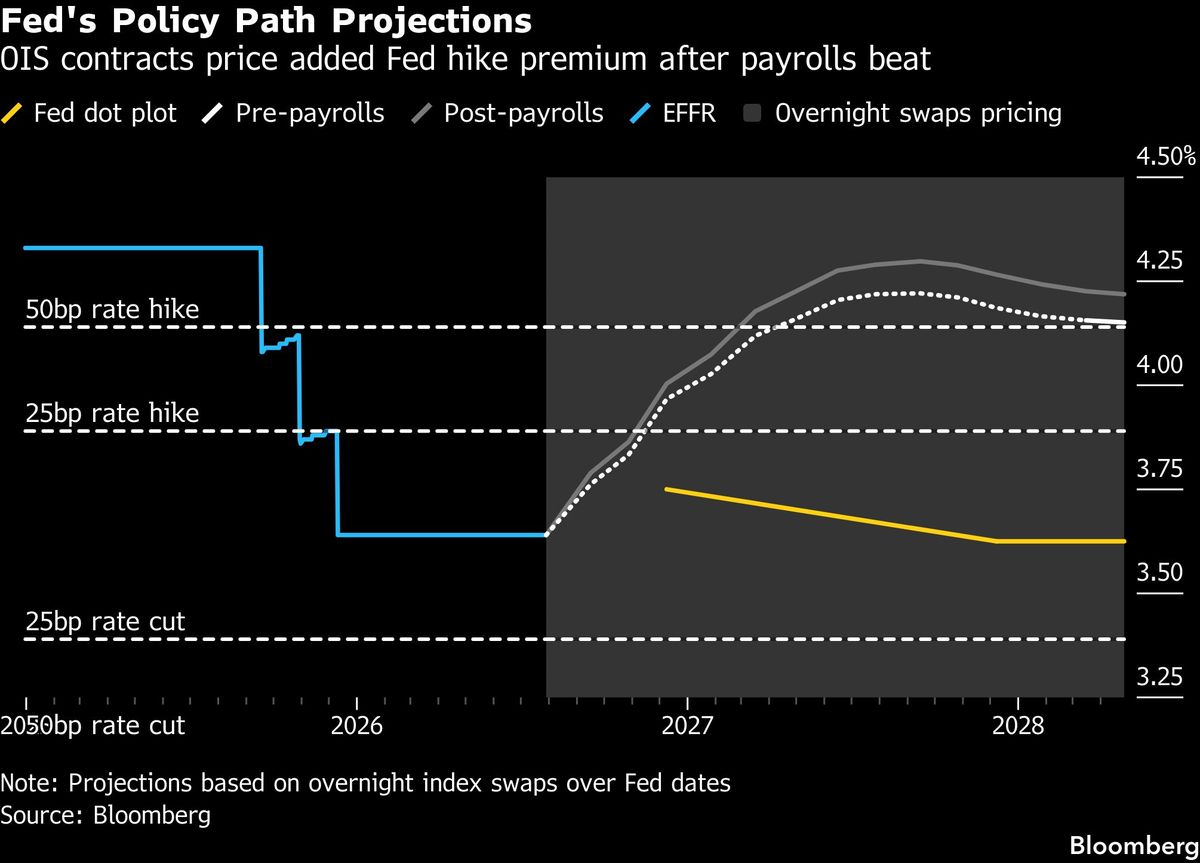
Non-farm payrolls increased 162,000 last month after upward revisions to the prior two months, according to Bureau of Labor Statistics data out on Friday. That topped all estimates in a Bloomberg survey. The unemployment rate remained at 4.1%.
While the data itself supports the argument for higher US borrowing costs, there’s heightened focus on inflation, which has exceeded the Fed’s target for the past five years. Bloomberg Economics expects next Friday’s reading of consumer prices for August to show headline inflation accelerating steadily at 3.4% annually, while the core metric ticks down to 2.4% — leaving central bankers led by chairman Kevin Warsh on hold this month.
A September rate hike is “all conditional on that inflation report and what the forward looking trajectory is coming from energy prices,” Jeffrey Rosenberg, portfolio manager at BlackRock told Bloomberg Television. “If inflation is continuing to show progress, then it’s a hold.”
One of the standout trades in Secured Overnight Financing Rate options after the data reflected a position targeting the Fed staying on hold for the rest of the year.
Ahead of next week’s inflation data, a deluge of corporate bond issuance and a treasury auctions post-Labor Day also stand to pressure yields next week. Focus is also on a buyback next week after Treasury Secretary Scott Bessent surprised investors with a mid-August announcement of plans to boost the operation’s size for longer-dated securities.
Earlier in the week, the 10-year benchmark yield hit a three-year high as soaring energy prices added to the momentum from hawkish comments from Federal Reserve chairman Kevin Warsh. Bonds then rallied, pulling the yield lower, following remarks on Thursday suggesting inflation may be slowing from governor Christopher Waller.
“Pricing for September’s meeting is not materially higher, signalling that similar to Waller’s messaging yesterday [Thursday], markets will be waiting on next week’s CPI print to settle on the Fed’s likely action in September,” said Molly Brooks, a US rates strategist at TD Securities.
“A hot jobs report was enough to raise rate hike bets and induce a significant bear flattening move across treasury yields as data prints gain in importance during a period of less forward guidance under new Federal Reserve chairman Kevin Warsh. That puts pressure on Warsh to follow through on hawkish Jackson Hole rhetoric given a hold against the global tide of tightening could steepen the US yield curve,” says Edward Harrison, Macro Strategist, Markets Live at Bloomberg Strategists.
It’s been a volatile period for bond markets globally. European sovereign debt bore the brunt of a resurgence in gas prices as fighting flared between the US and Iran, stoking fresh concerns over inflation.
A proposal by Norway’s sovereign wealth fund to reduce its allocation to government bonds — particularly US treasuries — in its US$2.3 trillion (RM9.3 trillion) portfolio, was also in focus on Friday.
Government securities would be cut to 50% of the bond portfolio from 70%, while exposure to riskier debt would be increased, Norges Bank Investment Management said in a letter sent to the Ministry of Finance.
Uploaded by Felyx Teoh