

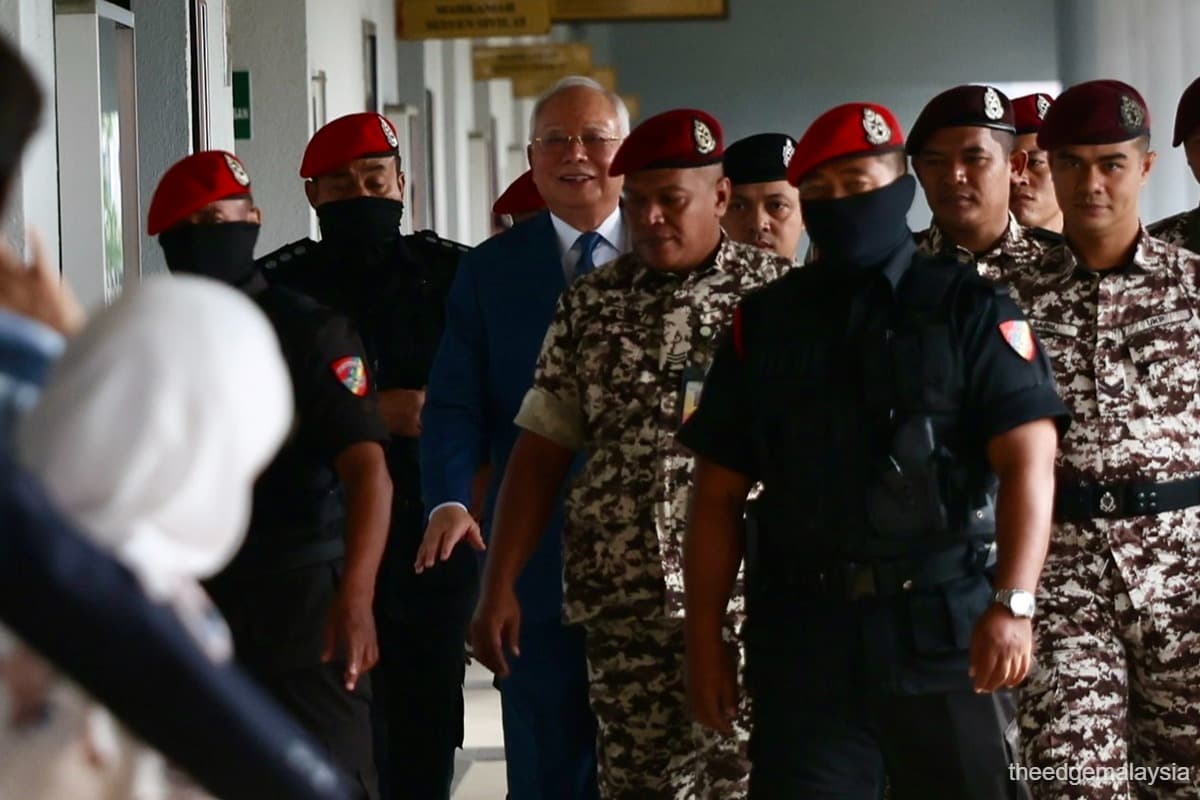
PUTRAJAYA (Sept 4): The Court of Appeal (COA) has allowed former prime minister Datuk Seri Najib Abdul Razak and his son to pause Inland Revenue Board's (IRB) bankruptcy notice against them.
A three member bench headed by Datuk Alwi Abdul Wahad and flanked by Datuk Shahnaz Sulaiman and Datuk Ong Chee Kwan had given their decision, stating Najib and his son Datuk Nazifuddin Najib’s appeal to stay their bankruptcy notice pending their case at the Special Commissioners of Income Tax (SCIT) was allowed.
“So in conclusion for all the above reasons, Appeal 61 is allowed and bankruptcy proceedings are stayed pending disposal of the appeal before the SCIT,” Abdul Wahab said in the bench’s unanimous decision.
The bankruptcy notice was issued by the IRB as a result of Najib’s unpaid additional assessment of close to RM1.7 billion and RM 37 million owed by Nazifuddin.
This appeal follows a High Court decision last November, which ruled that there was insufficient grounds to grant a stay despite their case being pending at the SCIT.

The appeals challenged a lower court’s refusal to grant a stay, which was initially based on the principle that tax debts must be paid before they can be disputed.
However, in Friday’s decision, the COA found that the judge failed to consider serious legal issues, including potential double taxation and claims that much of the debt was statutorily time-barred.
The court emphasised that while tax collection is vital, the discretion to grant a stay must be used to prevent irreversible personal and political harm.
Consequently, the bankruptcy actions are paused until the SCIT can formally resolve the underlying financial disputes.
The bench held that while the Income Tax Act (ITA) “pay first, dispute later” model is standard, courts retain the inherent jurisdiction to stay bankruptcy proceedings if sufficient grounds are demonstrated to prevent injustice.
Alwi also held that bankruptcy at this juncture would cause damage far beyond mere monetary loss for Najib.
He said it would cripple Najib’s ability to pursue his statutory appeal at the SCIT and automatically stay numerous other pending criminal and civil proceedings, disrupting the administration of justice.
“It is pertinent to observe that the additional tax assessment raised by the IRB are not final, being subject to review on the merits before the SCIT.
“In light of this non-finality, coupled with the challenges mounted by Najib, grave prejudice would ensue if the bankruptcy proceedings were permitted to advance to the stage of issuing a bankruptcy order,” he said.
The two men had applied for the stay on the grounds that the actual merits of the additional tax assessment is still at the SCIT stage. They want the SCIT hearing to go on before any determination is made on the bankruptcy proceedings.
The SCIT proceedings for Najib’s case is set for later this month and Nazifuddin’s case is slated for October.
The COA on Friday said that such an order of bankruptcy would “cripple” his appeal before the SCIT, thereby rendering his rights nugatory.
“We of the view that the harm occasioned cannot be adequately rectified or remedied by a subsequent refund should the SCIT ultimately re-evaluate and adjust the assessment in Najib’s favour,” Alwi read.
The court explicitly rejected the High Court’s view that a tax refund under Section 111 of the Income Tax Act was a sufficient remedy, stating that bankruptcy carries "irreversible consequences" far beyond mere monetary loss.
In its conclusion, the bench noted that while "balance of justice" favoured a stay, the government would not be prejudiced, as it remains entitled to collect the tax once the SCIT comprehensively determines the final liability.
While the "pay first, dispute later" framework is designed to secure revenue, the court emphasised it is not an absolute bar to judicial intervention when necessary to prevent injustice.
Breakthrough ruling for taxpayers
Speaking to reporters post-hearing at the Palace of Justice, counsel for Najib and Nazifuddin, Muhammad Farhan Shafee, described the ruling as a significant relief and a clear pathway for his clients to pursue their defence in the proper manner down the road.
"Both these tax assessments have never been determined on the merits before in any court," Farhan explained. "Today, the Court of Appeal very clearly stated that the two tax assessments against Datuk Seri Najib and also Datuk Nazifuddin are not final and are still subject to determination by the Special Commissioners of Income Tax (SCIT)."
Farhan noted that under the standard operation of the ITA, IRB can immediately enforce assessments in court regardless of pending disputes.
However, the appellate court recognised the severity of allowing bankruptcy enforcement before the merits were heard.
"The court has found that in both assessments, there are very novel issues that need to be determined first at the Special Commissioners before any enforcement, including bankruptcy proceedings, can proceed," Farhan said.
"The reason why they've said this is because the effect of bankruptcy can be irreparable and cause irreversible damage to both Datuk Seri Najib and Datuk Nazifuddin."
When asked if the ruling establishes a broader legal model given the rigid nature of current tax laws, Farhan highlighted the decision’s wider significance. "It is certainly a breakthrough decision. I personally think it actually balances the scale between revenue and the taxpayer. So this not only benefits the two appellants today, but it benefits the public at large, especially when there are situations and novel issues to be decided at the Special Commission," he said.