

(Sept 4): The financial strain facing some of Indonesia’s biggest state-owned construction firms, rooted in former president Joko Widodo’s infrastructure drive, risks forcing current leader Prabowo Subianto’s sovereign wealth fund Danantara to spend more to overhaul them, potentially limiting its ability to pursue new investments.
PT Adhi Karya, one of the Southeast Asian nation’s top builders, said it missed paying about 60.8 billion rupiah (US$3.4 million or RM14 million) of bond interest that fell due last week. The company said it’s currently undergoing restructuring to ensure business continuity and it’s arranging another meeting with bondholders on Sept 11 to effectively free Adhi from any potential liability arising from the missed payment.
Such situations among state-owned enterprises are raising the risk that the cost of cleaning up troubled firms could curb Danantara’s investment push. The 18-month-old wealth fund manages more than 800 SOEs — which it’s seeking to cut to about 200 — and controls assets that officials value at roughly US$900 billion (RM3.64 trillion).
“Adhi Karya is a large SOE and therefore more likely to receive Danantara’s support,” said Lakshmanan R, head of South, Southeast Asia & GCC Corporates at CreditSights in Singapore. “There could also be an impact on Danantara’s investment arm, with less capital available for new investments, and a need for more borrowings amid potentially higher borrowing costs.”
Adhi is among state builders that Danantara is seeking to consolidate as part of a broader revamp of the construction sector, a process that has been slowed by their billions of dollars in debts and financial problems extending into their subsidiaries.
Widodo, also known as Jokowi, left office nearly two years ago but his decade-long reign that tasked government contractors with building toll roads and highways left them with massive liabilities.
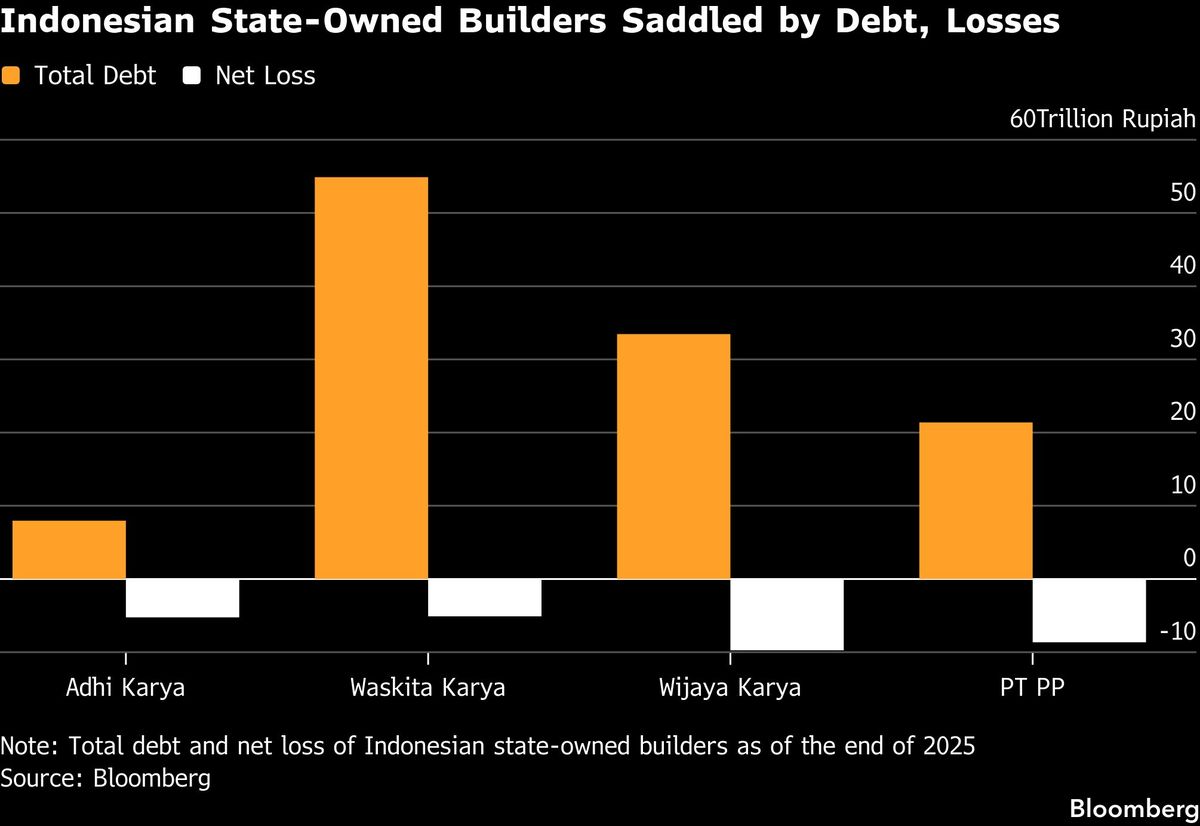
Total debt at four of the country’s biggest state builders surged 12-fold to about 124 trillion rupiah under Widodo’s term, with companies including PT Waskita Karya, PT Wijaya Karya, and now Adhi, struggling to meet their obligations.
Their combined debt has dropped slightly to nearly 118 trillion rupiah at the end of last year, according to data compiled by Bloomberg. That’s close to the amount the wealth fund is expected to remit to the government this year — 120 trillion rupiah — mainly from the dividends of state-owned firms, marking the first time some funds are returned to state coffers since Danantara’s creation in 2025.
Representatives for Adhi Karya, Danantara, Widodo, Waskita Karya and Wijaya Karya didn’t immediately respond to requests for comment.
On Friday, Waskita Karya said bondholders have approved a plan to extend the maturity of a 1.36-trillion rupiah bond it issued in 2019 to 2034, according to a stock-exchange filing. The bond originally fell due in May 2024.
Since 2023, the company said it has cut its debt by 21% to 66.5 trillion rupiah. “This step reflects both our sense of responsibility and our support for the partners who have helped us complete various infrastructure projects,” Waskita’s Finance Director Wiwi Suprihatno said.
Danantara has inherited a “genuine balance-sheet problem” with the state-run builders, said Alessandro Gazzini, managing director at consulting firm Alvarez & Marsal in Jakarta. But the problems are likely concentrated in the construction industry rather than indicative of financial stress across Indonesia’s entire state-owned enterprises.
While a restructuring at Adhi can be funded as demonstrated by Danantara’s 23.7 trillion rupiah capital injection into PT Garuda Indonesia last year, Gazzini said this means “every rupiah of repair now competes with its investment mandate”.
Distressed assets
“Distressed asset management seems outside of Danantara’s direct mandate,” said Mary Ellen Olson, senior analyst at Bloomberg Intelligence. With the fund financed by the dividends and borrowings, it probably lacks the resources “to be a bailout vehicle for all distressed assets”, she said.
Financial strains have emerged at other SOEs. Postal operator PT Pos Indonesia identified nine trillion rupiah of accounting adjustments covering 2023 through 2025 to clean up its books after missing a 24.1 billion rupiah sukuk coupon payment in July. It has subsequently paid the delayed coupon along with additional compensation to investors.
The cost of restructuring troubled SOEs is likely to spill over to state-owned banks which are their main lenders. “Banks may have to extend loan maturities, take haircuts, face missed interest payments and carry stressed exposures for longer, which could lead to higher non-performing loans and deterioration in asset quality,” said CreditSights’ Lakshmanan.
Private-sector borrowers are also increasingly turning to the same domestic funding pool as how some property developers have to done to repay offshore bonds. PT Jababeka used long-term financing from PT Bank Mandiri to repay US$185.9 million of dollar notes in June and PT Modernland Realty is seeking to restructure about US$274.5 million of dollar bonds due next year for a third time in five years.
That growing reliance on domestic funding means the restructuring of troubled SOEs could have consequences beyond the public sector, as Danantara and the state companies compete with private borrowers for financing from a banking system dominated by government-owned lenders. That means the funding pool for the private sector “will be potentially shrinking”, said Gazzini from Alvarez & Marsal.
Uploaded by Chng Shear Lane