

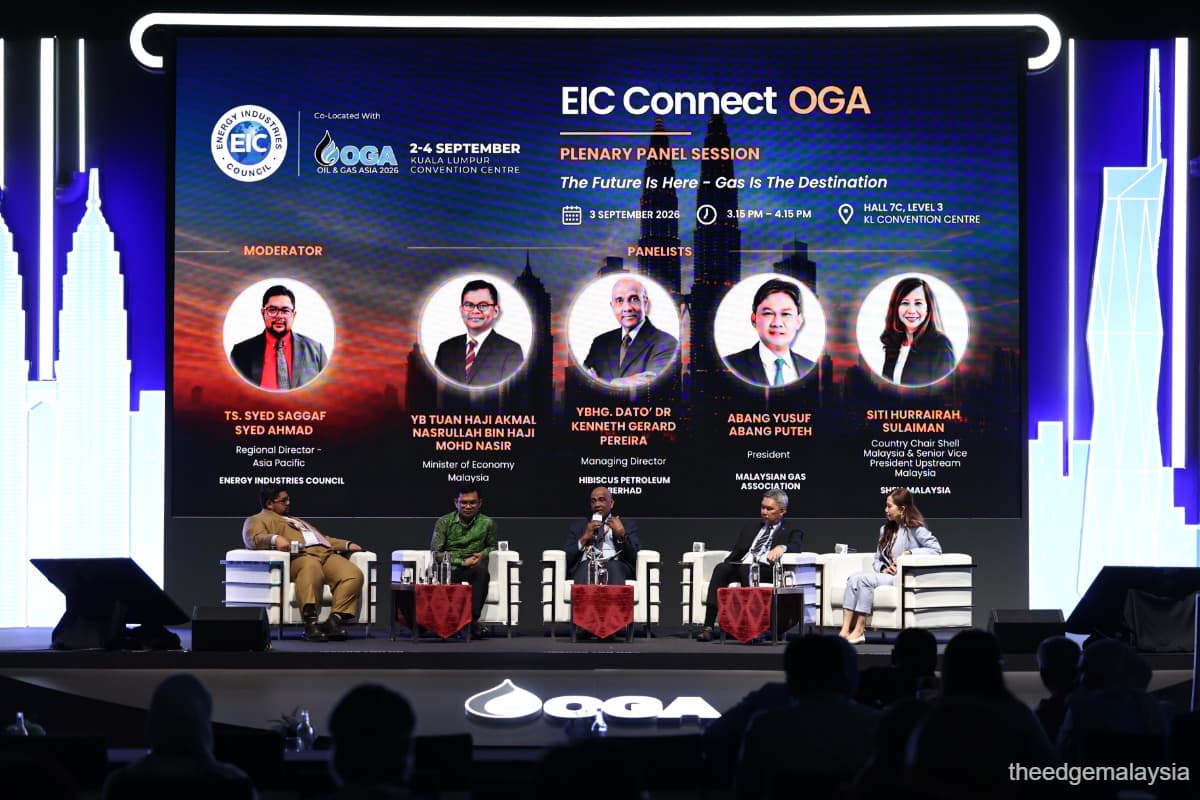
KUALA LUMPUR (Sept 3): Malaysia needs to ramp up investment in its gas infrastructure to ensure reliable fuel supply as it transitions to green energy, said oil and gas players.
Hibiscus Petroleum Bhd managing director Datuk Kenneth Gerard Pereira said the biggest gap in the energy transition was the lack of sustainable and appropriate investment, particularly long-term or “patient” capital.
Speaking during a plenary session at the Oil and Gas Asia 2026 forum on Thursday, Pereira said reliable energy infrastructure required continuous funding, including for essential projects such as regasification terminals, electricity grids and gas infrastructure.
“So, the issue is really funding. We can do all types of things if we have enough money.
"The energy transition problem is something that can be resolved if adequate, appropriate funding is put in place, and enough of it,” he added.
Pereira was agreeing with an earlier statement by Malaysian Gas Association president Abang Yusuf Abang Puteh, who said “super-reliable” infrastructure across the gas value chain was increasingly important as gas continues to play a significant role in Malaysia’s energy mix despite the rapid expansion of renewable energy.
“We are not talking just about receiving terminals, but liquefied natural gas (LNG) terminals, gas processing, distribution and transmission.
“This infrastructure is required for us to receive gas and distribute it to both industry and the power sector,” Abang Yusuf said
Under the National Energy Transition Roadmap, natural gas is expected to remain Malaysia’s primary transitional fuel, with its contribution to total primary energy supply projected to rise to 57 million tonnes of oil equivalent (MTOE) by 2050, from 41 MTOE currently.
Meeting this growth would require importing about 12.2 million tonnes of LNG annually—equivalent to around 170 LNG cargoes a year, said Abang Yusuf.
“Another important thing is market reform. Because we are relying more on imported energy, we should be aware that we are also exposed to international gas prices. And not only on the price, but also we are competing directly with international markets.
"So this is where the challenge is.. That cannot be separated when it comes to bringing in more gas or LNG into Peninsular Malaysia,” he added.
Earlier, Economy Minister Akmal Nasrullah Mohd Nasir urged oil and gas services and equipment (OGSE) firms to move beyond traditional service-based businesses by becoming technology partners, offering more integrated solutions and expanding beyond the domestic market into regional and international markets.
The shift is in line with the National OGSE Industry Blueprint 2021–2030 and its Mid-Term Review, which call for greater competitiveness, efficiency and technological capabilities, as well as a move towards greener and more sustainable business models.