

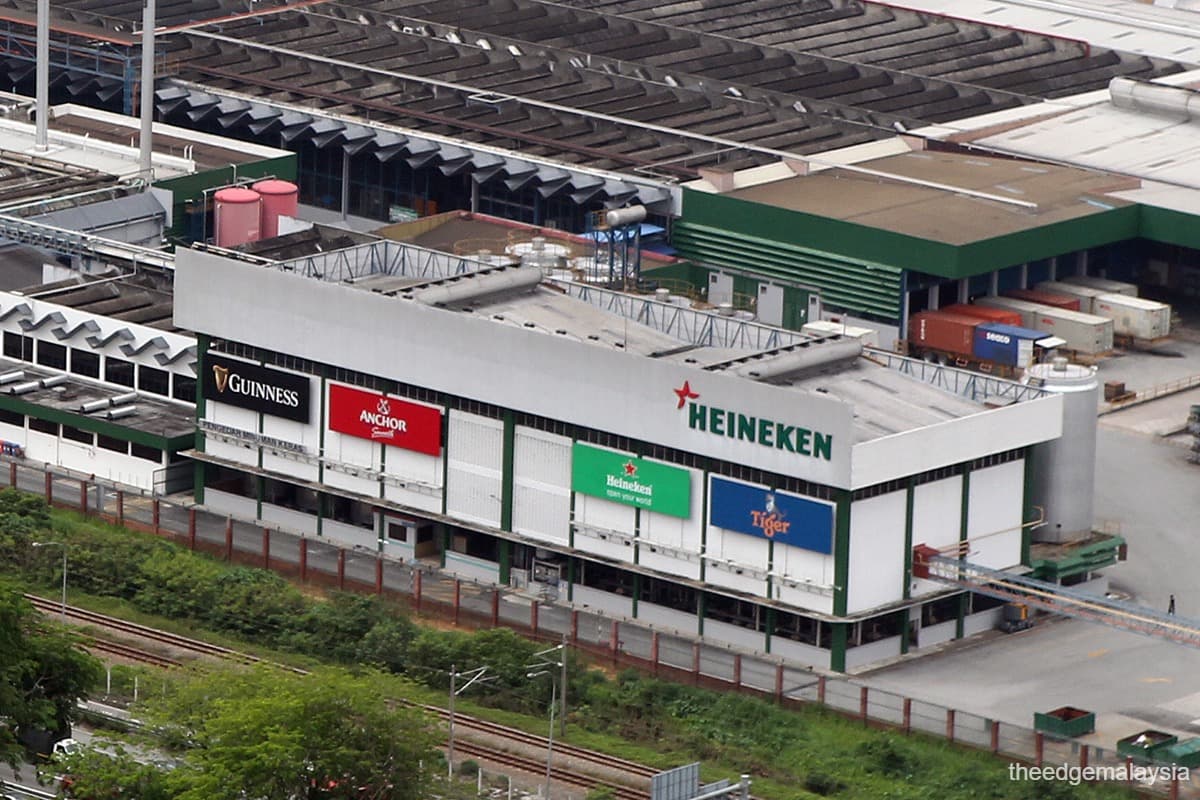
This article first appeared in The Edge Malaysia Weekly on August 31, 2026 - September 6, 2026
THE country’s two listed breweries — Heineken Malaysia Bhd (KL:HEIM) and Carlsberg Brewery Malaysia Bhd (KL:CARLSBG) — saw a sell-off of their shares this month.
It started after Heineken Malaysia announced lacklustre earnings for the June quarter, with net profit contracting year on year as subdued consumer sentiment weighed on revenue growth. Analysts slashed their earnings estimates, with several downgrading their calls on the stock.
In a single trading day, Heineken Malaysia’s shares fell 10% from RM19.10 at the close on Aug 5 to RM17.10 on Aug 6. Carlsberg, which had yet to announce its quarterly earnings at the time, was also dragged down by jittery investors, falling 5.4% over the same period. Carlsberg closed at RM14.94 on Aug 6.
The share price continued to decline for a week for Carlsberg and two weeks for Heineken before the slide eased. Carlsberg saw some rebound after the company announced its June quarterly earnings, which showed net profit and revenue increasing marginally.
Analysts say the sell-off was partly justified given the big miss in top- and bottom-line performance, particularly in the case of Heineken Malaysia. Yet, others opine that the sell-off in Carlsberg was overdone.

“The recent sell-off was partly justified by a genuine, sizeable miss in the top and bottom lines. The latest financial performance reflected subdued consumer demand and ongoing inventory normalisation across the customer and distributor network,” Fortress Capital Group CEO Datuk Thomas Yong tells The Edge.
“But it does, to a certain extent, look like an overreaction — though not an unreasonable one given the lack of near-term visibility on when destocking ends, the consumer macro backdrop as well as the potential excise duty hike in the upcoming Budget 2027 [which is set to be tabled in parliament on Oct 9].”
Given that the current price-earnings ratios (PERs) of both breweries are in the low teens, well below their historical median of close to 22 times, do they make a good buying opportunity?
Malacca Securities head of research Loui Low opines that much of the near-term weakness has been priced in for the breweries following the sharp correction in their share prices.
“At current valuations, the breweries look more attractive from a defensive and dividend-yield perspective, though excise duty and broader sin-sector policy risks may continue to cap valuations, especially around Budget 2027,” he says.
Dividend yields, which have often been a lure for investors looking to invest in breweries, have certainly trended higher following the sell-off in their share prices.
Carlsberg’s trailing 12-month (TTM) dividend yield now stands at 7.56% based on a share price of RM14.82, while Heineken Malaysia’s TTM dividend yield amounts to a whopping 9.43% based on its current share price of RM16.10.
The breweries are generous with dividends, with Heineken Malaysia’s dividend payout at around 100%, while Carlsberg’s payout has ranged between 75% and 90% over the last five financial years. Following the Covid-19 pandemic in 2020, the dividend per share for both breweries has increased.

Fortress Capital’s Yong says the breweries are trading “cheap” compared with their own historical valuations and are also cheaper than their regional beverage peers.
“Both operate in a two-player duopoly, with high regulatory barriers to entry. Hence, the current multiples look attractive on paper,” he notes, but also warns that the rise in excise duties is crimping consumer demand.
Carlsberg managing director Stefano Clini mentioned in the press release for the second quarter ended June 30, 2026 (2QFY2026) that the brewer is seeing early signs of the 10% increase in excise duty affecting consumer demand and spending.
During the tabling of Budget 2026 last year, the government had proposed raising excise duty on alcohol by 10% effective Nov 1, 2025. The hike, the first increase in nearly a decade, resulted in a new rate of RM192.50 per 100% volume per litre.
The last time duties were raised was in 2016, when locally produced hard liquor duties rose by 150%, while beer and stout duties were rebased to RM175 per litre of alcohol.
Policy risks are certainly an aspect investors are watching closely, especially with Budget 2027 just around the corner.
The brewers have seen lacklustre earnings performance in recent times. Analysts say this is a normalisation effect post-Covid-19, when the reopening created a surge in demand and the subsequent restocking cycle has been unwinding.
There is also anecdotal evidence that consumers, particularly younger people worldwide, are drinking more selectively and moderately.
Meanwhile, Yong says structural issues such as cost-of-living pressures are squeezing discretionary spending, while the higher excise duty is widening the price gap with illicit alcohol.
“All in all, near-term earnings weakness is mostly a normalisation/destocking story that should resolve, but the industry is sitting on top of a genuinely maturing, low-single-digit-volume-growth market where periodic tax shocks are now a recurring feature rather than a one-off event,” comments Yong.
Malacca Securities’ Low concurs, noting that lower consumption among younger people could limit volume growth over the longer term, implying that future earnings growth will depend more on pricing, premiumisation and product mix.
“While valuations have become more attractive, I think the upside may also remain capped for now. Without a stronger volume growth story, it may be difficult for the sector to command the higher valuation multiples seen previously,” he explains.
Based on data obtained from parent company Carlsberg Group’s recent annual reports, the volume of beverages sold by the group in Malaysia and Singapore, measured in million hectolitres (hl), declined from 1.5 million hl in FY2023 to 1.33 million hl in FY2024 and further to 1.31 million hl in FY2025.
The trend was in line with its Asia portfolio, where total beverage volume fell from 44.6 million hl in FY2024 to 43.5 million hl in FY2025.
Malaysia and Singapore make up only 3% of the volume of its Asia market, while the bulk comes from China and Hong Kong, at 69%, as well as Vietnam, Cambodia and Laos, at 28%.
Beer accounts for 87% of total volume, while the remainder comes from its Beyond Beer category and soft drinks.
As for Heineken Malaysia’s parent company, the group does not break down volume by country-specific markets. However, its data shows that volume in the Asia-Pacific region grew from 43 million hl in FY2023 to 45.3 million hl in FY2024 and edged up further to 45.5 million hl in FY2025.
However, Heineken Malaysia’s revenue was flat at RM2.8 billion in FY2025 compared with FY2024, while net profit slipped to RM459.34 million from RM466.75 million.
Interestingly, Carlsberg’s revenue slipped to RM2.26 billion in FY2025 from RM2.38 billion in FY2024, but net profit increased to RM377.2 million from RM340.7 million.
Having said that, Carlsberg seems to be the preferred counter of the two. It has nine “buy” calls, with an average target price of RM21.49, implying 45% upside from its closing price of RM14.78 last Thursday.
Analysts see Carlsberg as more resilient in terms of performance and have also pointed to its attractive dividend yield.
“The overall consumption environment could get more challenging in 2H2026, but Carlsberg’s marketing and cost-optimisation initiatives should mitigate the impact. It now trades at an attractive valuation after the recent sell-off. We think this is overdone in view of its resilient performance and attractive dividend yield on offer,” says RHB Research in an Aug 17 report.
For the cumulative six months ended June 30, Carlsberg reported net profit of RM181.86 million, up 3% from a year earlier, while revenue increased to RM1.22 billion from RM1.15 billion previously.
The earnings were below analysts’ expectations, as they accounted for 47% of consensus forecasts, due to weaker-than-expected sales.
As for Heineken Malaysia, analysts are split on the stock, with five “buy” and four “hold” calls. Three research houses downgraded their calls from “buy” to “hold” following its June-quarter earnings announcement.
Heineken Malaysia’s 1HFY2026 net profit totalled RM154.98 million, 24% lower year on year, while revenue was also lower at RM1.09 billion, down 15.7% from a year ago.
The results accounted for only 32% of analysts’ full-year forecast.
CGS International Securities, which recently downgraded the stock, says while it trades at 16.1 times FY2027 PER and offers a 6.1% FY2027 dividend yield, it sees limited near-term rerating catalysts for the stock. It names potential excise-duty hikes in the Budget 2027 announcement as a downside risk, as these could exacerbate illicit activities. It also sees weaker consumer demand for alcohol and sluggish tourist arrivals weighing on revenue.
The upside risks to its forecast include a stronger-than-expected recovery in consumer spending and on-trade demand, easing raw material and packaging costs, as well as higher-than-expected export volumes to Singapore.
The average 12-month target price for Heineken Malaysia stands at RM21.61, giving it a 33.6% upside from its closing price of RM16.18 last Thursday.
Save by subscribing to us for your print and/or digital copy.
P/S: The Edge is also available on Apple's App Store and Android's Google Play.