

This article first appeared in The Edge Malaysia Weekly on August 31, 2026 - September 6, 2026
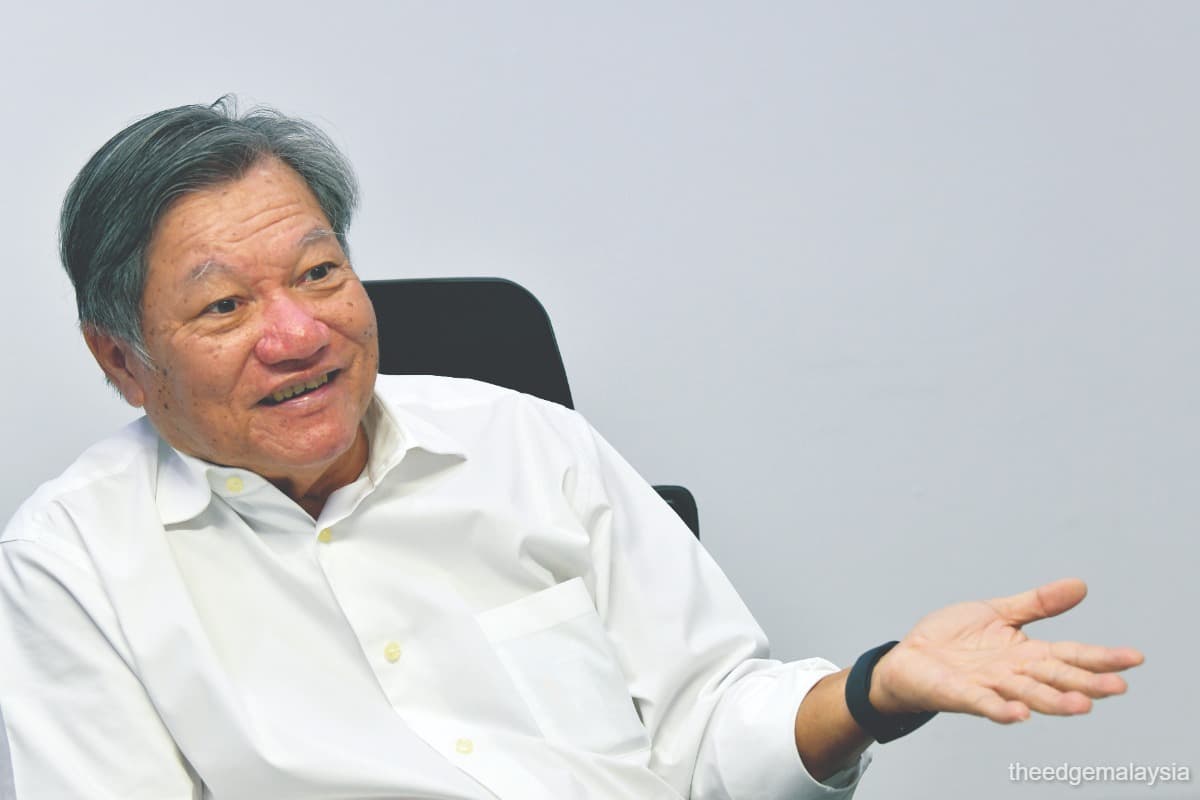
TAN Sri Eddy Chen smiles, looking relaxed. He has just got off the phone with one of his two daughters in Melbourne. Before that, he had grabbed a quick bite after holing the final putt of the day with his long-time golfing gang.
“I hope to play more golf,” he chuckles as we sit down for a cuppa at the Royal Selangor Golf Club.
Really?
Chen resigned as managing director of MKH Bhd (KL:MKH) effective from Aug 19, ahead of the first closing date of a takeover offer for the property developer by Batu Kawan Bhd (KL:BKAWAN). Batu Kawan holds a 48.38% stake in Kuala Lumpur Kepong Bhd (KL:KLK), the agri-based conglomerate whose core business remains plantations, alongside an established property development arm.
MKH has appointed Kenanga Investment Bank Bhd as independent adviser to the proposed RM2-a-share mandatory general offer (MGO) by Batu Kawan. The offer was triggered after Batu Kawan, via its wholly-owned unit Whitmore Holdings Sdn Bhd, agreed to acquire a combined 47.7% stake in MKH from the Chen family for RM549.8 million, or RM2 a share.
What’s next for Chen and MKH?
Interestingly, negotiations for the deal were wrapped up in just about two months, Chen says. The price was set and several suitors showed up. Batu Kawan was picked, even though its offer was the last to come through.
But why the exit? Why now?
“I am tired; I am not young. Property is a long game. I would love to travel more, play more golf, do things that I like,” says Chen. “I may just fade away …”
Do I detect a twinkle in his eye?
Is there really not a void in him? How does Chen pull the handbrake on himself when the vehicle appears to be gathering momentum after emerging from the pit stops?
“I may start something small on my own,” he finally says. “There is life after MKH.” That sounds more like the person I have known for more than three decades now.
Clearly, property development was not merely a business for Chen. It was a choice, a passion and, over four decades, a way of life.
MKH was founded in 1979 by his brother Tan Sri Alex Chen. Chen joined the board in the 1980s and became group managing director in 2005. The 74-year-old has helped transform the Kajang-based developer into a builder of integrated townships and transit-oriented developments (TODs), as well as a commercial player across the Klang Valley.
Chen is, quite simply, the face of MKH. So, how does one visualise him disappearing from the property industry altogether?
Stepping away from MKH cannot be easy. Cement, figuratively speaking, runs through his veins. Chen readily admits that he loves building things from nothing. He thrives on creating markets, spotting opportunities and moving decisively when they surface. I can bear testimony to that.
Through the years, MKH has survived major knocks, surviving the Asian financial crisis, the Global Financial Crisis and, most recently, Covid-19 and the Movement Control Orders (MCOs) that brought many developers to their knees.
A cursory look at MKH’s group pre-tax profit (PBT) shows earnings spiking in its financial year ended Sept 30, 2016 (FY2016), before normalising. Then came the Covid-19 disruption, followed by recovery and, subsequently, another period of normalisation.
FY2016 was an exceptional year for MKH, combining unusually strong profit recognition from property and construction with a significant unrealised foreign-exchange (forex) gain in the plantation division. MKH’s annual report says plantation PBT jumped 316.1% to RM63.1 million in FY2016, helped by an unrealised foreign-exchange gain of RM39.5 million, compared with an unrealised forex loss in the previous year.
Fast forward to FY2025, group PBT rose 15.3% to RM166.8 million from RM144.7 million in FY2024, even as revenue fell 10.1% to RM953.3 million. The improvement was not driven by property development; the property development and construction division recorded PBT of RM38 million, versus RM40.8 million a year earlier. MKH attributed the weaker property result to delays in newly launched projects that were still at a preliminary stage and a provision for liquidated ascertained damages relating to the KTM Komuter Station project.
The forward pipeline remains substantial, though.
MKH’s FY2025 annual report indicates that its FY2026 planned launches alone have an estimated gross development value (GDV) of RM1.38 billion. Spanning Kajang, Shah Alam and Kuala Lumpur, they comprise MKH Avenue 2, Annya @ Kajang 2 Precinct 3 Phase 3, RSKU @ Hillpark Shah Alam, TR Prestige @ Jalan Cochrane and Inspirasi Bukit Jalil. The group also had RM471.3 million in locked-in unbilled sales as at Sept 30, 2025.
So, the Chen family has walked away from MKH at a time when prospects appear to be improving.
That may well be true. But unlocking that potential requires substantial capital, resources and expertise. This is where the balance sheets of Batu Kawan and KLK could strategically come into play.
At its core, MKH is a relatively land-rich Kajang/Semenyih platform. Its attraction, therefore, lies well beyond its current earnings.
The company’s roots are in Kajang but its portfolio has expanded across the Klang Valley, with an emphasis on TODs, integrated townships, commercial development and high-rise residential projects. MKH has completed more than 59 property projects and has developments strategically located across the Klang Valley.
Importantly, some of the tracts still to be developed in Kajang appear to be among the better ones. Kajang 2 remains MKH’s flagship platform and, historically, has been described as the company’s crown jewel.
And there is market talk of several interesting tracts in established Klang Valley locations that are either under negotiation or nearing completion of negotiations.
That is why MKH is not simply a conventional property earnings story. It is a strategically located Klang Valley land bank with an established Kajang development platform attached to it. It is also about the pipeline, prospective new projects, the sold but unbilled units, and ongoing launches.
The real question is how much GDV can realistically be extracted from these assets collectively? And at what development margins and over what period?
With Batu Kawan/KLK’s balance sheet behind it, MKH’s ability to participate in larger joint ventures and undertake bigger-scale development projects could take on an entirely new dimension.
Of course, capital alone does not build townships. Expertise matters.
It is notable that KLK Land has more than 30 years of residential and commercial development experience. KLK says it first ventured into property development in 1990, leveraging the strategic location of its land bank in the peninsula. Its first major foray was Sierramas, developed through a joint venture with Tan & Tan Developments. Today, KLK Land focuses on township developments in Bandar Seri Coalfields and Caledonia in Bestari Jaya, both in Selangor, while it has also expanded into commercial and industrial development.
Let’s circle back to Chen. His real asset is not simply his shareholding in MKH, nor his former position in the company.
It is his judgement — accumulated through four decades of Malaysian property cycles, land acquisitions, township creation, housing policy, industry representation and crisis management.
Chen has seen Malaysian property from almost every side of the table: private and public.
He has crossed into public-sector housing through PR1MA Malaysia, where he served as chairman, and has participated in government-industry bodies involved in shaping policy around construction, housing and property development.
One of his most significant industry contributions came during his tenure as chairman of the Real Estate and Housing Developers’ Association (Rehda) Malaysia (1998 to 2002), when the industry successfully pushed for the government’s Home Ownership Campaign (HOC) during the Asian financial crisis.
The property sector was struggling. Developers were running out of cash, projects were being abandoned and companies were closing.
Rehda’s argument to the government was essentially this: Do not allow property — with its multiplier effect across more than 140 related industries — to become another casualty of the economic crisis. Instead, use property to help pull the economy out of it.
The government and Rehda subsequently worked together on an HOC package of incentives designed to stimulate the housing market. The objective was straightforward: stimulate transactions, improve cash flow and restore confidence in the market.
Over the years, Chen has collected numerous awards recognising both his business expertise and contribution to the industry. These include The Edge Malaysia Outstanding Contribution to the Real Estate Industry at The Edge Malaysia Property Excellence Awards (TEPEA) in 2024, The Edge Malaysia Outstanding Property CEO Award at TEPEA in 2018 and CEO of the Year at the Construction Industry Development Board (CIDB) Malaysia’s Malaysian Construction Industry Excellence Awards (MCIEA) in 2015. MKH’s own director profile confirms all three.
So, yes, there is life for Chen after MKH.
No, he is unlikely to simply fade away.
He may have left MKH, but Chen is not really leaving property development.
After decades of building MKH, what does a builder do when he no longer owns the building?
That’s the Real Deal.
And, as it turns out, that call from Chen’s daughter was about a prospective property development down south.
Au Foong Yee ([email protected]) is an editor emeritus at The Edge. She is chief judge of The Edge Malaysia Best Managed and Sustainable Property Awards and a judge of The Edge Malaysia Property Excellence Awards.
Save by subscribing to us for your print and/or digital copy.
P/S: The Edge is also available on Apple's App Store and Android's Google Play.