


This article first appeared in The Edge Malaysia Weekly on August 31, 2026 - September 6, 2026
LAST Thursday, The Edge reported online that national oil company Petroliam Nasional Bhd (PETRONAS), the Employees Provident Fund (EPF) and the Lim family, which owns substantial equity in and runs floating production storage and offloading (FPSO) player Yinson Holdings Bhd (KL:YINSON), were looking to take the latter private.
Interest in the story piqued later in the day, with a newswire reporting an offer price of RM2.35 per share for Yinson. It was highlighted that PETRONAS’ 51% unit MISC Bhd (KL:MISC) was in talks with the EPF and the Lims to take over Yinson as a consortium.
While details are scarce, the privatisation is expected to happen via a selective capital reduction, which makes sense, considering that the Lim family holds a 27.17% stake in the company while the EPF has 17.09%, or 44.26%, collectively. The role of PETRONAS or its unit MISC, and how they will participate, remains to be seen.
The only other substantial shareholder in Yinson is pension fund Kumpulan Wang Persaraan (Diperbadankan), or KWAP, which has 6.71% equity interest.
After market close last Friday, Yinson announced: “We, Yinson Legacy Sdn Bhd (the vehicle of the Lim family), being the major shareholder of the offeree, wish to inform that we are currently engaged in preliminary and exploratory discussions with MISC and other stakeholders, namely, affiliates of Yinson Legacy and the EPF, in relation to a potential proposal to privatise the offeree by way of a scheme of arrangement under Section 366 of the Companies Act 2016. The scheme, if implemented, is expected to involve the acquisition of all remaining ordinary shares in the offeree not already held by Yinson Legacy and certain parties acting in concert with it, and the EPF retaining its existing effective shareholding in the offeree.
“While negotiations are ongoing, an indicative offer price of RM2.35 per share is currently being considered, based on prevailing circumstances, should the proposed scheme materialise.”
However, Yinson cautioned that the final offer price remains subject to change based on, among others, due diligence and commercial viability.
“This notice does not constitute a firm intention to privatise the offeree and there is no certainty that any offer or transaction will ultimately be made. Shareholders and investors are advised to exercise caution when dealing in the securities of the offeree,” Yinson said.
This caution comes about after a report in June last year said that New York-based Stonepeak Partners was in exclusive talks with the Lim family to acquire Yinson and potentially valued the company at a whopping RM9 billion. However, the long-drawn-out talks failed to bear fruit and after a long silence, this new proposal has been hatched.
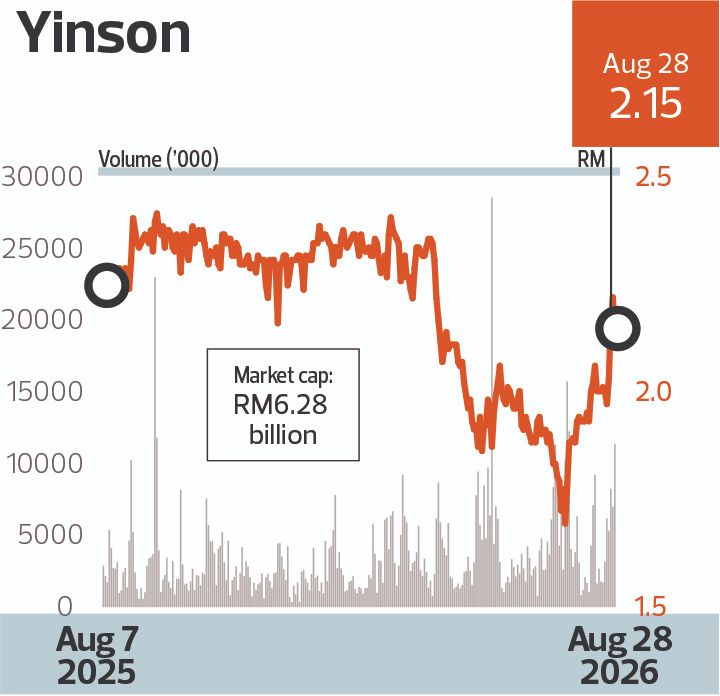
“What is clear is that it (the scheme of arrangement) will take a long time to conclude, which is why Yinson fell,” one market watcher says. Last Friday, Yinson shed seven sen to close at RM2.15, translating into a market capitalisation of RM6.28 billion.
On the deal
As at end-April this year, Yinson had RM4.62 billion in cash and bank balances, which would mean that a buyout of the remaining 55.74%, or 1.63 billion shares, would add up to RM3.83 billion.
For its three months ended April 2026, Yinson made a net profit of RM120 million on revenue of RM1.05 billion. A sticking point with regard to Yinson is its high debt level. As at end-April, it had long-term loans and borrowings of RM15.42 billion and short-term loans and borrowings of RM2.29 billion. A check on AskEdge indicates that Yinson’s net gearing is at 254.1%.
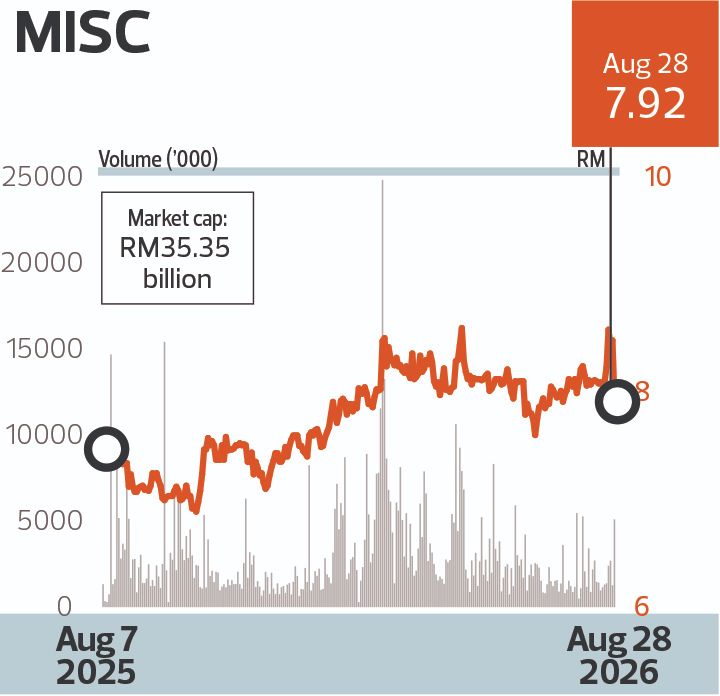
MISC, meanwhile, is a shipping giant with a market capitalisation of close to RM35.35 billion at its close of RM7.92 last Friday, after shedding 56 sen.
For its six months ended June 30, 2026, MISC chalked up a net profit of RM1.9 billion on revenue of RM7.68 billion. As at end-June, MISC had cash, deposits and bank balances of RM7.2 billion. On the other side of the balance sheet, the company had long-term interest-bearing loans and borrowings amounting to RM7.74 billion and short-term interest-bearing loans and borrowings amounting to RM5.22 billion. Its net gearing stood at just 16.4%.
In a nutshell, an FPSO is a tanker converted and utilised to process hydrocarbons from the sea before being offloaded into oil tankers. The beauty of an FPSO is that it removes the need for high capex, in that it does not require fixed infrastructure and long pipelines requiring maintenance. It also can be shifted and redeployed to new fields after work on an existing reservoir is concluded.
FPSOs were first constructed and utilised in 1977 and deployed at Shell’s Castellon field in the Spanish Mediterranean. They gained traction as a standalone solution for frontier areas and marginal fields. There are currently more than 270 FPSO vessels operating globally.
It is noteworthy that while Yinson has a fleet of 11 FPSOs and is the third largest FPSO player in the world, MISC, with a fleet of six FPSOs, is the sixth largest FPSO player in the world.
Collectively, the merged entity with 13 FPSOs will still be ranked third, behind Tokyo, Japan-based MODEC Inc and SBM Offshore NV of Schiphol, the Netherlands.
However, MISC also has five floating storage and offloading vessels and a semi-submersible floating production system (FPS Gumusut Kakap), which is similar to an FPSO.
MISC also has a 20% stake in FPSO Ventures Sdn Bhd, a company that undertakes operations and maintenance services for offshore floating systems. The remaining 80% is held by private company Ombak Simfoni Sdn Bhd, the vehicle of Datuk Seri Abdul Farish Abd Rashid and Datuk Seri Ahmad Fuad Md Ali.
There are other FPSO players locally, such as Bumi Armada Bhd (KL:ARMADA), in which Tatparanandam Ananda Krishnan’s estate has a controlling interest of 34.55%. Ananda died at end-November 2024.
What’s next?
While it is still conjecture, there is a view that the merged entity of Yinson and MISC will take over Bumi Armada.
“That is what we initially heard, that all the three would be merged,” a source familiar with the deal says.
The notion of Bumi Armada being up for grabs is not a surprise.
Last year, Bumi Armada and MISC mutually called off a proposed merger ahead of the lapse of their memorandum of understanding for the merger on Aug 14. The merger was announced on Nov 14, 2024, two weeks before Ananda’s death and was aimed at merging Bumi Armada’s FPSOs and MISC’s offshore assets.
As far back as 2017, Ananda was rumoured to be looking at selling Bumi Armada and one of the suitors back then was the Tata Group’s Shaporji Palonji Mistry, who was on Bumi Armada’s board from October 2014 to February 2017. A deal, however, failed to materialise.
It is also understood that there are currently parties looking at buying into Bumi Armada, but the talks are largely at the shareholder level and have been moving along at a snail’s pace.
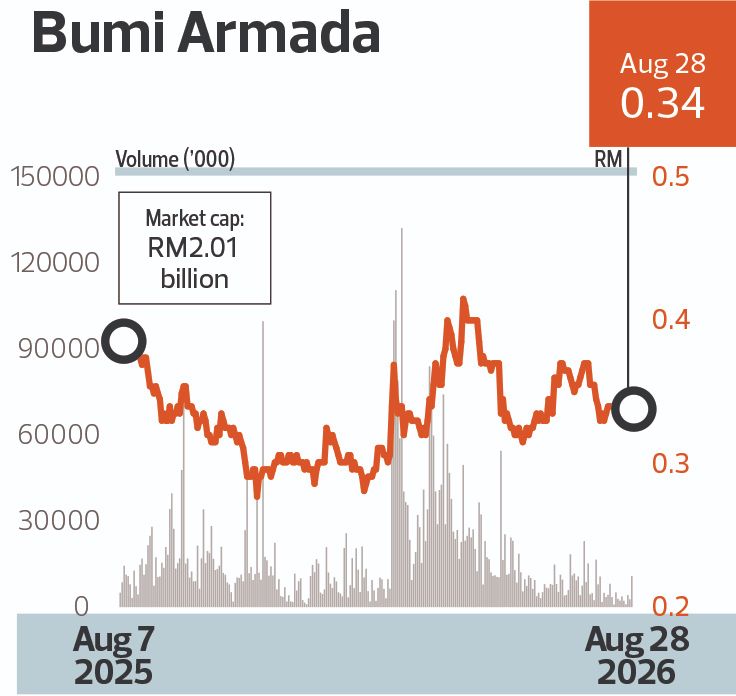
At its close of 34 sen last Friday, Bumi Armada had a market capitalisation of RM2.01 billion. The stock was trading at seven times its price earnings ratio — about half that of Yinson.
For its six months ended June 30, 2026, Bumi Armada registered a net profit of RM111.08 million on revenue of RM641.74 million. Its debts seem manageable with long-term debt commitments of RM1.4 billion and short-term borrowings of RM496.7 million. AskEdge has Bumi Armada’s net gearing at a reasonable 14.9%.
Bumi Armada, with its fleet of seven FPSOs, one floating storage unit and two pipe-laying barges, would transform the merged companies — itself, MISC’s offshore production assets and Yinson — into the largest FPSO player in the world with 21 assets, ahead of MODEC’s 19 FPSOs and SBM Offshore’s 17 FPSOs.
Meanwhile, the use of FPSOs seems to be gaining ground.
Last month, oil and gas-centric news portal Upstream Online reported that PETRONAS is considering using an FPSO for its deepwater Megah-1 oil development off Sabah.
In July, PETRONAS Carigali Sdn Bhd, the exploration arm of the national oil company, extended the Ratu Nusantara FPSO at its Bukit Tua oilfield off Indonesia for another 10 years.
In its Activity Outlook 2026-2028, PETRONAS comments on its use of FPSOs: “A strategic shift is underway focusing on optimisation rather than conventional deployment. This includes technical and economic feasibility assessments, life cycle analysis and cross-functional collaboration to ensure fit-for-purpose floater utilisation. With around 20 units of FPSO and FSO currently operating in Malaysian waters and even more planned for production, timely deployment and cost-effective acquisition are essential.
“The ultimate goal is to establish a comprehensive FPSO and FSO strategy that supports both near-term production and long-term sustainability, leveraging shared efficiencies, competitive yard selection and partnerships to build a resilient and future-ready offshore ecosystem.”
However, the demand for FPSOs over the next few years is not clearly stated in the Activity Outlook.
Nevertheless, for this mega merger between Yinson, MISC and Bumi Armada to come to fruition, the first hurdle, the announcement made just last Friday — a deal between Yinson and MISC — will be the toughest to clear.
Save by subscribing to us for your print and/or digital copy.
P/S: The Edge is also available on Apple's App Store and Android's Google Play.