

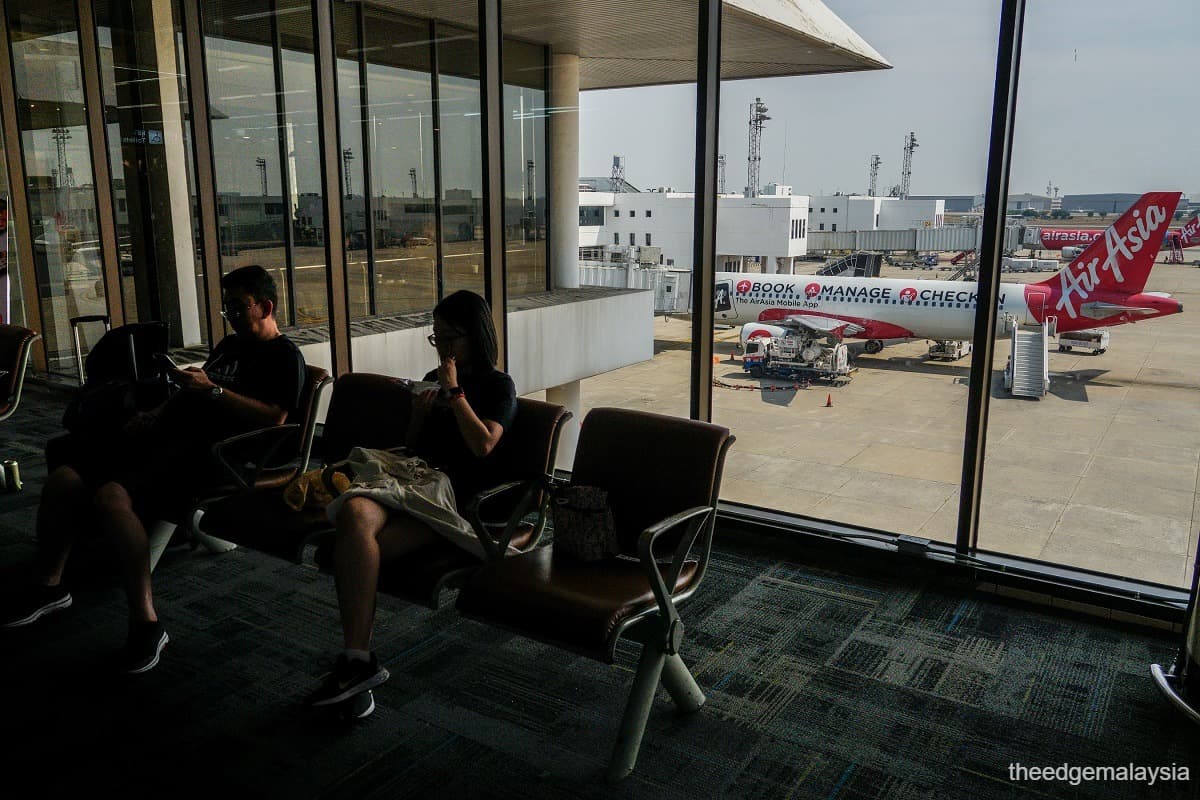
KUALA LUMPUR (Sept 2): AirAsia Group Bhd (KL:AAGB) is pursuing US$1 billion (RM4.05 billion) in financing from the international debt market, confirming a report in The Edge Malaysia weekly.
The group, in a statement on Wednesday, clarifies that its planned fundraising exercises, comprising up to US$1.0 billion in international debt markets and RM700 million in local credit facilities, are primarily targeted at debt restructuring/refinancing and balance sheet consolidation, rather than purely funding operational shortfalls.
The group said the fundraising would allow it to replace higher-cost debt taken on during the Covid-19 pandemic with longer-term financing on better terms, helping to lower its interest costs and improve its financial flexibility.
“This will optimise our capital structure, lower interest expenses and build significant financial flexibility as we transition back into sustainable growth,” AirAsia deputy group chief executive officer Farouk Kamal said in a statement.
The confirmation comes after The Edge, in its Aug 24-30, 2026 issue, quoted sources as saying that AirAsia was seeking to raise at least US$1 billion from the international debt market amid rising fuel costs and mounting losses.

Farouk explained that the financing is predominantly aimed at refinancing the group’s existing financing on better terms, rather than adding fresh leverage to its balance sheet.
“We are raising financing to collapse all our existing financing into one instrument with better terms, for example, better financing costs, better stretched timeline — duration and tenure — as well as potentially exploring a bullet structure,” Farouk told The Edge at the sidelines of its code-share announcement with Türkiye’s low-cost carrier (LCC) Pegasus Airlines on Wednesday.
AirAsia is targeting the fourth quarter this year to complete the fundraising, Farouk added.
AirAsia has reported two consecutive quarterly losses, with higher fuel costs and foreign exchange losses weighing on its financial performance.
The airline said the planned refinancing would also consolidate several existing facilities into a more streamlined debt structure, with longer maturities and lower financing costs.
AirAsia also clarified that the US$300 million in March was used to extend debt tenures and reduce principal obligations.
The group is also taking steps to cushion its margins from swings in energy prices. In the second quarter, it said it recouped 70% of higher fuel costs through fare adjustments and lower non-fuel operating expenses. Fuel costs accounted for around 60% of AirAsia’s operating costs in the second quarter.
AirAsia is actively establishing a broader fuel hedging strategy across the wider group. Specifically for Thai AirAsia, the group has secured 13% of its third quarter fuel consumption hedge at US$89 per barrel, Farouk said.
He said jet fuel prices were around US$150 per barrel, nearly double AirAsia’s usual level of US$85-US$90 but lower than the US$183 average in the second quarter.
He hopes prices will fall to US$120 or below, although the outlook remains uncertain.
AirAsia codeshares with Türkiye's Pegasus Airlines and amps up Istanbul frequency to daily
Meanwhile, AirAsia announced its first-ever codeshare partnership with Pegasus Airlines, connecting its Asean and Asian network with Pegasus’ European network through Istanbul.
The partnership will progressively open access to more than 100 routes between Asia and Europe via AirAsia and Pegasus’s combined network.
The partnership kicks off with five European destinations — London, Moscow, Ankara, Zurich and Athens — allowing passengers from Kuala Lumpur to connect to these cities via Istanbul.
AirAsia will also increase its Kuala Lumpur-Istanbul frequency from four times weekly to seven flights weekly by February 2027.
Following the partnership, its chief commercial officer Amanda Woo said AirAsia is looking to uplift the load factor by 15% to 20% for flights connecting Kuala Lumpur and Istanbul.
From January to August this year, the load factor for Kuala Lumpur-Istanbul is about 80%.
AirAsia’s share price ended half a sen, or 0.7%, to 71 sen on Wednesday, giving the group a market capitalisation of RM2.39 billion.