

This article first appeared in The Edge Malaysia Weekly on August 31, 2026 - September 6, 2026
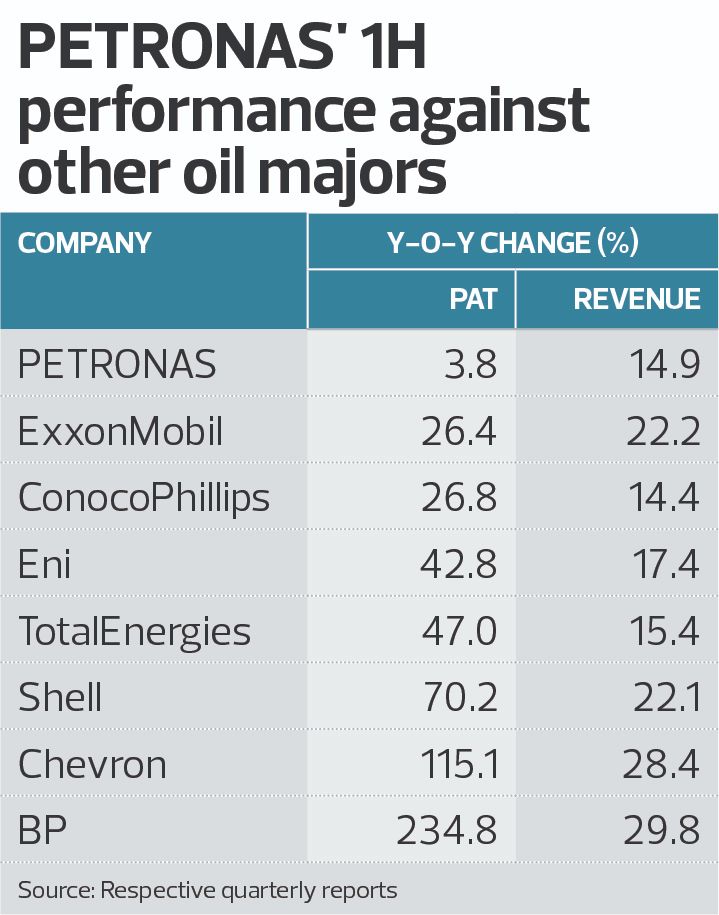
SHAREHOLDERS of international oil majors, such as Shell, Chevron Corp and Exxonmobil Holdings Corp, are probably enjoying “happy days”, as the companies have recorded great profit jumps and a surge in their share prices because of higher crude oil prices, as a result of the Middle East conflict.
Average Brent crude prices soared 28% to US$92.30 in the January to June period compared with US$71.87 a year ago.
Unfortunately, the Malaysian government — the sole shareholder of Petroliam Nasional Bhd (PETRONAS) — cannot truly revel in higher oil prices.
PETRONAS also has little to cheer about as it is navigating a sea of uncertainties — geopolitical disruptions, commodity price volatility and foreign exchange headwinds.
But, arguably, its biggest headache as the national oil company is the current national mandate thrust upon it — ensuring an uninterrupted supply of petrol at all pump stations nationwide at its own expense.
In a statement in conjunction with the release of the group’s half-year financial results, PETRONAS president and group CEO Tan Sri Tengku Muhammad Taufik points out that safeguarding energy security was PETRONAS’ priority in the first half of the year.
“To fulfil this duty, we undertook strategic investments to reinforce our portfolio for long-term resilience.
“In responding to the impact of the global energy crisis, PETRONAS leveraged the strength of our integrated portfolio and intensified efforts across the value chain to deliver uninterrupted energy for Malaysia as its national oil company,” he says.
As in past crises, Putrajaya has turned to PETRONAS. Amid the present Middle East conflict, the federal government has used PETRONAS as a buffer against escalating energy prices and the global fuel shortage.
The closure of the Strait of Hormuz has disrupted global energy supplies and maritime logistics. Besides ships having to take longer routes, shipping costs have risen three-fold and war risk insurance has ballooned by more than 10 times.
Even so, international oil majors are churning out stellar profits (see table). In comparison, PETRONAS’ net profit rose barely 4%, or RM1 billion, in the first half of 2026 to RM27.2 billion. Its revenue performed better, up 15% to RM152.4 billion from RM132.6 billion.
A stronger ringgit is not a boon to PETRONAS whose earnings are in US dollar. The local unit strengthened 9% to RM3.98 in 1HFY2026 against the US dollar, compared with RM4.38 a year ago.
It is worth noting that PETRONAS’ earnings were dragged down by large losses in its downstream operations. The division incurred a major loss after tax of RM15.2 billion in 1HFY2026 compared with about RM900 million a year ago.
PETRONAS attributed the wider loss to previously unrecognised accumulated share of losses of a joint venture following additional equity injection made during the period. Excluding the previously unrecognised accumulated share of losses, the downstream division would have booked a profit after tax of RM7 billion.
In May, PETRONAS acquired the equity stake held by Saudi Arabian Oil Co in Pengerang Refining Company Sdn Bhd and Pengerang Petrochemical Company Sdn Bhd at the Pengerang Integrated Complex, near southeast Johor. The two units are currently wholly-owned and operated by PETRONAS.
Lower net cash position
PETRONAS’ operating cash flow at the end of the first half was RM47.5 billion while capital investments amounted to RM41.4 billion, including RM24.55 million spent on investments in associates and joint ventures.
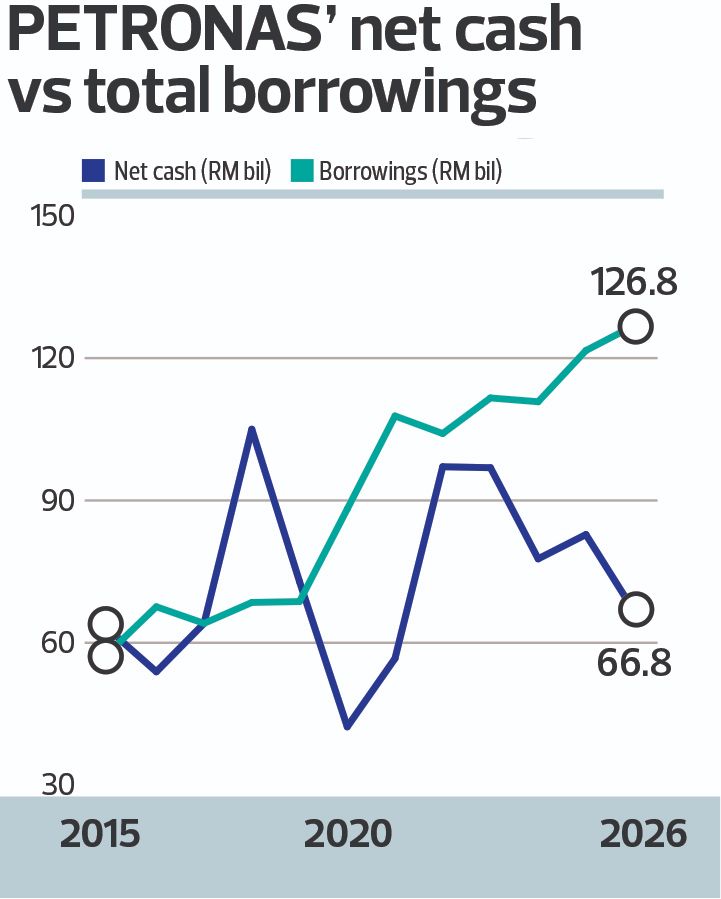
Its total borrowings swelled to RM126.8 billion as at June 30 — likely the highest level ever. The pace of increase accelerated after Covid-19, with total borrowings expanding to RM111.6 billion in 2023 from RM68.7 billion at end-2019.
At the same time, PETRONAS’ cash pile has been growing over the past 10 years. It exceeded the RM200 billion mark in 2022 with RM201.2 billion. But in 1HFY2026, its cash pile dipped to RM193.6 billion from RM204.4 billion at end-2025. It was RM213.54 billion as at June 30, 2025.
However, attention needs to be drawn to its net cash position, which contracted to a five-year low of RM66.8 billion as at June 30, despite the sharp rise in crude oil prices. It was a drop of 19.3%, or RM16 billion, from RM82.8 billion six months earlier.
Chairman of the Crisis Management Task Force (PPPK), Tan Sri Mohd Hassan Marican, in June highlighted that the country’s fuel subsidy bill had surged from RM700 million in January to an unprecedented RM5 billion within a short time.
Hassan, who previously helmed PETRONAS, said the national oil firm plays a critical role in ensuring fuel security by helping to address supply shortfalls by other petrol retailers operating in Malaysia, and bears significantly higher procurement and operational costs.
PETRONAS is absorbing these additional commitments, which can run into hundreds of millions of ringgit, according to Hassan. The Edge is given to understand that the amount is about RM600 million to RM700 million a month. How much will that eat into its cash pile?
Save by subscribing to us for your print and/or digital copy.
P/S: The Edge is also available on Apple's App Store and Android's Google Play.