


This article first appeared in The Edge Malaysia Weekly on August 31, 2026 - September 6, 2026
THE country’s intergenerational resource wealth fund, the National Trust Fund Inc (KWAN), should see its net assets double in about 10 years through compulsory contributions and investment returns. Deputy Finance Minister Liew Chin Tong told parliament this when winding up the debate on the recently passed KWAN Bill 2026, which compels both Petroliam Nasional Bhd (PETRONAS) and the federal government to make annual statutory contributions to the fund.
While its 2025 annual report had not been released, KWAN should have grown to at least RM24 billion by end-2025, with PETRONAS contributing RM0.5 billion to the fund that year, and assuming 5% growth over its net asset of RM22.4 billion as at end-2024.
Doubling from RM24 billion to RM48 billion over 10 years requires only 7.18% growth annually over a decade. Helped by contributions, which Liew says are about RM800 million initially, net investment returns retained needs to be only 4% to 5% for KWAN to double its fund size by 2034.
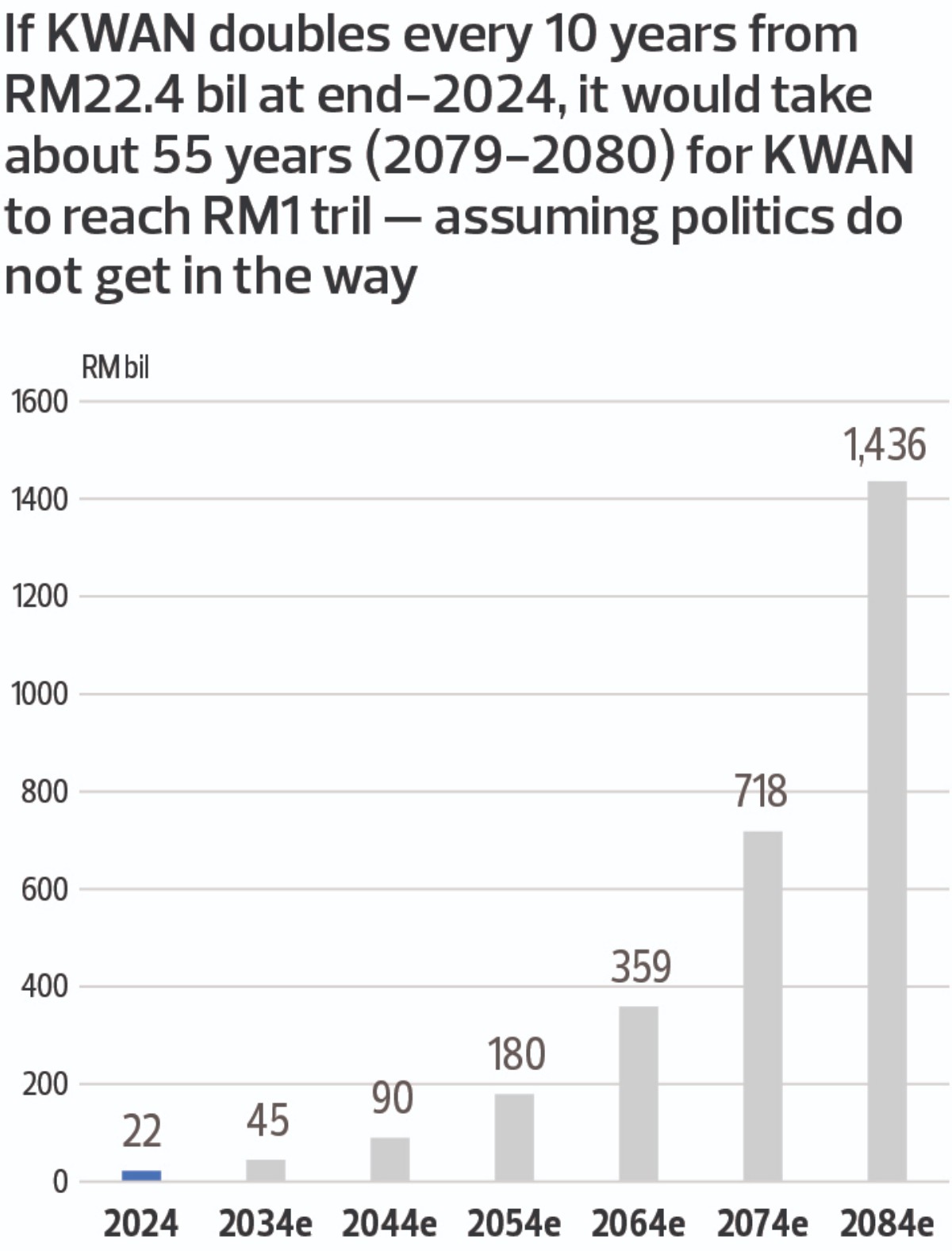
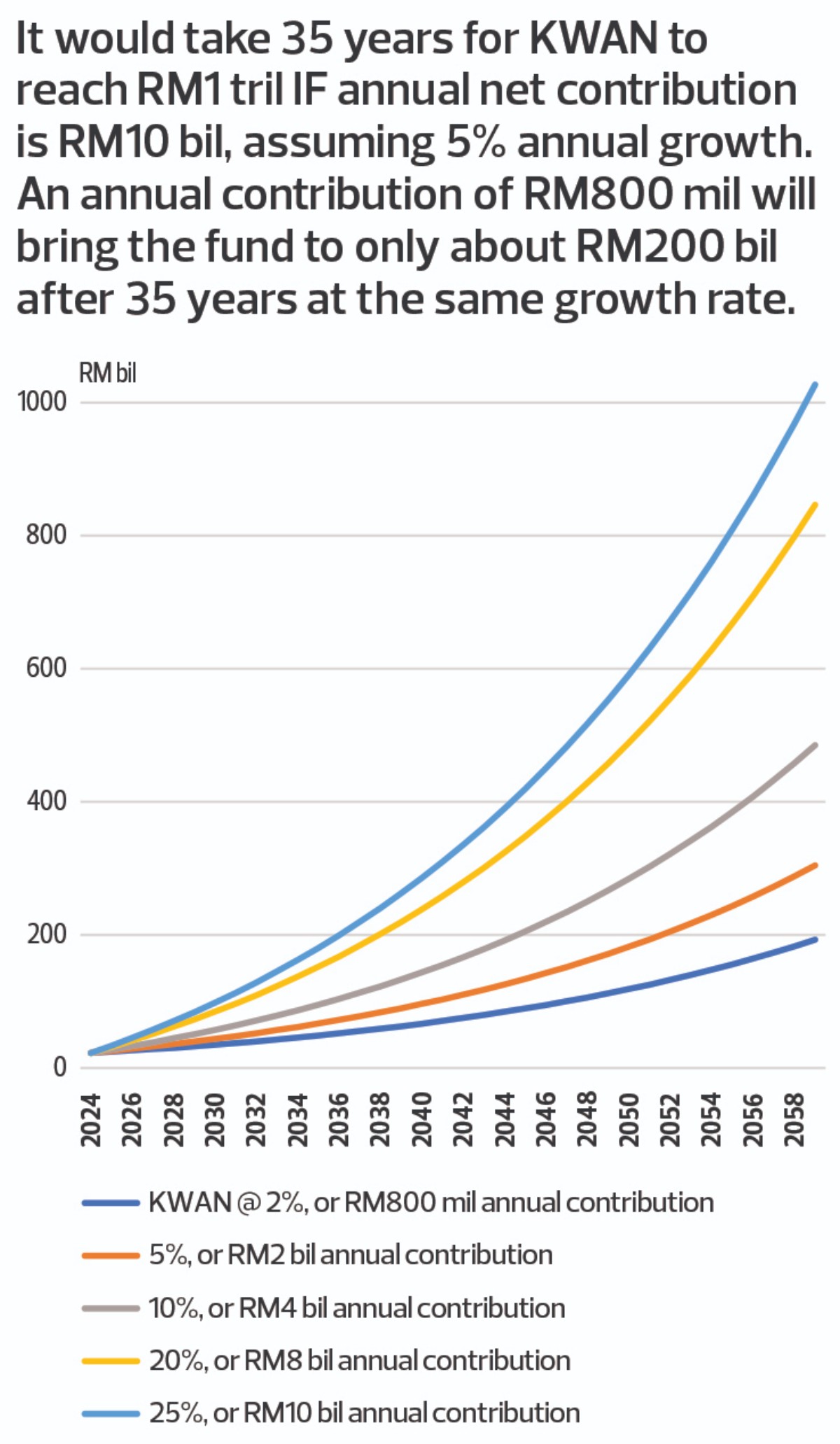
Mathematically, doubling the fund size every 10 years over 55 years should push KWAN above the RM1 trillion mark by 2080, or about three decades after Malaysia becomes an aged nation by 2048 (14% of population aged 65 and above). For KWAN to reach RM1 trillion by 2080, it would need to grow 5% annually, assuming a simplistic RM800 million in annual net contributions.
To shorten that journey by 20 years, enabling KWAN to cross RM1 trillion within 35 years, or by 2059 — around the time one in five of the population is projected to be aged 65 and above, making the country a super-aged nation — annual net contributions would need to be RM10 billion instead of the projected minimum of RM800 million. Back-of-the-envelope calculations show that the latter would bring the fund size to only about RM200 billion at the same 5% annual growth rate.
Put another way, unless contributions rise meaningfully, investment returns will have to be higher to deliver overall fund growth as the pool gets bigger.
Spending now versus later
As Malaysia’s annual budget has been more than RM400 billion since 2024, setting aside RM10 billion a year, or about 2.5% of the budget, would involve sizeable expenditure reprioritisation or revenue expansion compared to just RM800 million a year. Recall the public pushback in April this year when Treasury secretary general Tan Sri Johan Mahmood Merican issued a memo asking all government ministries and agencies to collectively trim RM10 billion in non-essential spending from their 2026 operating expenses to help Putrajaya cover the surge in the fuel subsidy bill, following the Middle East conflict.
Politics is another complication to KWAN’s pathway towards RM1 trillion. Large pools of public funds have a way of acquiring “purposes” for spending.
Even at RM24 billion, KWAN has already seen two withdrawals totalling RM5.042 billion in its first 36 years: RM5 billion to procure Covid-19 vaccines and cover related expenses from 2021 to 2023; and a RM42 million drawdown in 1998 for a wetland sanctuary project.
Malaysia also has the example of Kumpulan Wang Persaraan (Diperbadankan) (KWAP), set up in 2007 to assist the federal government in funding its public-sector pension obligations.
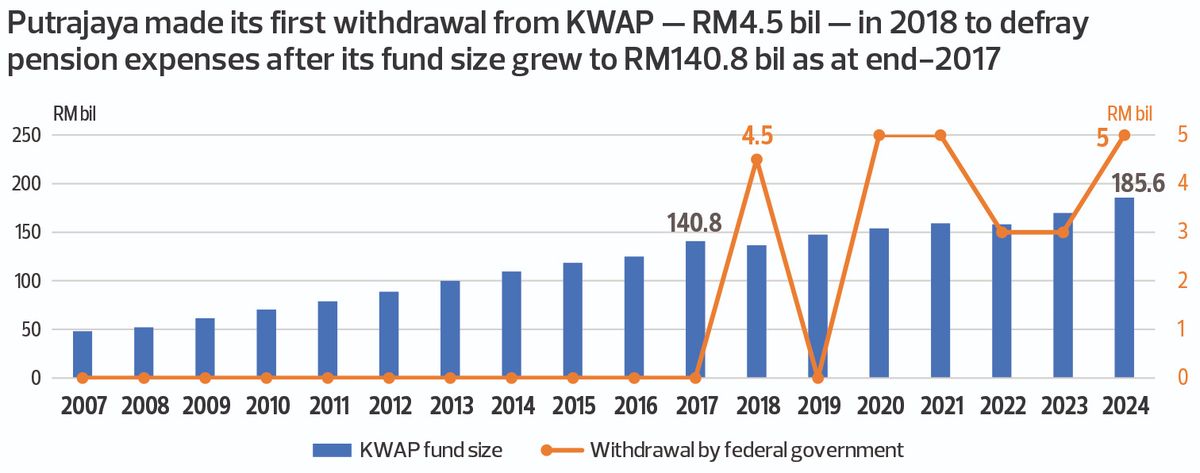
KWAP had a fund size of RM140.8 billion at end-2017, before Putrajaya made its first withdrawal of RM4.5 billion in 2018. There was no withdrawal in 2019, but RM30 billion was withdrawn between 2020 and 2026, including RM5 billion this year, to help fund public pension obligations. The obligations reached RM42.8 billion in 2026, up from RM35.9 billion in 2024 and RM40.06 billion in 2025. Its 2025 annual report had not been released at press time.
To be sure, defraying public pension obligations is consistent with KWAP’s mandate. Some may even argue that a degree of restraint has already been shown, given that KWAP’s fund size has continued to grow for the most part despite the withdrawals.
The larger the pool becomes, the harder its annual returns would be to ignore — a RM200 billion fund could deliver RM10 billion a year at a 5% return, while a RM500 billion fund could generate RM25 billion at the same rate.
Even half of the RM10 billion could give all Malaysians aged 18 and above at least RM200 one-off cash, as demonstrated by the RM2.2 billion required to give the RM100 Sumbangan Asas Rahmah (SARA). A little over half of the RM25 billion could give RM500 cash to every Malaysian adult.
No points for guessing where most politicians would lean when choosing between spending on voters today and saving for future generations who have little say at the ballot box.
Yet Norway and Singapore are prime examples of what could happen when strict discipline is exercised to grow pools of public funds into sizeable engines that can power future growth.
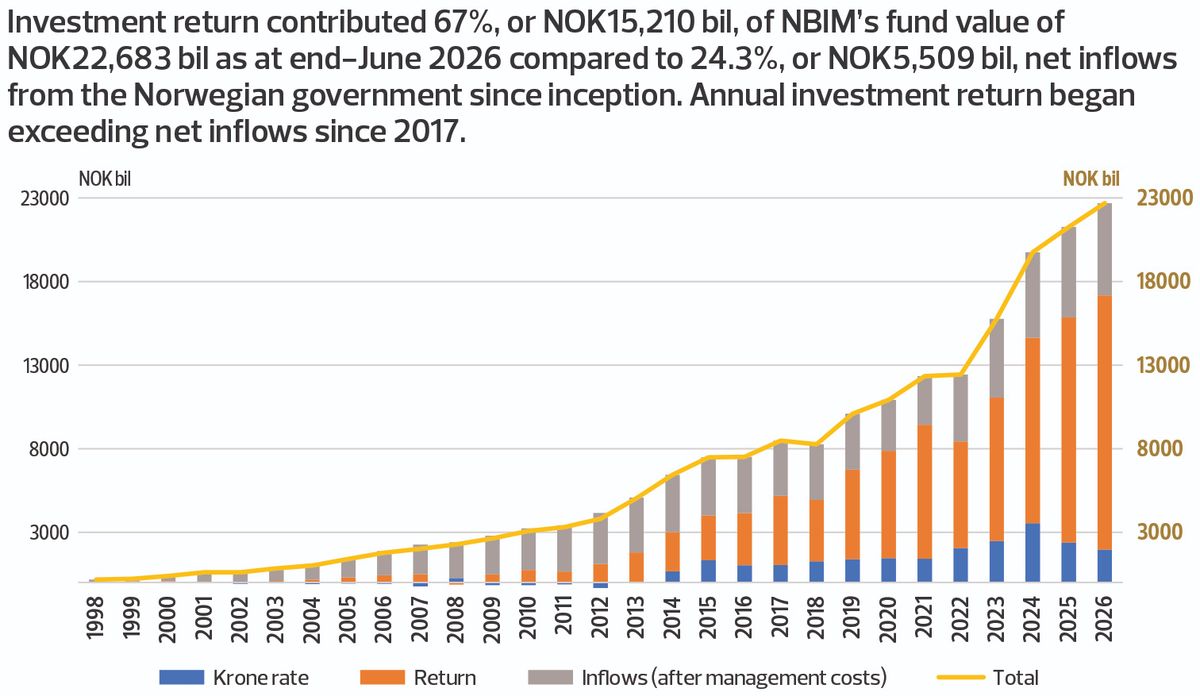
Norway’s Government Pension Fund Global — the world’s largest sovereign wealth fund, valued at US$2.3 trillion (RM9.26 trillion) at end-June 2026 — was set up in 1990 to invest the country’s surplus petroleum revenues. Investment returns now account for 67% of its value, compared with just 24.3% from net inflows by the Norwegian government. Annual investment returns began exceeding net inflows in 2017, according to data from its manager, Norges Bank Investment Management, the central bank.
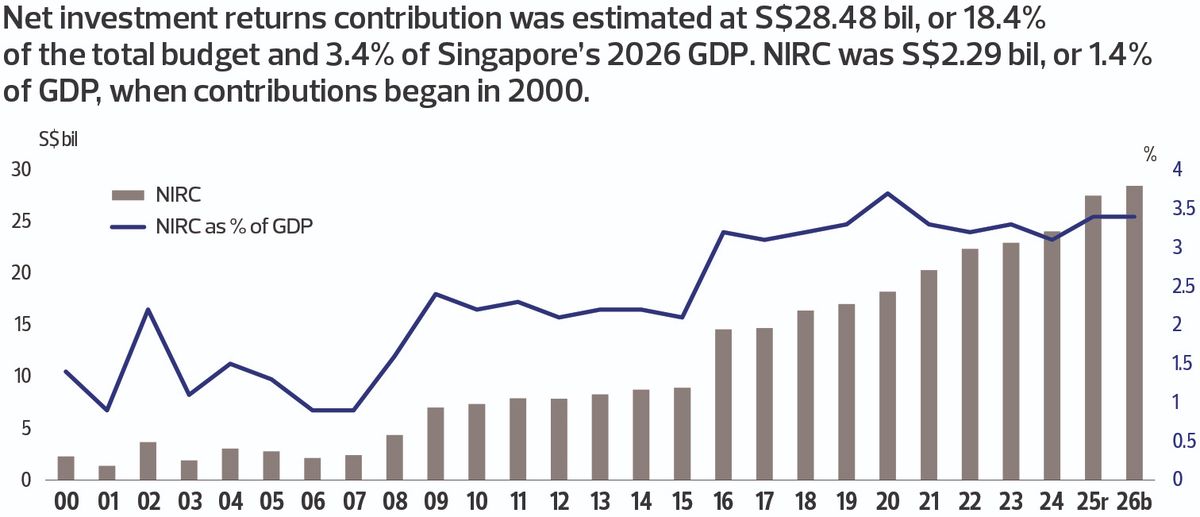
Across the Causeway, Singapore, which has far fewer natural resources, has accumulated more than US$1 trillion in reserves, which, for example, allowed it to pay top dollar for vaccines during the Covid-19 pandemic. Since 2016, net investment returns contribution (NIRC) has contributed more to the country’s national budget than either personal income tax or goods and services tax (GST). NIRC includes 50% of net investment returns from Temasek Holdings Pte Ltd, the city state’s investment arm; GIC Pte Ltd, which manages the government’s reserves; and the Monetary Authority of Singapore, the central bank.
From just S$2.29 billion, or 1.4% of the city state’s GDP when contributions began in 2000, NIRC is today estimated at S$28.48 billion (RM90.14 billion), or 18.4% of the total budget and 3.4% of Singapore’s 2026 GDP when its budget was tabled in February. Singapore recently raised its 2026 GDP growth forecast to between 4.5% and 5.5%, from 2% to 4%, following 6.1% growth in the first half of the year, driven by the artificial intelligence boom.
Malaysia is fortunate to have PETRONAS, which contributed RM516 billion to the government between 2019 and 2025, bringing total contributions since its inception in 1974 to RM1.6 trillion. Even 1% of that RM1.6 trillion would have given the country an additional RM16 billion, excluding the compounding power of investment returns over five decades.
Malaysia has demonstrated its capability to deliver stellar investment returns. The RM1.54 trillion managed by the Employees Provident Fund on behalf of its 18.5 million members makes it one of the world’s largest pension funds.
Sovereign wealth fund Khazanah Nasional Bhd — which, for the most part, has to borrow to generate returns for the country, while being expected to participate in nation-building projects and own strategic assets that may not immediately generate profits — paid RM11 billion in dividends, or RM1.57 billion on average, to the federal government from 2019 to 2025. During that period, its seven-year rolling annualised return was 6.1%, bringing total assets to RM156 billion at end-2025.
In other words, Malaysia can turn KWAN into a trillion-ringgit sovereign wealth fund if enough capital is set aside and allowed to grow large enough to become a new engine of growth, rather than merely a useful pool of savings for extra pocket money.
Save by subscribing to us for your print and/or digital copy.
P/S: The Edge is also available on Apple's App Store and Android's Google Play.