

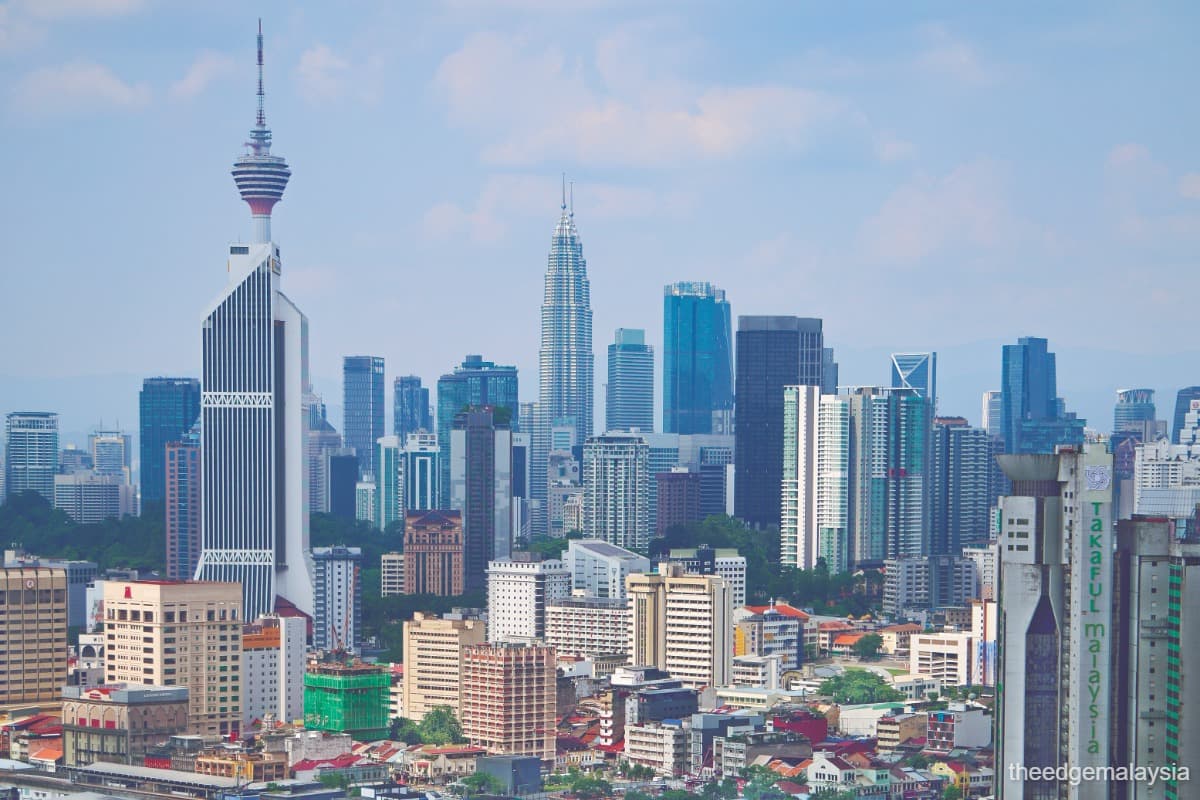
This article first appeared in Capital, The Edge Malaysia Weekly on August 31, 2026 - September 6, 2026
WITH the FBM KLCI set to expand to 50 constituents, from 30, it is worth looking at which of the 20 potential new entrants analysts favour. Screening the entrants by the number of ‘buy’ calls, six names stand out as those most favoured by research houses. The list comprises a mix of semiconductor, construction and building materials counters riding some of 2026’s biggest earnings swings.
Sime Darby Property Bhd
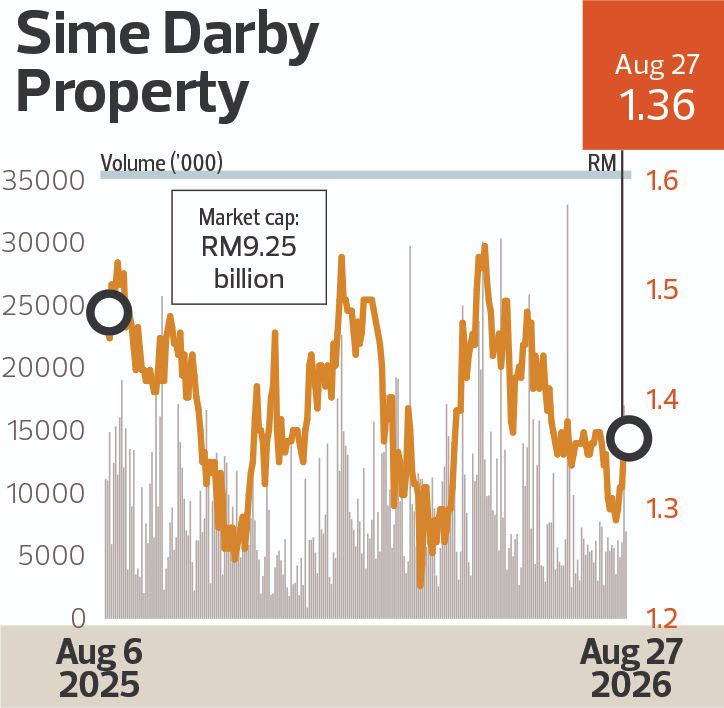
With a market capitalisation ranging between RM8.5 billion and RM10.5 billion over the past two years, Sime Darby Property Bhd (KL:SIMEPROP) has generally sat comfortably among Bursa Malaysia’s top 50 companies by market capitalisation.
Right now, the property group is no longer just building more properties; the bigger story is its seven-year SHIFT32 strategy, launched this year to pivot towards recurring income through asset ownership and investment management — a shift that could fundamentally change how investors value the company.
Its assets under management (AUM) surged 79% from RM2.8 billion in December 2025 to about RM5 billion in July, putting it halfway towards its RM10 billion target by 2028. At an annualised yield of 6.3%, the RM5 billion portfolio implies roughly RM315 million of annualised property-level income once fully developed. While this is not directly comparable with group net profit, which is after corporate overheads, finance costs and taxes, it provides a sizeable recurring-income base that could increasingly support earnings..
Sime Darby Property is also able to tap external capital, allowing the group to expand its portfolio without having to fund the entire asset base from its own balance sheet, while potentially generating asset, development management and fund management income.
In July, it established a RM2.6 billion green sukuk programme to finance data centre infrastructure, and raised RM1.25 billion in third-party institutional capital through its New Economy Venture (NEV) fund.
This greater financial firepower comes at a time when the group has a vast 11,000 gross acres of land bank, representing an estimated RM104 billion in gross development value. This gives Sime Darby Property ample capacity to replenish its development pipeline and capture demand in high-growth segments.
Over the past five years, the company’s revenue has risen from RM2.22 billion in FY2021 to RM4.18 billion in FY2025, while net profit climbed from RM136.9 million to RM517.7 million.
Industrial property has become an increasingly important growth driver, with its contribution rising from 18% of sales in FY2021 to 36% in FY2025, highlighting the group’s ability to capture demand from data centres and high-tech industrial parks. Residential and commercial sales have also remained resilient, exceeding RM2 billion annually over the past five years.
The more significant change for investors, however, is the new dividend policy. Sime Darby Property has raised its targeted payout ratio to between 40% and 60% of profit after tax and minority interests (Patami) from the previous minimum of 20%, reflecting the confidence in growing contribution from recurring income.
Analyst sentiment is equally strong. All 13 analysts covering the stock have a “buy” call, with target prices ranging from Public Investment Bank’s RM1.55 to Affin Hwang Investment Bank’s RM2.25. The consensus target of RM1.88 implies 38.2% upside from its last close of RM1.36. — By John Lai
Frontken Corp Bhd
Despite a sizeable warrant conversion that added 159.19 million shares, equivalent to 9.6% of its share base, Frontken Corp Bhd (KL:FRONTKN) has pushed its share price another notch higher this year.
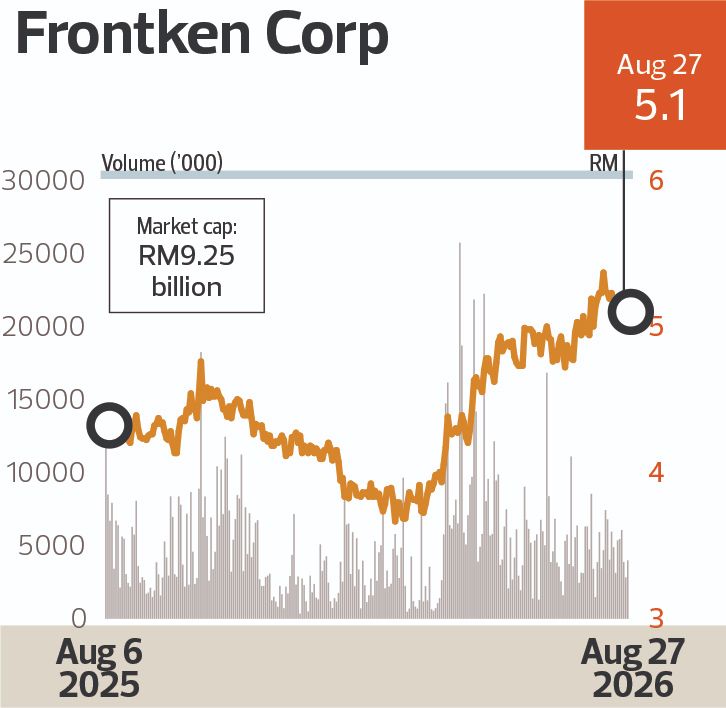
The stock has risen about 11% from RM4.61 at the start of the year to RM5.10 this month, lifting its market capitalisation from RM6.86 billion to RM9.25 billion. Frontken, which is principally involved in the provision of surface treatment and advanced precision cleaning to the semiconductor sector, now ranks 46th among Bursa Malaysia companies by market capitalisation.
The stronger share price was achieved despite the dilution, with its forward price-earnings ratio (PER) expanding from 42.8 times to 46.9 times amid positive sentiment towards semiconductor-related stocks during the current upward cycle.
Frontken is a leader in precision cleaning and coating services, particularly for the semiconductor industry. Taiwan accounts for about 62% of group revenue, with Taiwan Semiconductor Manufacturing Co Ltd (TSMC) contributing roughly one-third, making the company a direct beneficiary of the sustained ramp-up of advanced semiconductor nodes.
As chipmakers migrate to smaller nodes and increasingly complex processes, tighter contamination controls are making precision cleaning more critical to production efficiency. Frontken helps customers reduce chamber downtime and maintenance frequency while extending component life, giving investors exposure to front-end semiconductor manufacturing without the heavy capital expenditure (capex) associated with chip fabrication.
The company is also accelerating capacity expansion, with three new plants either under development or being brought online, alongside further expansion at its existing Plant 1. Plant 2 is expected to begin low-volume production in September, while Plant 3 and Plant 4 are targeted to support growth from late 2026 and 2028 respectively, with a potential Plant 5 providing further upside.
The accelerated capex programme points to stronger demand visibility, particularly in Taiwan and Singapore, which are expected to remain key earnings drivers through FY2026 and FY2027.
More importantly, the warrant conversion has strengthened Frontken’s balance sheet, with cash holdings rising to RM1.52 billion, from RM841.13 million. The stronger cash position gives the group greater flexibility to pursue overseas expansion, although management remains disciplined on large-scale acquisitions. It is likely to approach the US market via a joint venture or smaller-scale entry, while Japan is viewed as a more strategically attractive market.
Frontken has also delivered steady financial growth, with revenue rising from RM450.22 million in FY2021 to RM607.76 million in FY2025 and net profit increasing from RM104.5 million to RM154.23 million. Net profit margin widened from 23.21% to 25.38%, reflecting improved operational efficiency and a better mix of higher-margin jobs.
Analyst sentiment remains strong, with 13 “buy” calls and one “hold”. Target prices range from Berjaya Research’s RM5.04 to Macquarie Research’s RM6.10, while the consensus target of RM5.69 implies 11.6% upside from RM5.10. — By John Lai
Dialog Group Bhd
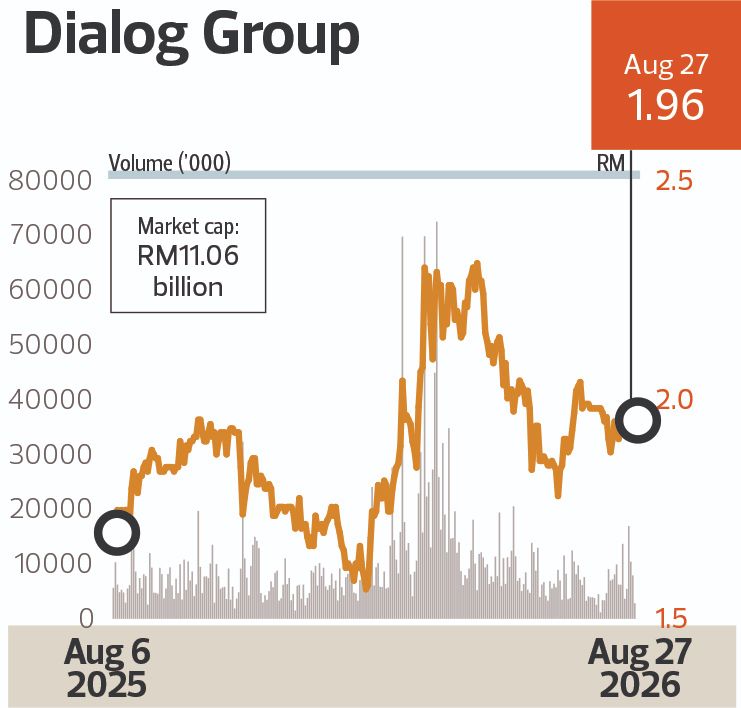
With a market capitalisation of about RM11.1 billion and a 17.6% share price gain year-to-date (YTD), Dialog Group Bhd (KL:DIALOG) starts FY2027 (ending June 30) with a more stable earnings base and several new assets coming onstream. The group’s midstream tank terminal business already contributes about half of group earnings via recurring income, while new upstream production from Cendramas and the Baram Junior Cluster will provide the next leg of growth.
Dialog closed FY2026 with core net profit rising 47% to RM617.6 million, according to Maybank Investment Bank. Revenue increased 15.3% to RM2.88 billion while reported net profit nearly doubled to RM593.6 million, from RM303.8 million a year earlier.
Dialog operates across the upstream, midstream and downstream oil and gas and petrochemical value chain.
The group’s midstream division contributed roughly half of FY2026 earnings, according to HLIB. Tank utilisation remains above 90% and independent storage rates are stable at S$6 to S$6.50 per cu m per month. UOB KayHian Research notes that storage is already operating around multi-cycle highs, with occupancy rates above 94%, providing a stable earnings base but limiting near-term upside.
With utilisation already high, growth will increasingly come from additional capacity. HLIB says the 150,000 cu m Dialog Terminals Langsat 3 expansion is due to start operations in September, with 100,000 cu m already contracted to EcoCeres. Further additions include a 272,000 cu m expansion at Pengerang Terminals Two for the Pengerang biorefinery and 614,000 cu m at Pengerang Terminals Five for petroleum and biofuel products. Dialog also has about 660 acres available in Pengerang for further expansion.
The next earnings step-up is likely to come from the upstream division, which contributed about 25% of earnings in FY2026, even though production was affected by maintenance in local fields. Higher oil prices helped offset weaker volumes.
The Cendramas and the Baram Junior Cluster are expected to begin contributing in FY2027, with upstream’s share of group earnings projected to rise to between 30% and 40% from about 25%.
Finally, the group’s downstream division has stopped being the drag it was in FY2025. Following major turnarounds in FY2026, UOB KayHian said the segment returned to sustainable profitability after loss-making legacy engineering, procurement, construction and commissioning (EPCC) projects weighed on FY2025 performance.
Earnings visibility remains supported by the same terminal expansion programme, including EPCC work for Langsat 3, Pengerang Terminal Two and Pengerang Terminal Five, giving the division continued project visibility as Dialog builds out its recurring midstream asset base.
The stronger FY2026 performance also translated into a higher dividend payout. Total dividends rose to 4.7 sen per share, from 3.1 sen in FY2025, while Dialog remains in a net-cash position, providing capacity to fund its expansion pipeline.
Analyst sentiment is broadly bullish, with 12 “buy” and two “hold” calls. The consensus 12-month target price of RM2.45 implies 25% upside from the last close of RM1.96. — By Zachary Nathan
ViTrox Corp Bhd
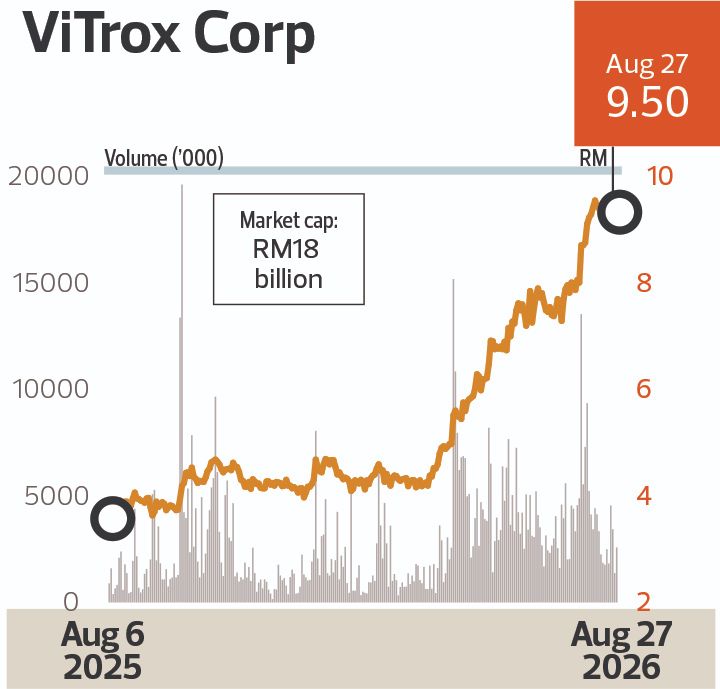
ViTrox Corp Bhd (KL:VITROX) has been a standout performer on the bourse this year, rallying 139% YTD as at the close on Aug 27. The gains come as brokers reassess the semiconductor inspection specialist’s exposure to the artificial intelligence (AI) capex cycle that has taken markets by storm.
The more important story for ViTrox is that demand continues to outpace delivery capacity. Its book-to-bill ratio hit a record 1.5 times in the second quarter of 2026, up from 1.3 times in the previous quarter and 1.1 times two quarters earlier, even as revenue itself jumped 40% quarter on quarter (q-o-q) to RM375 million. Estimates by UBS show that 60% to 70% of equipment sales are now tied to the inspection of AI server-related devices and semiconductors, a share expected to keep climbing as customers scale advanced packaging and AI hardware output.
UBS projects aggregate 2026 capex to grow 71% year on year (y-o-y) among major outsourced semiconductor assembly and test players and 60% among major electronics manufacturing services customers.
Supply has become the binding constraint. ViTrox is adding floor space via Campus 4, Campus 5 and two new warehouses to relieve near-term bottlenecks, according to Maybank Investment Bank Research. Campus 5, which measures 500,000 sq ft and is due within 12 to 15 months, could add at least RM800 million of annual revenue capacity from FY2028.
The scale of the turnaround shows up in the historical numbers, too. Net profit fell from about RM201 million in FY2022 to RM90 million in FY2024, while revenue declined for two consecutive years before rebounding 52.7% to a record RM843 million in FY2025. Revenue for 1HFY2026 surged 98% y-o-y to RM642 million, while net profit attributable to shareholders more than doubled to RM136.2 million.
Research coverage remains bullish overall, with 11 “buy”, two “hold” calls and one “sell” call. The consensus target price of RM10.61 implies 11.6% upside from the last close of RM9.51. — By Zachary Nathan
IJM Corp Bhd
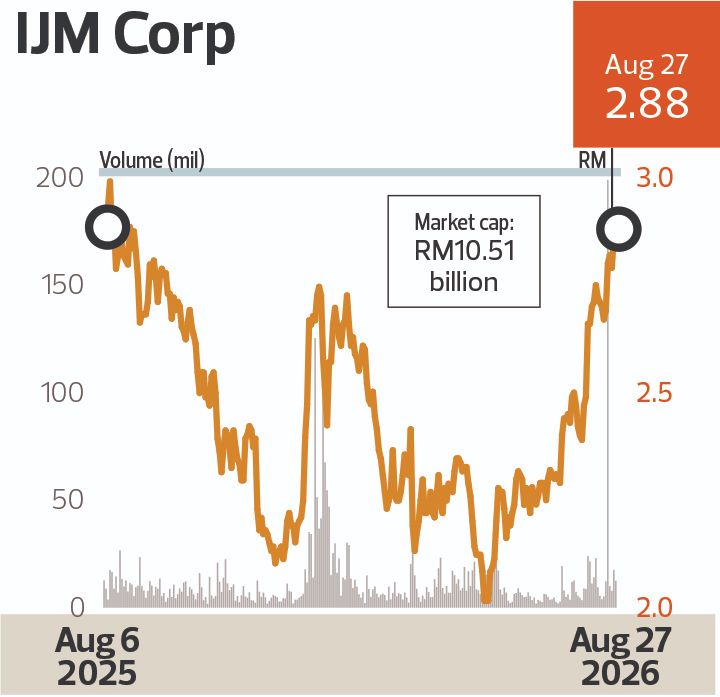
IJM Corp (KL:IJM) has staged a recovery this year, following what some have called “two lost years”, when the group underperformed peers such as Gamuda Bhd (KL:GAMUDA) and Sunway Construction Bhd (KL:SUNCON), despite being one of the big three contractors domestically. Shares have gained 30.3% YTD.
The more prominent question is whether IJM can structurally lift its depressed returns. Core return-on-equity bottomed at 3.3% in FY2026, when core net profit fell to just RM3 million from RM403 million in FY2025. Revenue came in at RM6.88 billion in FY2026, from RM6.25 billion in FY2025. UBS expects core earnings to rebound by about 39% in FY2027, and a further 14% and 8% in FY2028 and FY2029 respectively.
Construction is the key swing factor. IJM’s order book replenishment has hit record highs, with data centre jobs alone contributing RM5 billion since FY2022, despite a late entry into the hyperscale segment.
JP Morgan forecasts RM8 billion worth of new contract wins in FY2027, the top end of management’s own RM6 billion to RM8 billion guidance. The research house attributes the stronger outlook to tightening industrial land in Penang, where Batu Kawan has roughly 300 acres left and the Penang Development Corporation is seeking another 2,000 acres — a scarcity it expects to support a longer industrial building cycle as new capacity gets developed.
According to UBS, IJM’s order book stood at RM7.1 billion in FY2026, while its tender book has ballooned to RM18 billion, comprising mostly data centres and other industrial buildings.
Property and port operations should also turn the corner from low bases, UBS says. Property sales recovered to RM1.8 billion in FY2026, from RM1.5 billion in FY2025. Meanwhile, Kuantan Port saw throughput fall 15% to 20.6 million freight weight tonnes (FWT) in FY2026, as key customer Alliance Steel underwent major blast furnace maintenance. Throughput is expected to recover 10% to 22.7 million FWT in FY2027.
The bigger re-rating catalyst may be capital return rather than earnings alone. IJM’s three-year, RM3 billion value realisation plan includes regular dividends, a distribution of 140 million treasury shares, the proposed listing of IJM Construction, toll road monetisation and a full exit from India. JP Morgan estimates that monetising treasury shares alone could add about 4% of market value on top of a roughly 3% dividend yield.
Analyst sentiment remains strong, with 13 “buy”, three “hold” calls and one “sell” call. The consensus target price of RM3.20 implies 11.1% upside from the last close of RM2.88. — By Zachary Nathan
Malayan Cement Bhd
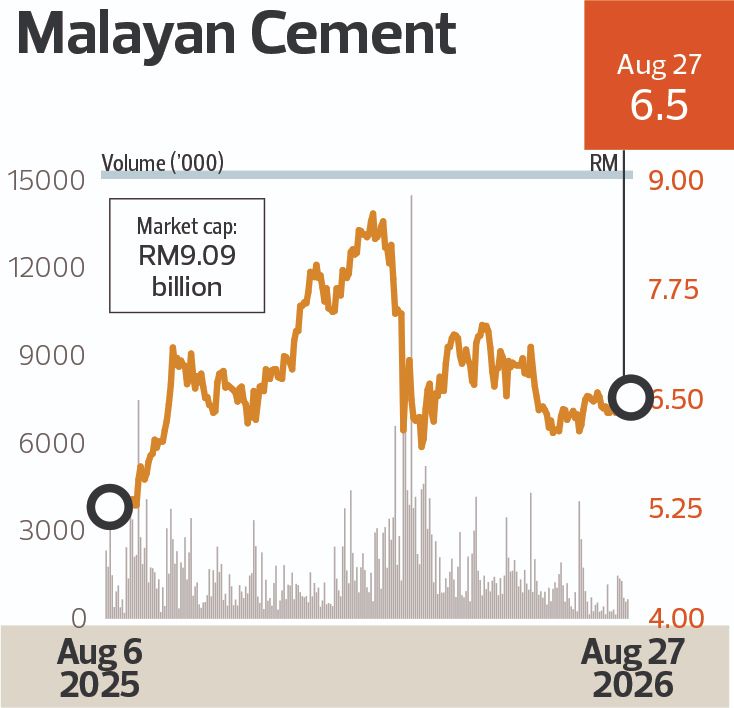
Malayan Cement Bhd (KL:MCEMENT) enters FY2027 (ending June 30) with earnings momentum intact but margins facing a near-term squeeze from rising coal costs. The counter closed at RM6.50 on Aug 27, down 14.46% YTD.
Full-year FY2026 net profit attributable to owners came in at RM903.17 million, up 34% y-o-y, beating consensus forecasts. The performance came from ready-mixed concrete and drymix turnover amid lower energy costs and reduced finance costs. Coal is now the key swing factor into FY2027.
HLIB forecasts coal costs rising about 20% q-o-q to around US$85 per tonne in 1QFY2027, with coal accounting for roughly 30% of cement production costs. Margins are expected to moderate as cheaper FY2026 coal inventories are depleted. HLIB adds that Malayan Cement’s coal supply is unlikely to be hit by Indonesia’s regulatory uncertainty, as procurement is sourced from Indonesian state-owned entities. MBSB Research notes that the group’s rolling two- to three-month procurement strategy should keep the cost impact manageable.
HLIB trimmed FY2027 earnings forecasts by 6% on higher coal cost assumptions, and MBSB raised FY2027 expected earnings by 3%, following a stronger FY2026 base.
Beyond coal, MBSB flags a multi-year demand pipeline as the bigger re-rating driver. These include warehouses, data centres and residential projects, alongside the anticipated MRT3 rollout, the Johor-Singapore Special Economic Zone, and Budget 2026/13th Malaysia Plan infrastructure spending on roads, schools and hospitals. China’s coal output could normalise as Indonesian supply improves, providing a further catalyst that could unlock further upside from currently elevated production costs, says HLIB.
Analysts remain predominantly positive on the stock, with six “buy” calls and one “hold” call. The consensus target price of RM8.77 implies 34.9% upside from the last close of RM6.50. — By Zachary Nathan
Save by subscribing to us for your print and/or digital copy.
P/S: The Edge is also available on Apple's App Store and Android's Google Play.