

This article first appeared in Capital, The Edge Malaysia Weekly on August 31, 2026 - September 6, 2026
THE expansion of the country’s flagship index, the FBM KLCI, is expected to lift Main Market coverage to 70%,from 60%, bringing the benchmark into the range of more mature markets such as the Standard & Poor’s 500, at about 80% of investable US market capitalisation, and South Korea’s Kospi 200, at roughly 89% of its market.
On diversification, new or wider representation from industrials, technology and real estate is the clearest evidence of progress.
It has been 17 years since any changes have been made to the FBM KLCI. Its expansion is set to begin later this year in two phases. The first, on Dec 21, will see 20 stocks added at 50% of their final index weight. Subsequently, on June 21, 2027, they will reach 100% of their final index weight.
The expansion has a dual mandate. The current FBM KLCI covers only about 60% of Main Market capitalisation, and expanding to 50 would lift coverage to roughly 70%, providing a more representative measure of the broader market.
The expansion will also reduce sector concentration while improving industry diversification. The index has long been concentrated in financial services and utilities, accounting for 42.3% and 15.3% of index weightage respectively, according to FTSE Russell. Sectors that stand to gain amid financial services and utilities dilution are technology, energy, real estate, industrials and consumer discretionary.
The implemented changes are narrower than what was first announced in March this year. The joint consultation paper proposed three elements: (i) expanding the FBM KLCI to 50 constituents; (ii) reducing the FBM70 to 50 constituents, and; (iii) an optional 10% company-level weight cap on KLCI constituents. Only the first two survived, as the company-level weight cap was dropped.
The FBM70 will be renamed the FTSE Bursa Malaysia Mid Cap Index, keeping the FBM100, which comprises both indices, at exactly 100 constituents.
Price effects on the KLCI
Despite all the sectoral weight shifting, Noah Jia En, a fund manager at KAF Investments, does not expect the transition itself to knock the index around.
“There are only a handful of passive funds tracking the KLCI,” he says. Active fund managers — who weigh company fundamentals more than benchmark weightings — should comfortably absorb the roughly 15% deviation the dilution creates, as the combined weight of the existing 30 constituents falls from 100% to around 85%.
Noah says the two-phase rollout does some of that work, too. Spreading the mechanical balancing — the actual buying and selling tied to the weight changes — across two dates allows the market time to digest it, rather than absorbing it all at once.
But prices will not wait. “Most of the price adjustment is likely to take place ahead of the Nov 23 cut-off, as active fund managers will likely position themselves ahead of the benchmark changes,” he says.
That positioning has a clear target. Financial services and utilities may be hardest hit, but they are not the only sectors in motion. Technology, energy, real estate, industrials and consumer discretionary are sectors that stand to gain and are largely untouched by the current 30-stock index.
CIMB Securities’ internal simulation puts the numbers to the shift. Of the 20 likely additions, five come from industrials, four from consumer discretionary, three from technology, two each from real estate and consumer staples, and one apiece from financial services, telecommunications, utilities, healthcare and energy.
Technology stands out most starkly because it is starting from nothing. Hong Leong Investment Bank (HLIB) calls it the reshuffle’s “biggest winner”, rising from zero currently to an estimated 1.9% at Phase 1, before climbing further to 3.4% by Phase 2.
Who gets a seat at the table
The steepest individual cuts will come from familiar heavyweights. CIMB names Malayan Banking Bhd (KL:MAYBANK), Public Bank Bhd (KL:PBBANK), CIMB Group (KL:CIMB) and Tenaga Nasional Bhd (KL:TENAGA) as facing the steepest individual weight cuts from the dilution.
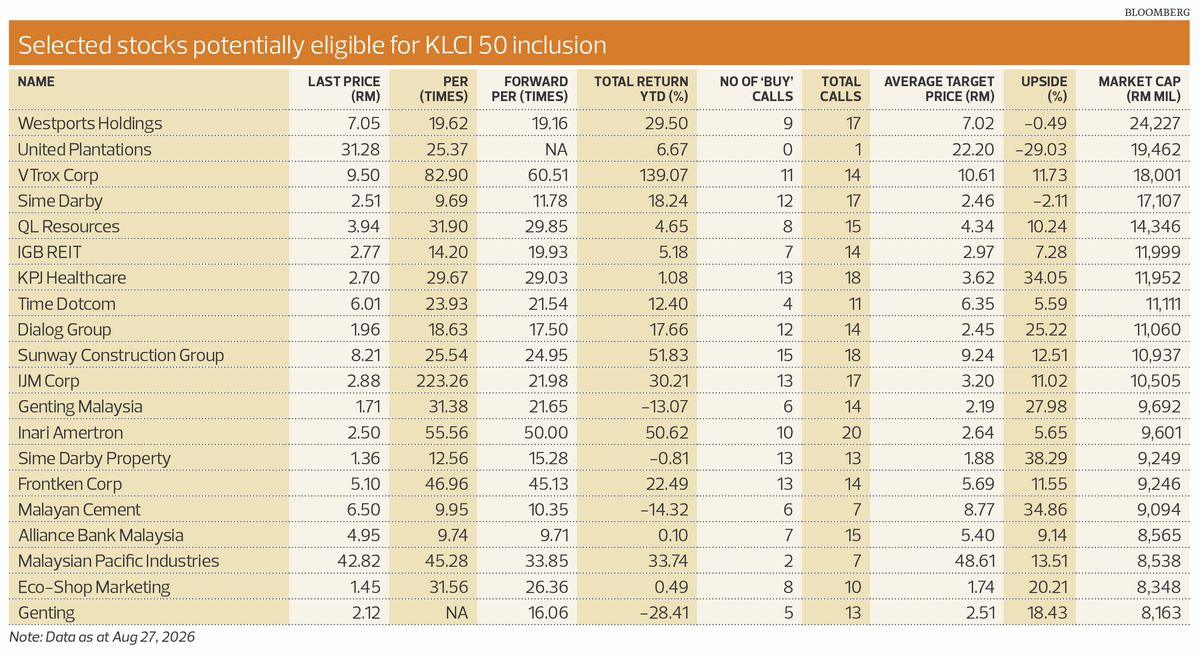
Independent simulations by HLIB and CIMB Securities, using data as at Aug 19 and 20 respectively, arrived at 20 of the same names. The list remains a moving target until the actual Nov 23 ranking cut-off locks it in.
Regardless of how the composition eventually shakes out, the new constituents will inevitably skew towards existing large-caps rather than small-cap upstarts, owing to methodology requirements. Westports Holdings Bhd (KL:WPRTS), United Plantations Bhd (KL:UTDPLT) and ViTrox Corp Bhd (KL:VITROX) top the list by market capitalisation, each valued above RM17 billion. Even the smallest on the list, Genting Bhd (KL:GENTING), was trading at a market capitalisation of about RM8.2 billion at the time of writing.
Noah does not expect constituent inclusion to transform these companies.
“Since the FBM100 is a popular benchmark, most potential new entrants are large-cap stocks that are already well followed by institutional investors,” he says, adding that a one-off re-rating is more likely than lasting improvements in liquidity, institutional ownership or valuations.
A wider net, not a lower one
While the transition is expected to remain orderly, HLIB has flagged what it calls a “possible transitory overhang” for the existing 30 constituents. The phased rollout could stretch incumbent dilution to mid-2027, and investors may be reluctant to add to positions they know are shrinking in influence throughout that window. By HLIB’s own estimates, the combined weight of the existing 30 falls to 91.3% at Phase 1 and 84% by Phase 2.
The clearest tension sits with the one proposal that did not survive the consultation. Bursa Malaysia and FTSE Russell’s own enhancement FAQ acknowledges that feedback on the proposed 10% company-level cap was split, with some respondents in favour and others warning it would trigger frequent rebalancing and restrict the contribution of strongly performing constituents. No capping mechanism was ultimately introduced. That decision leaves a gap between the stated goal and the outcome.
Even after full implementation, financial services remains by far the index’s largest sector at 36.5% to 36.8%. Utilities, the next largest sector, will be weighted at 13.4% to 15.8%. A 10% cap would have made that dominance close to impossible to sustain, mechanically limiting any single constituent’s weight regardless of how large it grew. Without one, nothing stops current, or future, heavyweights from growing back into the same outsized share over time.
A wider, more diversified KLCI, even without a cap, is a step in the right direction, say market players.
This is not the KLCI’s first overhaul. Changes to the index came in 1986, 1995 and, most significantly, in 2009, when Bursa Malaysia and FTSE Russell cut the constituent count from 100 to 30, and renamed the benchmark to the FTSE Bursa Malaysia KLCI (FBM KLCI). The changes went beyond the size of the index, introducing a free float-adjusted methodology, a 15% minimum free float requirement and liquidity screening, replacing the old full market cap weighting.
Save by subscribing to us for your print and/or digital copy.
P/S: The Edge is also available on Apple's App Store and Android's Google Play.