

(Sept 1): India’s long-awaited private investment cycle may finally be stirring, adding another engine of growth that could help the world’s fastest-growing major economy sustain its momentum after years of heavy lifting by the government.
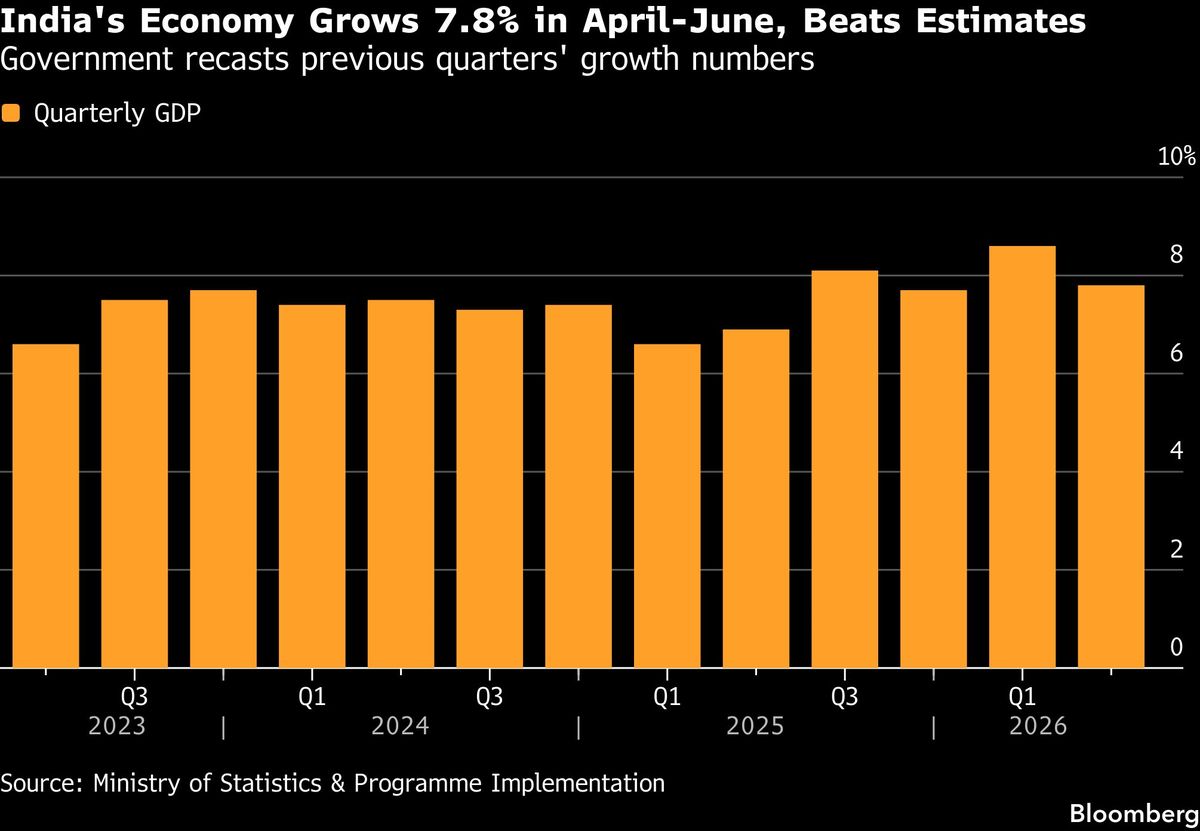
The economy grew at a brisk 7.8% pace in the three months-ended June, data on Monday showed, driven by manufacturing, construction and services sectors. Household demand remained an ongoing source of strength.
The figures showed that gross fixed capital formation, a proxy for government and industry spending, surged 11.9% to an all-time high, up from 10.8% the previous quarter and now accounts for a bit over one-third of gross domestic product.
“A lot of investment is happening under the hood. They are not big ticket and so the announcements are not dramatic,” said Soumya Kanti Ghosh, economist at the State Bank of India. “But the private sector has invested heavily in renewables, data centres, etc in recent years.”
He raised his forecast fiscal-year expansion by 70 basis points to 7.3% and anticipates the strong investment momentum will continue.
The government’s capital expenditure has surged more than sixfold to 12.2 trillion rupees (RM520 billion) in the current fiscal year-ending March 2027 from 2014-2015 levels as it builds more roads, ports and bridges. And now, there are other signs too that show companies are becoming more willing to invest.
Bank lending to industry and services accelerated in recent months after lagging consumer borrowing for much of the post-pandemic period. Lending to medium-sized businesses jumped to a record high of 4.8 trillion rupees in July, 30% higher than a year earlier, according to Reserve Bank of India data.
Companies including Tata Steel Ltd and the Adani Group have in recent months announced investment plans across sectors ranging from manufacturing and energy to infrastructure.
“The strength in manufacturing and investment activity aligns with our view of India being on the cusp of a capex up-cycle,” said Morgan Stanley economists Upasana Chachra and Bani Gambhir as they lifted their fiscal year growth estimate to 7.3%.
India produces everything from automobiles and mobile phones to pharmaceuticals, chemicals and steel, and is trying to build a larger semiconductor industry. But manufacturing’s share of the economy, at 17%, remains below Modi’s 25% goal.
The stronger demand was reflected across industries in Monday’s data:
- Manufacturing expanded 9.2%, up from 7.3% a quarter earlier.
- Construction grew 7.7% while electricity grew 8.9%.
- Services remained the strongest sector of the economy, rising 10%. This was led by financial, real estate, information technology and professional services, which grew 12.1%.
- Exports grew 12% compared with 3.7% in the March quarter.
The manufacturing pickup is particularly important for Modi, who has sought to bolster production in order to create jobs for millions of people entering the workforce each year in the world’s most populous nation.
India also revised the higher growth rate for the March quarter to 8.6% on Monday. Economists say India will need to maintain this pace for the next two decades to avoid the so-called middle-income trap. In such a scenario, rising wages erode a country’s low-cost advantage before productivity and skills improve enough to compete with richer economies.
The June quarter performance also puts Asia’s third-largest economy on track to exceed a 7% growth rate in the 12 months to March 2027. While strong, India will have to expand even faster to attain Prime Minister Narendra Modi’s dream of becoming a developed nation by 2047.
If the private investment boom — seen in the June quarter — extends, India’s hope may still be alive, economists say.
The strength of India’s economy may give the RBI more confidence that it can focus on inflation. After minutes of its August meeting, it struck a more hawkish policy tone. Yet it will want to avoid jeopardising a private-investment recovery that some economists say is still fragile.
“Private capex has only recently started picking up again,” following the uncertainty triggered by the Middle East conflict, said Debopam Chaudhuri of Piramal Group.
“The recovery in private investment is encouraging — but it is still at an early stage and needs supportive financial conditions to become self-sustaining,” he said, arguing against prematurely raising interest rates.
Uploaded by Arion Yeow