

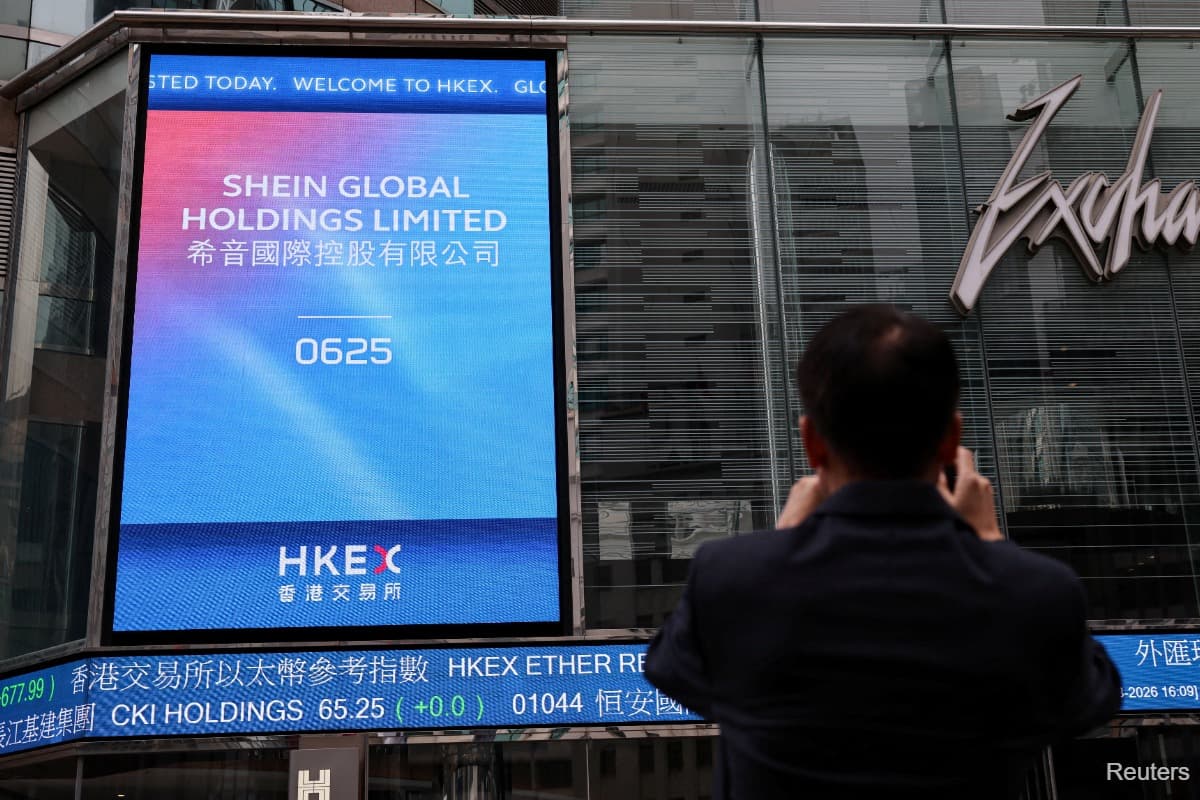
HONG KONG (Sept 1): Shares of fast-fashion retailer Shein ended flat in their Hong Kong debut on Tuesday, recovering from a sell-off fuelled by investor worries that various setbacks and delays to a market listing have eroded its competitive advantages.
The stock fell as much as 10% in early trade and its rebound was a result of so-called stabilisation measures applied to large listings to avoid sharp declines on a debut day, according to one source and analysts.
Known globally for selling US$5 tops and US$10 dresses, Shein has been humbled by tariff and duty changes in the US and Europe that have contributed to a dramatic decline in its valuation.
Founded in China in 2012 and headquartered in Singapore since late 2021, Shein spent years touting its credentials as a global company before re-embracing its Chinese roots to list in Hong Kong.
That capped a four-year quest to go public and the associated intense scrutiny that ultimately led to Chinese authorities blocking those efforts.
Shein shares finished at HK$48.50, just below the HK$48.56 initial public offering (IPO) price, recovering from as low as HK$43.80. The close price valued the company at about US$26.3 billion (RM106.2 billion), far below its 2022 peak of nearly US$100 billion.
The stock stabilisation move and relatively fewer shares available for trading could have helped Shein shares on Tuesday, but they might come under pressure again, said Jianggan Li, the chief executive officer of consultancy Momentum Works in Singapore.
"I think the real test is how the stock trades over the next few weeks once the excitement of the debut — and eventually the stabilisation period — passes."
Shein and Goldman Sachs, the IPO stabilising manager, did not immediately respond to a request for comments. The source, who has direct knowledge of the matter, declined to be named without an authorisation to speak to the media.
Unlike most company bosses, founder and CEO Sky Xu, known for shunning the limelight, did not speak at the event though later took pictures with Shein employees on stage. He declined to respond to Reuters' questions.
"As a new company listed in Hong Kong, we will continue to innovate, optimize, and cooperate with our supply chain partners for mutual benefit and win-win results," Shein chief financial officer Leigh Gui said at the opening gong ceremony.
Valuation still seen as expensive
Investors and analysts have worried about Shein's slower growth, higher trade costs and tighter regulatory scrutiny.
"I think the weak debut shows that even after the huge valuation reset, investors still don't see Shein as obviously cheap," said Charu Chanana, the chief investment strategist of Saxo.
She said Shein was valued at 15 times forward earnings, more than double the multiple for PDD, the owner of rival Temu, which meant "investors were being asked to pay a premium despite weaker growth visibility and significant regulatory and trade risks".
Demand for Shein's stock during the IPO was tepid compared to high-profile offerings from the artificial intelligence (AI) and robotics sectors.
The retail tranche was subscribed 5.63 times, while the international portion was subscribed 2.59 times. Some deals have been hundreds of times oversubscribed, especially from Hong Kong's army of retail investors who track IPOs very closely.
The amount sold in the IPO represents about 6.6% of Shein's enlarged share capital. Cornerstone investors took about one-fifth of the IPO and are locked up for six months, leaving roughly 5% freely tradeable.
First-quarter loss, new strategies
Last year, the US ended the de minimis duty exemption for e-commerce shipments under US$800 that had powered Shein's direct-shipping model. The European Union recently followed suit, imposing fees on low-value packages.
Shein's net income slid 39% last year and it swung to a loss in the first quarter.
Shein has said it expects first-half operating profit margin to be slightly lower than in the first quarter, hurt by higher customs duties, tariffs, fees and logistics costs in Europe and the Middle East.
"Daily active users in Europe have fallen around 45% since the European Union scrapped its duty exemption on small parcels, and Temu has seen a similar drop," said Josh Gilbert, the lead analyst for Asia-Pacific at eToro.
"This is less a Shein problem, but more so the end of an era for cheap cross-border shipping. The brand's reach is unquestionable, but a large share of that loyalty has always belonged to the price tag."
Shein has been trying to widen beyond its own-label ultra-cheap fast fashion, having expanded its third-party marketplace and bought US apparel brand Everlane in May.
Regulatory risks remain a concern.
Shein has disclosed an ongoing US Federal Trade Commission consumer protection investigation that could result in significant penalties. The European Commission is also examining the company's handling of illegal products, the potentially addictive design of its platform and the transparency of its recommendation systems.
The IPO has helped Shein compensate early investors who invested at much higher valuations. The company has agreed to make cash payments totalling about US$3.5 billion and share adjustments to some preferred shareholders.
"This IPO is not just a fundraising event — it is also, and probably more of, a capital-structure event," said Li.
Uploaded by Tham Yek Lee