

This article first appeared in The Edge Malaysia Weekly on August 31, 2026 - September 6, 2026

Every investment is a bet.
When investors buy shares because they expect corporate earnings to exceed expectations, they are betting. When traders buy oil futures because they believe conflict in the Middle East will disrupt supply, they are betting. Venture capitalists funding an artificial intelligence (AI) start-up are betting. Banks financing a new factory are betting.
Capitalism itself is built upon allocating capital under uncertainty.
Yet when someone wagers on a football match or buys a lottery ticket, society calls it gambling.
Where, exactly, is the line?
The rapid rise of prediction markets such as Kalshi and Polymarket has exposed how blurred that line has become.
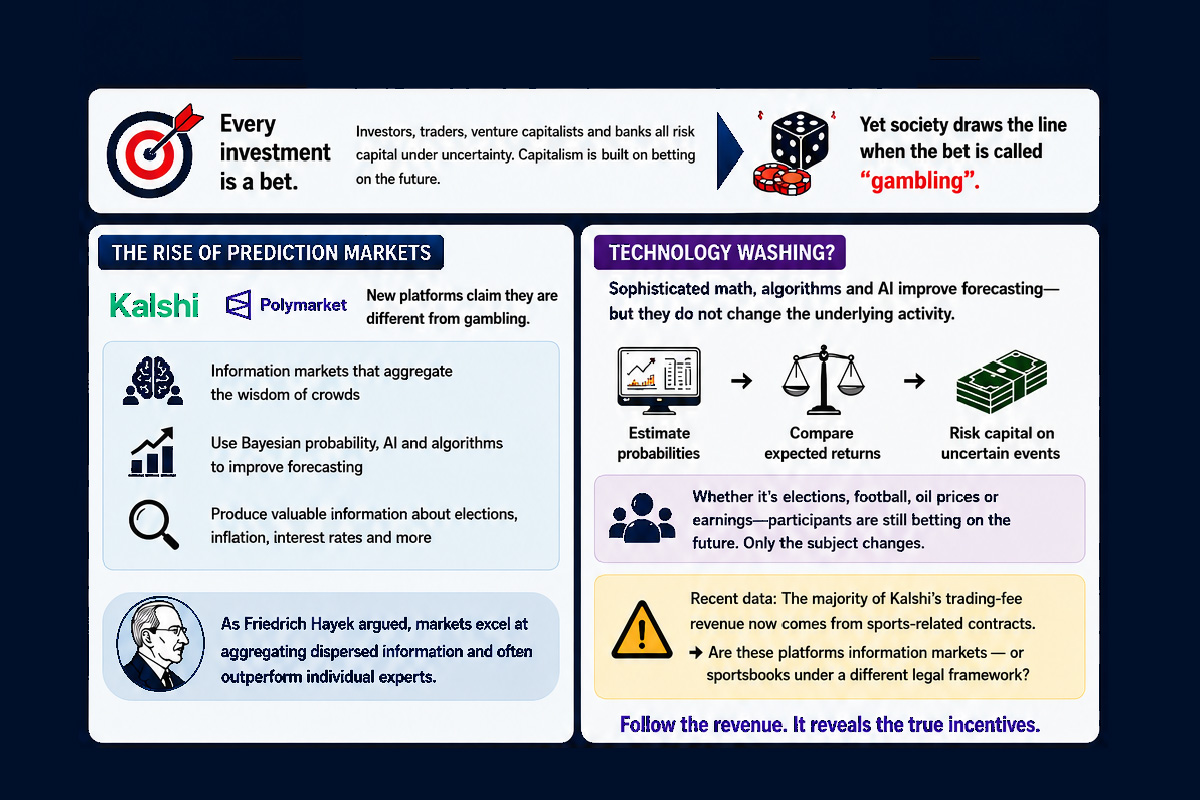
Their advocates argue that these platforms are fundamentally different from gambling. They describe them as information markets that aggregate the wisdom of crowds. They speak of Bayesian probability, market efficiency, collective intelligence, AI and price discovery. The argument is that these markets produce socially valuable information by forecasting elections, inflation, interest rates and economic events. There is considerable truth in this.

As Friedrich Hayek argued, markets are remarkably effective at aggregating dispersed information. Prediction models can, therefore, produce forecasts that are often more accurate than individual experts because they harness the collective judgement of thousands of participants.
But there is also a danger of what might be called technology washing.
Every technological era invents new language to make familiar activities appear fundamentally different. During the dotcom era, everything became an internet company. During the crypto boom, everything became Web3. Today, almost everything is AI-powered.
Prediction markets risk becoming another example.
Sophisticated mathematics, algorithms and AI undoubtedly improve forecasting. They do not fundamentally alter the underlying activity.
Participants are still risking money on uncertain future events.
Whether predicting inflation, corporate earnings, election results, football matches or horse races, the underlying mathematics is identical. Participants estimate probabilities, compare expected returns and commit capital accordingly.
Only the subject of the prediction changes.
If that sounds uncomfortable, it is because the distinction between investing, speculation and gambling has never been as clear as society often assumes.
An option trader wagering on next month’s interest-rate decision is risking capital on uncertainty. A fund manager buying shares ahead of an earnings announcement is doing precisely the same. These are informed bets.
The conventional defence is that financial markets serve broader economic purposes. They allocate capital, finance innovation and transfer risk, whereas gambling merely redistributes wealth, largely to the operator.
Again, there is considerable merit in this distinction.
Yet reality is more nuanced.
Recent estimates suggest that the overwhelming majority of Kalshi’s trading-fee revenue now comes from sports-related contracts rather than macroeconomic or financial events. Polymarket remains more diversified, particularly during election cycles, but sports and entertainment have also become major sources of activity.
If that is where these businesses generate most of their revenue, one naturally asks whether they are functioning primarily as information markets or increasingly as sportsbooks operating under a different legal framework.
The answer cannot simply be found in marketing language. It should begin with a much simpler question.
Where does the revenue come from?
Revenue often reveals incentives more clearly than mission statements. Prediction markets, therefore, expose a deeper inconsistency.
Most societies prohibit some forms of gambling while actively licensing others. Casinos are legal. State lotteries are legal. Horse racing is legal. Sports betting is legal in some jurisdictions but prohibited in others.
Meanwhile, economically similar activities become criminal offences simply because they fall outside of licensing framework.
Governments rightly argue that licensed operators are regulated, taxed and subject to anti-money laundering controls, consumer safeguards and responsible gambling requirements.
All of this is true.
Regulation undoubtedly reduces many of the social harms associated with gambling. But regulation alone does not explain why one wager becomes socially acceptable while another remains illegal. Nor does mathematics.
The economics of risking money on uncertain future outcomes remains fundamentally the same whether the wager concerns elections, football, oil prices or corporate earnings.
What differs is not the economics. It is the legal and institutional framework surrounding the transaction.
Societies may also choose to prohibit or discourage certain forms of gambling on moral or social grounds. That is entirely legitimate. But moral judgements should not be confused with economic distinction. They answer different questions.
This also helps clarify three separate debates that are often conflated.
The first is an economic question: What constitutes gambling?
The second is a policy question: Which forms of gambling should society permit?
The third is a political economy question: Who decides?
Ultimately, these are institutional choices.
Governments presumably balance competing objectives: reducing social harm, preventing organised crime, generating tax revenue, creating employment, attracting tourism, encouraging innovation and maintaining public confidence.
These are legitimate considerations. But they also remind us that the boundary between investing, speculation and gambling is not determined by mathematics alone.
It is determined by institutions.
This leads to a more fundamental question.
Whose interests are being served?
When policymakers invoke “the public interest”, whose interests have they actually balanced?
Public choice economics has long argued that public policy does not emerge from an abstract pursuit of the common good. It emerges from interactions among voters, politicians, regulators, businesses, courts and organised interest groups — each responding to their own incentives.
Industries with billions of dollars at stake have strong incentives to shape regulation. They lobby, commission research, educate policymakers and, in some jurisdictions, resort to outright corruption. Governments pursue legitimate objectives such as tax revenue, employment, investment and economic growth. Civil society, meanwhile, emphasises consumer protection, public health and social welfare. These interests often overlap, but they are not identical.
The resulting laws are, therefore, neither purely objective nor necessarily captured by vested interests. Rather, they reflect an ongoing negotiation among competing interests and incentives.
That observation extends far beyond gambling. It explains why identical economic activities are sometimes classified differently across countries. It explains why one form of wagering is celebrated as financial innovation while another is condemned as gambling. It explains why the same mathematical act may be described as investing, speculation, hedging, prediction or gambling, depending on the legal framework in which it occurs.
Economics teaches us that incentives shape individual behaviour. Perhaps the more profound lesson is that incentives also shape institutions. And institutions, in turn, decide which risks society chooses to legitimise.
The debate over Kalshi and Polymarket is therefore not fundamentally about prediction markets. It is about something much larger.
There is no purely objective economic definition separating investing, speculation and gambling. The underlying economics of uncertainty is often remarkably similar. What differs are the legal boundaries that societies construct around those activities.
Those boundaries are not determined by mathematics. They are shaped by institutions, which, in turn, are shaped by incentives.
The real debate, therefore, is not whether prediction markets constitute gambling, but how societies decide which risks deserve legitimacy, who has the authority to make those decisions, and whether those rules ultimately reflect the public interest — or the interests of those with the greatest influence over defining it.

Portfolio commentary
The Malaysian Portfolio closed marginally higher for the week ended Aug 26. The two winning stocks were Kim Loong Resources (+3.0%) and Malayan Banking (+0.8%). On the other hand, United Plantations (-1.5%), Hong Leong Industries (-0.2%) and LPI Capital (-0.1%) ended in negative territory. Total portfolio returns now stand at 220.4% since inception. This portfolio is outperforming the benchmark FBM KLCI, which is down 4.4% over the same period, by a long, long way.
The Absolute Returns Portfolio, meanwhile, fell 0.6% last week. The loss pared total portfolio returns to 33.1% since inception. The top gainers were Sun Hung Kai Properties (+3.7%), Thermo Fisher Scientific (+3.3%) and Microsoft (+2.5%) while the notable losers include Alibaba Group Holding (-6.1%), Talen Energy (-5.0%) and Nvidia (-3.6%).
The AI Portfolio also ended in the red, down 2.3% and reducing total portfolio returns to 25.7% since inception. The biggest gainers were Cadence Design Systems (+6.3%), Hewlett Packard Enterprise (+4.0%) and Marvell Technology (+3.3%) while the top losers were Unusual Machines (-15.6%), Alibaba (-6.1%) and Akamai Technologies (-4.2%).
Disclaimer: This is a personal portfolio for information purposes only and does not constitute a recommendation or solicitation or expression of views to influence readers to buy/sell stocks. Our shareholders, directors and employees may have positions in or may be materially interested in any of the stocks. We may also have or have had dealings with or may provide or have provided content services to the companies mentioned in the reports.
Save by subscribing to us for your print and/or digital copy.
P/S: The Edge is also available on Apple's App Store and Android's Google Play.