

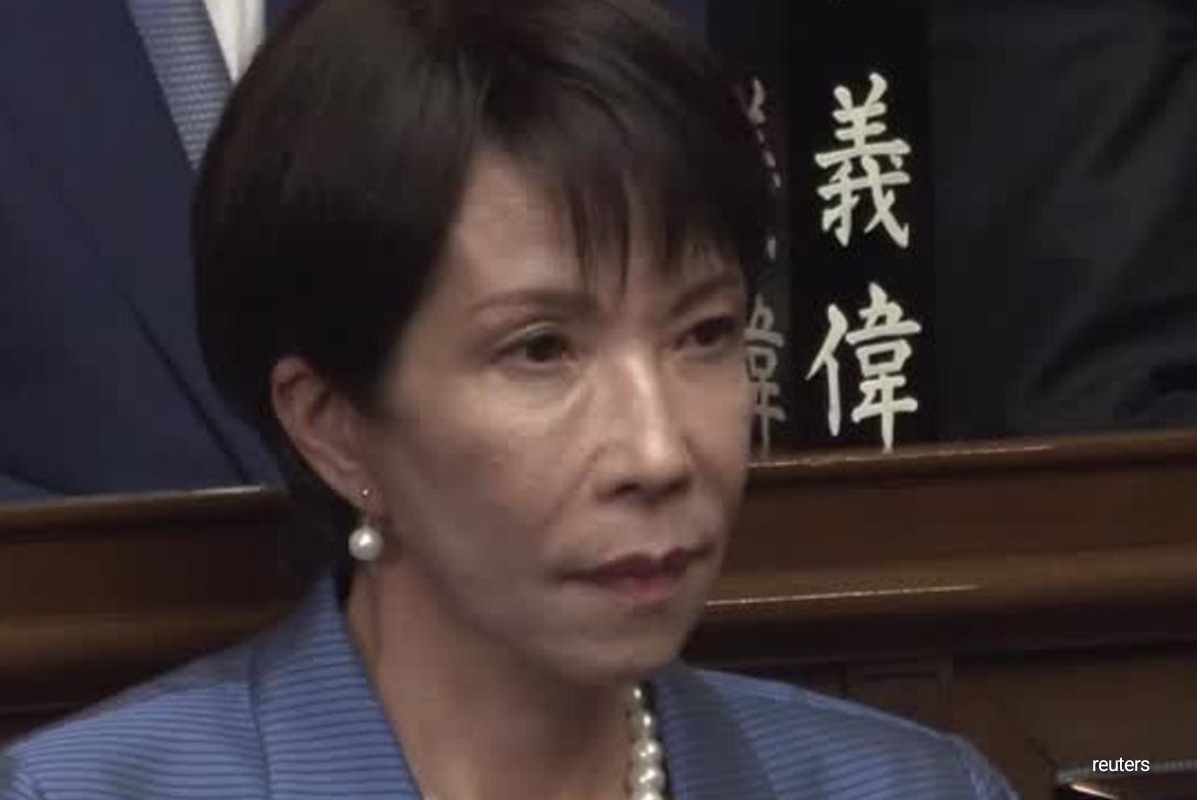
TOKYO (Aug 28): Japan's government aims to keep new government bond issuance to around ¥40 trillion (US$251 billion) for the fiscal 2027 budget, Prime Minister Sanae Takaichi said in an interview with the Yomiuri newspaper.
Her comments came as Japan's budget requests from government ministries and agencies for the next fiscal year are expected to exceed ¥130 trillion, setting a record for a fourth consecutive year. Kyodo News reported on Friday that the total could reach around ¥140 trillion.
In the interview, Takaichi cited the case of the fiscal 2025 budget, where a rise in tax revenue partially offset the extra burden of an extraordinary budget and allowed the government to keep new bond issuances below the previous year's level at about ¥40 trillion.
"We will continue with the same approach going forward," she said.
Takaichi's government plans to incorporate into the initial budget spending that in recent years was often financed through supplementary budgets, a move that could inflate the headline expenditure in the initial budget.
While the ¥40 trillion issuance is equivalent to the fiscal 2025 budget, it is far larger than ¥32.7 trillion new debt issuance planned for the current fiscal 2026 budget.
"If Prime Minister Takaichi has in mind the roughly ¥40.3 trillion in new bond issuance after the fiscal 2025 budget, her target may be viewed as somewhat expansionary," said Toru Suehiro, the chief economist of Daiwa Securities, in a report on Friday.
Takaichi also said in the interview that the government could tap foreign exchange reserves, a US$1.3 trillion war chest for future yen intervention, to fund her plan to slash the consumption tax on food.
The tax cut, a centrepiece of Takaichi's efforts to ease the impact of rising living costs on households, creates a revenue shortfall of roughly ¥5 trillion annually, intensifying pressure on the government to explain how it plans to fund the shortfall.
The finance ministry said on Friday it would request a record ¥36.64 trillion (US$229.78 billion) for debt-servicing costs, including interest payments and debt redemption, in the fiscal 2027 budget, up by ¥5.36 trillion from the current fiscal year.
The increase reflects higher domestic bond yields, which prompted the ministry to raise its assumed interest rate to 3.8%, the highest in 29 years, from 3.0% in the initial fiscal 2026 budget and the 2.6% used when ministries submitted their budget requests a year earlier.
Uploaded by Siow Chen Ming