

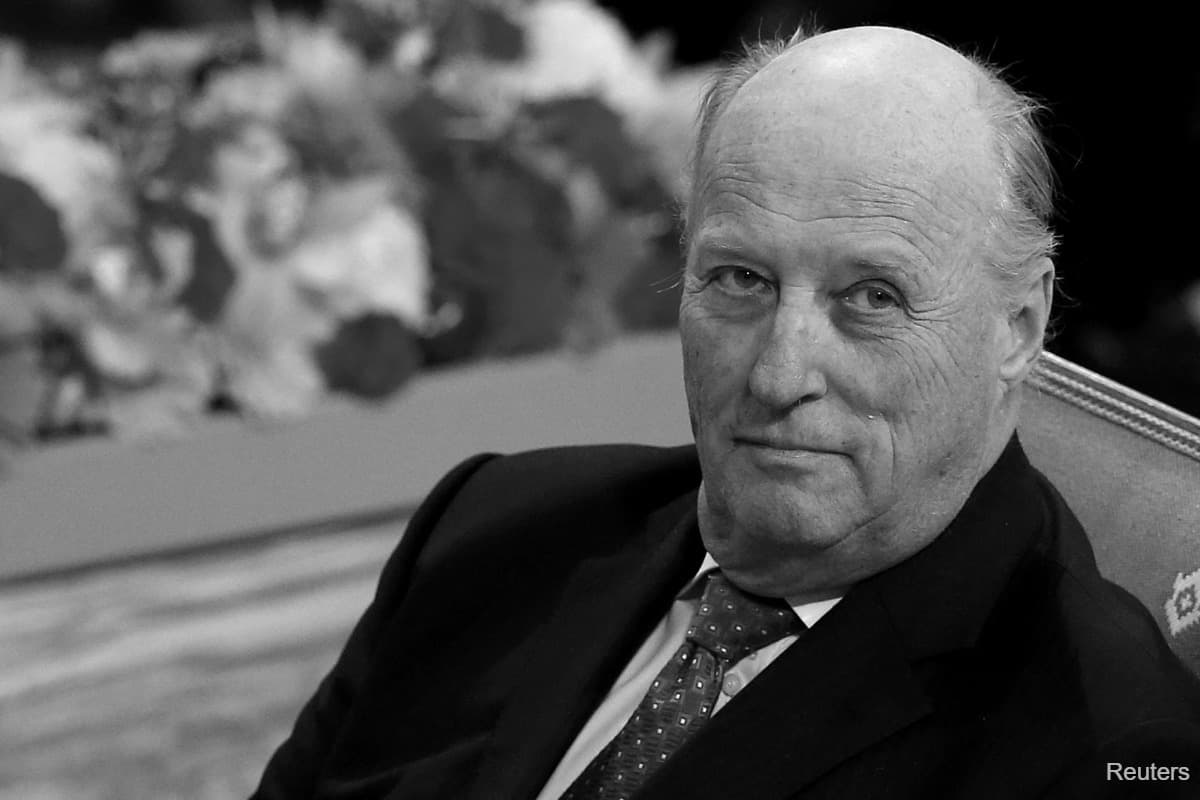
(Aug 28): King Harald V, Norway’s monarch for 35 years and a three-time Olympic yachtsman, has died. He was 89.
The king died at the Rikshospitalet in Oslo at 6.35am on Friday, the Royal Palace said in a statement on its website. In and out of hospitals for the past two years, he was admitted on Aug 17 for treatment of blood anaemia. He had a heart pacemaker surgically implanted in 2024.
A keen sportsman, King Harald competed in sailing at the Olympics in Tokyo in 1964, Mexico City in 1968 and Munich in 1972, and went on to become world champion in 1987 with his boat, Fram X. He was subsequently active in helping Norway host the 1994 Olympic Winter Games at Lillehammer.
Harald was popular for his inclusive style and willingness to broach topics that may have been controversial for a monarch, garnering 76% support among 16- to 20-year-olds in a survey in 2022.
On his first royal visit as king to northern Norway in 1992, he honoured the efforts of the then-mostly forgotten Soviet-backed partisans in the Second World War. And in a speech marking 25 years as king in 2016, he acknowledged same-sex relationships.
After the terror attacks of 2011, he said he believed in an open democracy and society and that “freedom is stronger than fear”.
As a constitutional monarch, the king’s function was mostly ceremonial. He approved the government’s laws each week and delivered a speech at the opening of parliament. The monarch’s role involves carrying out extensive duties at home and abroad, including hosting visiting heads of state.
Harald and Queen Sonja, whom he married in 1968, had two children, Crown Prince Haakon and Princess Martha Louise. The crown prince, 53, was in line to succeed him as king.
Norwegian soil
Harald was born on Feb 21, 1937, the third child of Crown Prince Olav and Swedish-born Crown Princess Martha. He was Norway’s first prince born on Norwegian soil in 567 years. His father had come to Norway as a two-year-old in 1905, when his own father, Prince Carl, was named King Haakon VII upon Norway’s declaration of independence from Sweden.
Harald was three when Germany invaded Norway in April 1940 and the royal family escaped abroad.
His grandfather and father, as king and crown prince, spent the next five years in London with Norway’s government-in-exile. Harald, his mother and two sisters moved to the outskirts of Washington, DC, where they became close friends of President Franklin D Roosevelt — a chapter of history that inspired the 2020 fictionalised drama Atlantic Crossing.
After returning to Norway in 1945, Harald attended public school in Oslo and trained as an officer in the Norwegian army before spending two years studying social science, history and economics at Balliol College, Oxford. He became crown prince, the title given to the person next in line to the throne, on King Haakon’s death in 1957.
Harald broke new ground among Scandinavian royals when he was allowed to marry a commoner, Sonja Haraldsen, in 1968. Their son, Crown Prince Haakon, took the modernisation of the monarchy one step further in 2001 when he married Mette-Marit Tjessem Hoiby, who had a son from a previous relationship.
Harald became king on Jan 17, 1991, upon the death of his father, King Olav V. His two older sisters were unable to succeed to the throne as the constitution at the time didn’t allow female monarchs. That was changed in 1990.
Harald was a second cousin of England’s Queen Elizabeth II through their common great-grandfather, King Edward VII.
Uploaded by Chng Shear Lane