

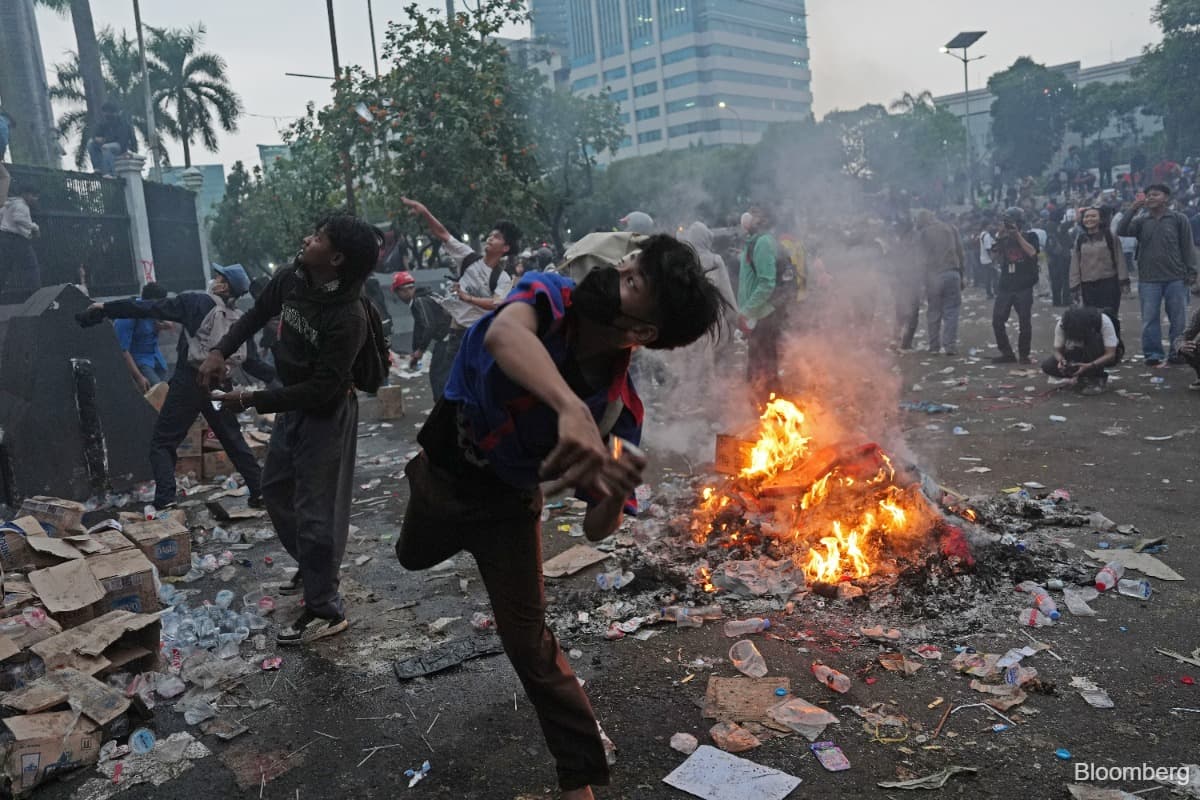
(Aug 28): Protests in Jakarta late into Thursday night underscore a persistent challenge for President Prabowo Subianto, as unease lingers over the cost of living and jobs, as well as corruption, government spending and the military’s expanding role.
The demonstrations marked a year after the worst nationwide violence since 1998 shook the country and threatened Prabowo’s image of control. While far smaller, the turnout grew well beyond early police estimates and the rally became increasingly confrontational into the evening before police dispersed demonstrators with water cannon.
Indonesia has now seen demonstrations in August for three consecutive years, each triggered by a different issue. In 2024, protesters rallied against lawmakers’ attempt to override a Constitutional Court ruling on regional elections.
A year later, anger over living costs and lawmakers’ perks exploded into nationwide unrest after a ride-hailing driver was killed by a police vehicle.
This week’s protest began around anti-corruption legislation before broadening into complaints over economic conditions and government policies.
Markets on Friday showed little sign of worry over a repeat of last year’s turmoil. The benchmark stock index gained as much as 0.7% after rallying 1.8% in the previous session. The rupiah strengthened 0.1%, set for its first gain this week, and the 10-year government bond yield slid seven basis points.
The protest ending without developing into broader nationwide unrest helped remove part of the political risk that had been priced into stocks, according to Liza Camelia Suryanata, head of research at PT Kiwoom Sekuritas Indonesia.
“The market does not actually need every political issue to be resolved immediately,” she said. “What it needs is certainty that the situation is not getting worse, that there is room for dialogue, and that there is an exit mechanism acceptable to both sides.”
While Prabowo has recently been able to instil a sense of relative political and market calm, signs of dissatisfaction have been growing at home.
A survey released this week by Tempo Data Science put satisfaction with the Prabowo-Gibran administration at 37%, down from 58% in March and 75% in December.
High food prices, difficulty finding jobs and concerns about the economy were among the main sources of dissatisfaction, though a majority of respondents still said the country was heading in the right direction.
Indonesia’s economy is expanding at more than 5%, unemployment has edged lower and Prabowo retains strong institutional control backed by a broad parliamentary coalition. There’s no clear economic crisis and no unified opposition movement capable of turning every protest into a national challenge.
Thursday’s protest illustrated that fragmentation. It began with an anti-corruption group from Pati regency in Central Java demanding passage of a long-delayed asset-forfeiture law. By nightfall, that group had gone home — but thousands of students and other demonstrators remained outside parliament, setting fires, throwing bottles and confronting police.
That came even after parliament made an unusually concrete concession. Lawmakers signed a commitment to pass an asset-forfeiture bill by Dec 15.
By evening, the gathering became a collection of different grievances. Student and civil-society groups raised concerns ranging from food prices and difficulty finding work to Prabowo’s flagship spending programmes and the military’s growing role in civilian affairs.
“There are various factors driving the protests, from economic pressures and corruption to frustration with corrupt political elites, but the common thread is a perception that ordinary people are not seeing enough benefit from the government’s ambitious economic agenda,” said Siwage Negara, a research fellow at the ISEAS-Yusof Ishak Institute in Singapore. “That said, Prabowo still has considerable political power and a strong coalition, so we should not interpret these protests as an immediate threat to his government.”
Many of those grievances have surfaced repeatedly this year. Students demonstrated in Jakarta in June over rising living costs, government spending priorities, Prabowo’s free-meals programme, the Red-and-White Village Cooperatives and the military’s role in civilian affairs.
Some of those programmes have since attracted deeper scrutiny. Corruption investigations into the free-meals programme have implicated former senior officials, as well as members of the security forces, sharpening questions about governance around one of Prabowo’s signature initiatives. The village-cooperative programme has also faced criticism over financing, procurement and implementation.
The military’s expanding role in civilian institutions has become another source of unease, reviving memories of Indonesia’s authoritarian past under the late dictator Suharto.
The heavy security posture Thursday and into Friday reflects how deeply last year’s unrest continues to shape government calculations.
The military said it had more than 70,000 personnel available for broader security operations in Jakarta, including about 40,800 personnel on standby and roughly 29,700 from the Jakarta military command and operational reinforcements. It wasn’t clear how many were assigned specifically to Thursday’s demonstration or actually deployed.
The police deployed 4,274 personnel around parliament and had detained 65 people ahead of the rally. Police said they seized bladed weapons, gasoline and materials that could be used to make Molotov cocktails.
“The real test for Prabowo is whether he treats the protests mainly as a security and political problem, or as feedback about his economic policies and government accountability,” Negara said. “In my view, knowing his character, his response will be quite defensive, and this will make further dissatisfaction from the public.”
Uploaded by Chng Shear Lane