

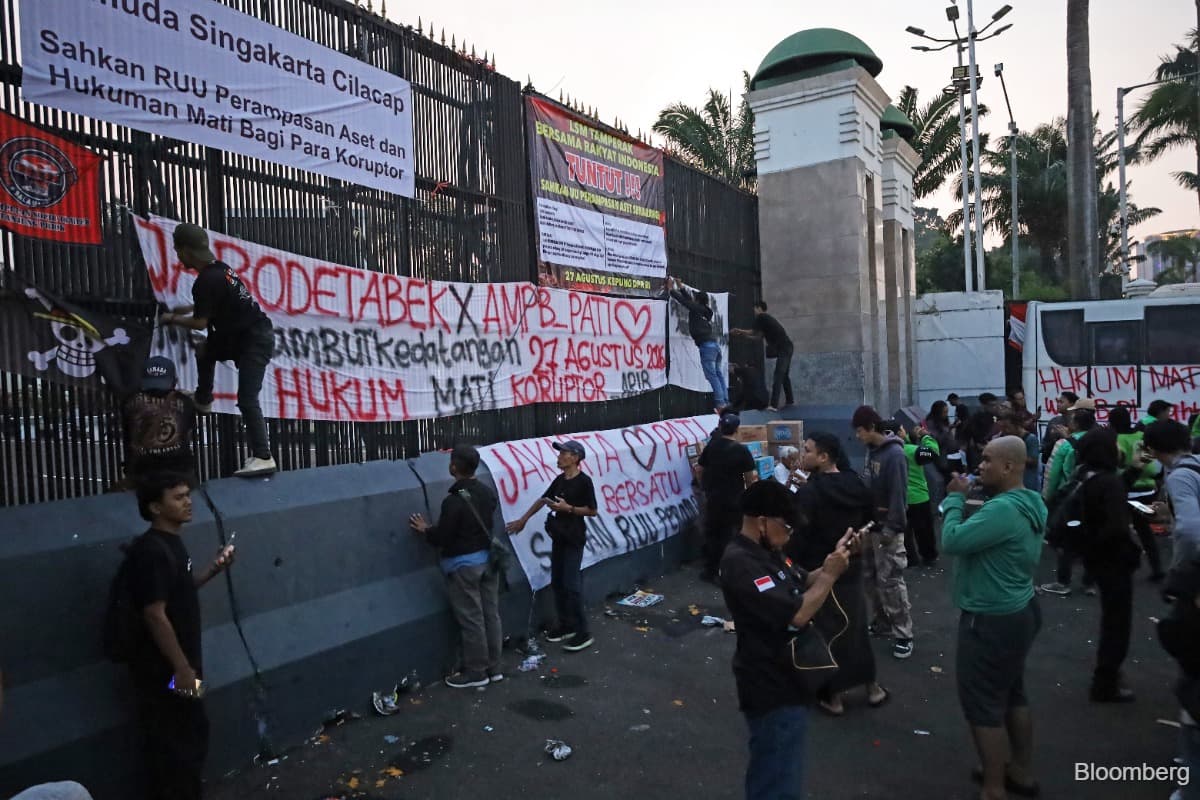
(Aug 27): Indonesian lawmakers pledged to pass a law allowing the seizure of assets linked to corruption cases as thousands of protesters descended on the parliament in Jakarta on Thursday.
The demonstration, which weighed on the rupiah and government bonds, turned tense in the afternoon as some participants set fires and throwing bottles at police. But the protests appeared much calmer than those that engulfed Indonesia last August, and markets gradually recovered.
Parliamentary leaders met with protest leaders on Thursday, and promised to pass the asset forfeiture bill by Dec 15 or resign, according to a commitment letter read out to the crowds by a protester, standing beside some lawmakers. That appears to have calmed demonstrators, some of whom were carrying banners calling for the death penalty for corrupt officials and passage of the asset-forfeiture bill.
Legislators have debated the legislation for more than a decade, and the bill was one of the main rallying points at the demonstration which was peaceful until late afternoon. The debate has stalled because the current draft allows the state to seize suspected wealth without a prior criminal conviction, shifting the burden of proof onto the asset owner. Critics fear this could violate the presumption of innocence and could be weaponised as a tool for political or retroactive overreach.
“For more than 10 years we’ve had no certainty,” one protest leader told the crowd, warning that if the bill isn’t passed by Dec 15, protesters would “drag all the parliament leaders out of the building.”
Worry that the protest would balloon into a larger demonstration led the rupiah and government bonds lower for a third consecutive day. The rupiah weakened 0.1% to 17,726 against the US dollar, after sliding as much as 0.4% in intraday trading on Thursday, while the yield on 10-year government bonds rose three basis points to 7.08%.
Still, stocks closed 1.8% higher as it became apparent that large-scale, violent protests were unlikely.
“Easing concerns over the protest helped improve market sentiment and encouraged short covering by investors,” Andrey Wijaya, an analyst at PT RHB Sekuritas in Jakarta, said.
The protest coincides with the one-year anniversary of large-scale cost-of-living demonstrations that led to a broad-based selloff and prompted President Prabowo Subianto to replace his finance minister. Thursday’s rally was far smaller than those seen last year, when the death of a ride-hailing driver fuelled nationwide protests that left several people dead.
“Investors are wary of chances of social unrest similar to the one that happened in August last year,” said Lionel Priyadi, an analyst at PT Mega Capital Sekuritas. There were rotations from rupiah-denominated bonds to dollar ones in anticipation of the protest, he added.
Parliament carried on as normal. Prabowo attended the opening of a Nahdlatul Ulama gathering, Indonesia’s largest Muslim organisation, outside Jakarta on Thursday.
Thursday’s demonstration brought together a patchwork of groups with varying complaints and doesn’t represent a single nationwide movement, making its scale and political significance difficult to gauge. Attendees included some students, some ride-hailing drivers and many visitors from the neighbouring province of Central Java.
Apart from the asset-forfeiture law, demands included lower living costs, changes to government programmes and broader political accountability.
However the protest so far lacks the support of the broad student-labour coalition that has powered some of Southeast Asia’s largest demonstrations. A nationwide alliance of university student councils isn’t joining, while the University of Indonesia’s student executive body had yet to commit to participating. Major labour groups also didn’t mobilise for the protest, potentially limiting turnout.
Police had closed off the stretch of road in front of parliament and redirected traffic, while public transport and traffic in central Jakarta largely operated as usual.
“We expect investors to turn more cautious ahead of planned demonstrations at the parliament, involving several groups with various economic and political demands,” Rully Arya Wisnubroto, head of research at Mirae Asset Sekuritas Indonesia, said in a note earlier. “If orderly, we expect the effect to be more of a temporary risk premium than a fundamental shift.”
Uploaded by Evelyn Chan