

This article first appeared in Wealth, The Edge Malaysia Weekly on August 24, 2026 - August 30, 2026
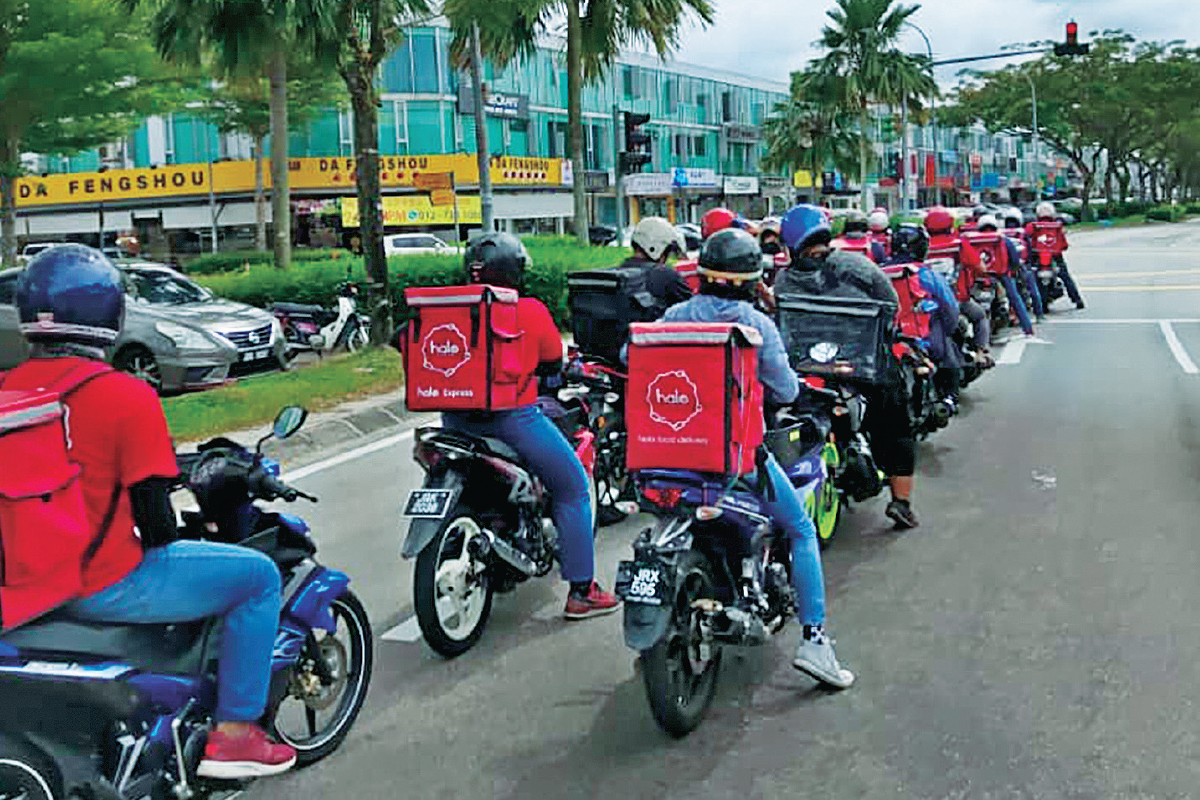
While Grab and Gojek continue to dominate the urban e-hailing and on-demand delivery market, Haloje Delivery has stepped in to meet the needs of underserved communities in the suburban and semi-urban areas.
Haloje founder and director Jalluddin Abu Hassan conceived the idea in 2019 after visiting a small-town phone dealer while serving as chief financial officer of a telecommunications company.
Recognising the stark contrast in conveniences compared with urban cities, he founded Haloje to offer a hybrid service model — providing core services such as parcel deliveries, groceries and other on-demand needs beyond urban centres to bridge the gap.
Now, the firm is looking to raise a maximum of RM2 million for 11.76% of its equity through an equity crowdfunding (ECF) campaign hosted on Ata Plus. The funds would be used mainly for business expansion.
Haloje currently serves three groups: consumers with limited delivery options, small merchants burdened by high commissions and low visibility, and aspiring delivery riders seeking job opportunities.

Aside from staying away from urban areas, the platform prioritises micro, small and medium enterprises rather than big merchants to carve out a niche.
“During the movement control order, there were many players in the market doing food delivery, including AirAsia for example, but now they’re gone because we can’t fight the big players with big monies and very strong technologies. That’s why I’m focusing on suburban areas in Malaysia,” says Jalluddin.
So far, Haloje has onboarded 34,000 active merchants and 65,000 delivery riders, and amassed 1.9 million downloads for the app.
Haloje was first launched in Batu Pahat, Johor, and began expanding to other areas such as Muar, Sabah and Sarawak. It now operates in 89 sites, covering 60% of suburban locations across Malaysia, according to Jalluddin.
The company also recently began operating in four areas within Bekasi, Indonesia, to tap into the republic’s fast-growing delivery market.
“In Indonesia as well, I’m focusing on the suburban areas [across Java] and I’m not entering Jakarta. We are doing a similar model there as we did in Malaysia,” says Jalluddin.
Haloje earns its revenue from marking up merchant products on its app, which allows it to operate on a zero-commission model. For instance, if a plate of nasi goreng is sold at RM10 by the merchant, the price will be displayed with a markup of 10% to 30%, depending on the merchant and type of food. The amount made from the markup goes into Haloje’s coffers without eating into the merchant’s profit margin.
“Other apps will ask for a percentage of that price, but we don’t. Whatever is sold, the vendor gets it back 100%,” explains Jalluddin.
Other revenue streams include delivery fees charged to customers based on distance and service type, and rider ecosystem revenue, such as rider onboarding fees, merchandise (rider uniforms and bags) and value-added services.
Haloje is operated under Techzilla Global Solutions Sdn Bhd, a technology company offering custom software, cloud computing and cybersecurity services. By leveraging Techzilla’s existing technological capability, the platform is able to enable digital inclusion for small businesses and develop the app in-house to adapt to the demands of each market.
Jalluddin shares that 90% of Haloje’s revenue in the Malaysian market comes from food delivery, and 10% from pick-up services.
In Indonesia, on the other hand, demand has been higher for motorcycle rides, which contribute 70% of its Indonesian revenue, with the remaining 30% from pick-ups.
The ECF campaign starts at a minimum investment of RM100. Jalluddin explains that setting such a low threshold reflects Haloje’s goal of making investment more accessible to its users and riders.
“I initially wanted to put RM10 [as the minimum investment amount], but was told that the amount was too small, so I set it at RM100. I think that’s the minimum for my riders to be capable of investing. I want to give them a chance to own part of the share of the company,” he says.
The largest portion of the funds collected (40%) will be injected into regional expansion, followed by 20% each for technology development and platform enhancements, and for Malaysian market expansion. The remaining funds will be split equally between governance and pre-IPO preparation (10%) and working capital (10%).
Hungry for expansion
Jalluddin shares that the expansion in Indonesia will create a key growth engine for the company, as greater volume and scale drive profitability.
It is currently targeting operations in six new areas by 2026: Kota Depok, Kota Tangerang Selatan, Kabupaten Tangerang, Kabupaten Karawang, Kota Pekanbaru and Tanjung Selor.
In Indonesia, Haloje operates an asset-light model by appointing a country distributor to manage operations and an area director for oversight, enabling scaleability.
The company has also formed a strategic partnership with Indonesia’s Union of the Islamic Community (PUI), whose 20.67 million members could support market access and local ecosystem development.
Indonesia is a key target market for Haloje due to its proximity to Malaysia, which enables better localisation strategies, as well as the implementation of unique functions within its app, supported by Techzilla.
“One of Haloje’s features is that Indonesian workers in Malaysia can send money to or order food for their family members back home, which is a feature that other platforms don’t have,” shares Jalluddin.
“If I’m an Indonesian worker in Malaysia and want to send money to my family, I can use Halo Wallet so that they can order food or rides using the money. That’s why I chose Indonesia.”
He emphasises that Halo Wallet is designed as a closed-user-group wallet within the Haloje ecosystem rather than a general remittance service. Transfers are capped at RM100 and can only be used for platform functions such as ordering food or using ride services.
Haloje initially planned to enter the Singaporean market by leveraging deliveries across the Singapore–Johor Bahru Causeway, but encountered significant technical challenges in cross-border transactions.
Due to this bottleneck, Jalluddin’s new strategy after Indonesia is to look into opportunities and corporate deals in the southern Thailand market.
“I chose Thailand because there are so many tom yam restaurants in Malaysia that are actually from southern Thailand. I can use the same concept, where those tom yam vendors in Malaysia can send money and order food for their family members back in southern Thailand,” says Jalluddin.
Solid scaling strategy
Gordon Low, founder and managing partner of management consulting firm PiValue Strategy, sees Haloje’s business strategy as a solid plan, though its success will largely hinge on its expansion in Indonesia.
One of the major concerns in running a delivery platform is the entrenched presence of dominant players such as Gojek and Grab in Indonesia and Malaysia, but Low notes that Haloje’s niche in servicing untapped suburban areas puts it in a position to capture an underserved market.
With the platform targeting expansion in Indonesia, the potential from the suburban whitespace in the country may be as large as, or even larger than, that in Malaysia, he says.
The zero-commission structure is another sensible way to win merchants in suburban markets that larger platforms tend to price out or overlook.
“Whether it becomes something more durable than a pricing decision — a genuine source of merchant loyalty that’s harder for a well-capitalised competitor to simply out-subsidise — will depend on factors the financials alone can’t demonstrate, such as merchant retention rates and how tightly the area director builds relationships beyond price,” says Low.
However, this strategy comes with a trade-off. Because Haloje marks up prices instead of charging merchants a percentage-based commission, it would be hard for the company to raise prices further, and if it does, this could affect volume growth, given that it targets cost-conscious, underserved suburban customers. Low sees this tension as something to keep tabs on as the company scales.
He notes that Haloje has also built real traction with a strong user base across consumers, merchants and riders. This leaves Haloje three strategic paths for further growth: deepening density in its existing network, expanding regionally or diversifying into new delivery segments.
Low adds that the priority and urgency of Haloje’s expansion plan will depend on the reliability of the strategies deployed in the platform’s home market. The success of an existing business model will be a big determining factor for its replicability in foreign markets and sets a more reliable foundation for the business.
Looking forward, Haloje pitches a financial projection of roughly two times its current revenue, which is still below the historical high of more than RM1 million recorded in financial year 2023 (FY2023).
Low considers Haloje’s growth projections for FY2026 and FY2027 reasonable, noting that many early-stage pitches forecast three- to fivefold annual growth that sometimes bears little relation to historical performance.
Haloje’s projected growth will take time, as generating repeat transactions from app downloads and PUI’s channel access, refining suburban routing technology, and building out the country distributor network will not happen immediately after funding.
“Its success rests on two premises: that PUI’s member profile genuinely aligns with Haloje’s target customer base, and that the localised operator model proven in Malaysia can be replicated successfully in Indonesia,” says Low.
Overall, Low sees Haloje as a business that has meaningfully improved its cost discipline and identified a genuine underserved niche.
Path towards self-sufficiency
On Haloje’s financial health, Tradeview Capital research analyst Tan Jia Hui reads FY2025 as a transitional, investment-phase year — one in which the company must learn to stand on its own without three major supports: non-recurring grant income, related-party funding and pre-commercial software capitalised on the balance sheet.
Tan’s biggest concern is that while external grant funding has greatly supported the financial recovery seen in the FY2025 accounts, the question is how the platform can sustain itself without such injections.
She points out that the entire reported profit, and more, is attributable to other operating income of RM157,933 in FY2025.
In FY2024, the other operating income line of RM186,715 was almost entirely grant-driven, comprising RM94,000 of Malaysia Digital Economy Corporation (MDEC) grants and RM91,340 of Employees Provident Fund (EPF) programme income. The two figures totalled RM185,340, or 99.3% of that year’s other operating income.
“The FY2025 composition of other operating income is not disaggregated in the accounts provided, but the pattern points to continued reliance on the same government and agency support,” she says.
Stripping out other operating income, Haloje ran an adjusted pre-tax loss of about RM52,000 in FY2025 against roughly RM1,000 in FY2024 — a widening operating loss rather than the improving profitability the headline implies, says Tan.
The dependence on external support is further reflected in Haloje’s liquidity. Tan calculates that FY2025’s current ratio stood at 0.26 times and its quick ratio at 0.19 times, compared with 0.33 times and 0.28 times respectively in FY2024.
The auditor also flagged a material uncertainty related to going concern, citing FY2024’s net current liabilities of RM428,582 and negative equity of RM29,685. This was alleviated in FY2025, when the company returned to positive equity.
However, Tan cautions that the concern was relieved by a fresh capital injection and shareholder support, rather than by a resolution of the underlying liquidity strain.
Meanwhile, its audited reports show two consecutive years of revenue contraction, falling to RM522,227 in FY2025 from RM741,755 in FY2024 and RM1.08 million in FY2023.
Tan explains that the decline was broad-based. The delivery-fee line, which carries the bulk of the top line, fell 31.1% to RM441,242, while revenue earned from trading-related activities eased 20.4% to RM80,985.
Haloje’s gross merchandise value (GMV) — the value of transactions processed through the platform before incentives, refunds and commissions — contracted 21.1% to RM6,802,186 in FY2025 from RM8,626,373 the year before.
“The revenue capture on GMV therefore compressed to 7.7% from 8.6%, indicating that fee income is falling faster than platform sales volume, a read consistent with heavier promotional intensity or an adverse mix rather than pricing power,” explains Tan.
Additionally, while the company’s gross margin improved from 61.6% to 71.7%, this gain can be traced to direct costs dropping 48.2% while revenue fell 29.6%.
“Until the delivery operation covers its own cost base and GMV re-inflects, the financial position is best characterised as fragile and support-dependent,” Tan says.
Groundwork in expansion plans expected to yield turnaround
Despite Tan’s concerns, Jalluddin addresses the issues raised and explains the reasoning behind Haloje’s financial performance.
He acknowledges that the MDEC grant covered roughly 50% of operating costs, but says with the activities now in place from its Indonesian expansion, the company expects stable revenue from next year that will allow it to turn a profit without external capital.
“I can say that until 2028, Malaysia will be the core [base engine], but by 2029, Indonesia will exceed Malaysia in terms of revenue contribution because of the volume gain.”
As for the limited cash flow, he says a large portion of the cash on hand was used to develop the Haloje app.
“The cash flow is quite low because we have commitments for capital development and app development in Indonesia. On the app’s development, I can say that it is 95% settled,” says Jalluddin.
Haloje also runs operations in Malaysia daily, with only two days off a year, which helps ease cash flow through a constant stream of revenue.
Additionally, much of the financial support comes from Jalluddin himself, as he does not want to take bank loans and incur high interest rates.
On the declining revenue since FY2023, Jalluddin explains that the drop is not limited to Haloje, as an industry-wide increase in food costs has affected its competitors too. He also says the return to dine-in options after the Covid-19 pandemic has reduced food delivery activity.
Looking at the forecasts for the coming years, Jalluddin says the growth target is 3% per month, especially for Indonesia, given the potential revenue from its expansion. He believes this is a fair assumption based on the existing food delivery vertical.
“When I did my projections at that time, I had yet to launch my e-hailing service in Indonesia — I only did it for food delivery. But with the e-hailing that launched in Kota Balikpapan in June, I believe the numbers are achievable [and could go even higher]. But we want to maintain it. I don’t want to be too aggressive.”
Investors can participate in Haloje’s ECF campaign until it closes in May 2027. More information can be found on the Ata Plus website.
Save by subscribing to us for your print and/or digital copy.
P/S: The Edge is also available on Apple's App Store and Android's Google Play.