

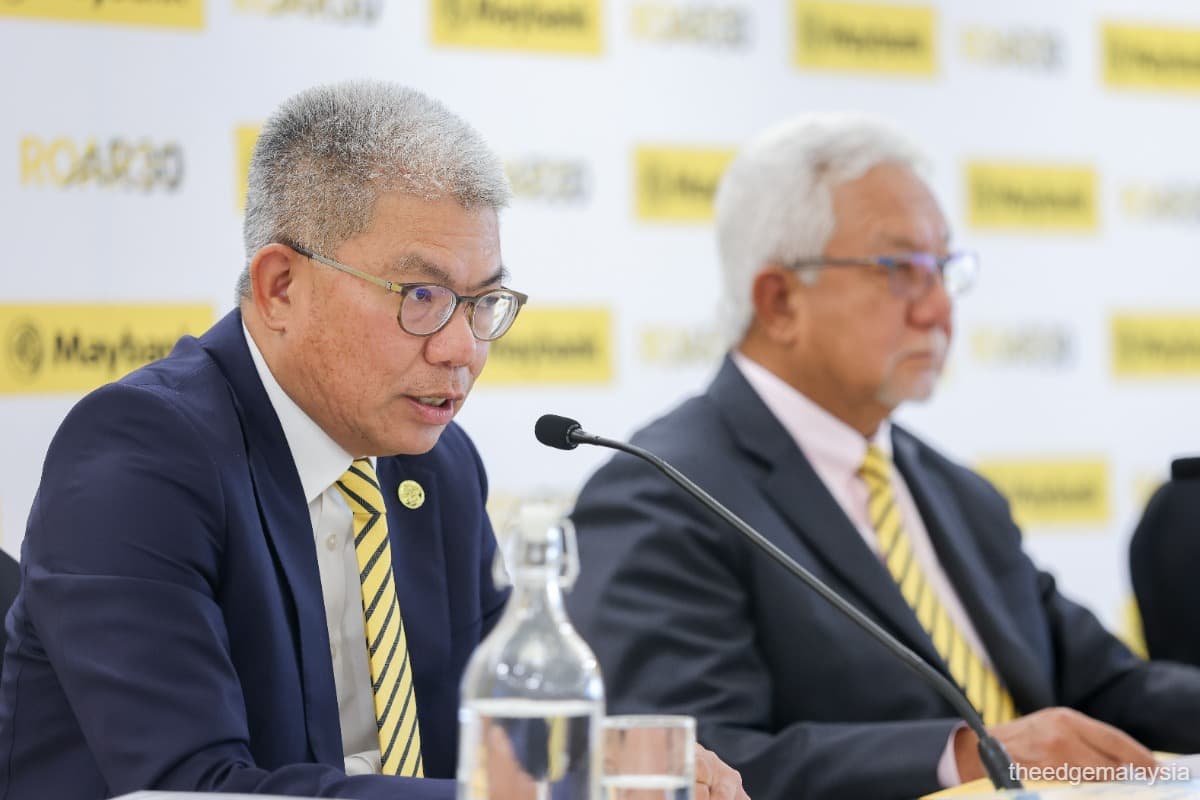
KUALA LUMPUR (Aug 27): Malayan Banking Bhd (KL:MAYBANK) said the impact of the Middle East conflict on its asset quality has been less severe than initially expected, with borrowers showing limited signs of financial stress, said president and group chief executive officer Datuk Seri Khairussaleh Ramli.
Speaking at a press briefing following the bank’s second-quarter results announcement, Khairussaleh said Maybank had been actively engaging with customers, particularly small and medium enterprises (SMEs), since the conflict erupted to assess both its direct impact on their businesses and any knock-on effects on their cash flows and ability to service loans.
“Since the conflict erupted, we have been active in engaging with our customers, especially borrowers and particularly SMEs.
“However, we are pleasantly surprised that the impact has not been as severe as anticipated. We continue to monitor the situation closely given the volatility, but even in worse scenarios, we stand ready to support our borrowers, particularly SMEs,” he said at a briefing on Thursday.
“Alhamdulillah (praise be to God), the spillover impact on asset quality has not been as severe as we had provisioned for,” Khairussaleh added.
WATCH: Middle East conflict impact ‘not as severe as expected’ — Maybank
Maybank’s gross impaired loan ratio stood at 1.35% as at June 30, 2026, while its loan loss coverage remained at 103.1%, or 112.1% excluding the provision reclassification.
The bank’s reported net credit cost (NCC) for the second quarter ended June 30, 2026 (2QFY2026) stood at eight basis points, while normalised NCC, excluding the provision reclassification for corporate borrower restructuring, was 20 basis points.
The lower provisions for corporate borrowers were partly offset by additional overlays to address emerging risks and model limitations, which stood at RM2.6 billion.
Asked about the bank’s outlook as the prolonged conflict continues to drive up costs, Khairussaleh said he remains optimistic.
“I am always an optimist. Malaysia is an open trading economy, so external events will inevitably impact us. While global geopolitical developments remain fluid, domestic activity remains very sound. Consumption and investments remain robust and are the primary drivers of our economic performance,” he said.
Maybank is maintaining its full-year guidance for FY2026, including a minimum return on equity of about 11.8%, loan growth of 4% to 5%, net credit cost of around 20 basis points and a cost-to-income ratio of around 49%, said Khairussaleh.
SME loan demand softens amid rising competition
Competition from lower-cost Chinese manufacturers has put pressure on local SMEs, with businesses facing tighter margins and the need to adapt to a more competitive environment.
Asked whether Maybank was seeing any slowdown in SME loan demand amid competition from Chinese businesses, Khairussaleh said there had been “a slight decline in applications within the SME segment”, although approval rates had remained consistently high.
“Malaysia’s GDP (gross domestic product) grew 6% in the second quarter, driven by domestic consumption, investment and E&E (electrical and electronics) exports. Through foreign direct investment and export growth, together with local content requirements, SMEs will be integrated into the supply chain, creating sustainable business opportunities,” he added.
WATCH: Maybank sees slight dip in SME loan applications, approvals stay high
Shares of Maybank closed down 10 sen, or 0.93%, at RM10.62 on Thursday, valuing the country’s largest lender by total assets at RM128.46 billion.