


This article first appeared in The Edge Malaysia Weekly on August 24, 2026 - August 30, 2026
THE shopping platform Pinduoduo has been available in Malaysia for only a short nine months, but it has already gained traction both online and offline. Its rise has been swift; even direct competitors such as Shopee, TikTok Shop and Lazada are said to be worried.
In December 2025, Pinduoduo launched a targeted campaign in Malaysia, offering myriad personal and household goods as well as snacks for a fraction of the prices locally. The timing coincided with a period of heightened cost-of-living pressures and global uncertainty, which made the platform’s promise of ultra-low prices particularly resonant.
“I bought a tube of cream for RM8 that is normally sold here for more than RM24 and shipping is free. So, why not?” a Pinduoduo shopper tells The Edge.
Another user bought 30 toilet rolls for just RM20, which he says is 30% to 40% cheaper than his local grocer but only “if you don’t mind waiting a month for it”.
The long wait is due to the several stages involved in the fulfilment chain. After an order is placed, it typically goes through warehouse consolidation and sorting, which can take several days. Because the free shipping option routes the item via sea freight, transit to the destination country adds 15 to 30 days. The parcel then clears customs before final delivery to the customer’s doorstep Pinduoduo’s rise in Malaysia has been sudden, but the platform itself is not new. It is a digital mobile marketplace founded in China in 2015 by Colin Huang, a former Google engineer, and quickly became one of the country’s largest e-commerce players. Its model was simple: Aggregate demand from millions of users and connect them directly with manufacturers, cutting out middlemen and driving prices down to levels that seemed almost unreal.
The company that owns Pinduoduo, PDD Holdings Inc, was listed on the Nasdaq in 2018, raising about US$1.6 billion in its initial public offering. Backing came from prominent investors, including Tencent Holdings Ltd, the Chinese tech giant behind WeChat and a sprawling ecosystem of digital services. That relationship proved crucial. Pinduoduo was integrated into Tencent’s platforms early on, allowing users to discover the app through WeChat and QQ, two of China’s most widely used social networks.
This social element became central to Pinduoduo’s identity. Shopping was no longer a solitary activity but a gamified experience. Users were encouraged to invite friends to join group purchases, unlocking lower prices as more people participated — the more people they brought in, the cheaper the item became. Consumers rode the sense of momentum and gladly got a hit of dopamine with every discount unlocked.
That behavioural pull has had its effect on Malaysian consumers. Some users who downloaded the app for the first time reported spending up to RM1,000 in a single session. So, the draw alone is not just about the price but the experience of watching costs drop as more buyers join in. It feels like a game, and winning feels good.
By March and April 2026, the app had gone viral in Malaysia, climbing to the top of the iOS shopping charts in the country, driven largely by word of mouth and social media. Users shared screenshots of products priced at a fraction of what they would have cost on other platforms. A pair of shoes for RM6. A phone case for RM1.50. The prices were startling, and they worked to grab attention.
Part of what made the experience seamless for Malaysian consumers was the integration with the Touch ’n Go eWallet. The ability to pay using a familiar local payment method removed a significant barrier to entry. Consumers did not need to enter credit card details or navigate unfamiliar payment gateways. They could simply tap and pay, just as they would with any other local platform.
This was a smart move that gave Pinduoduo a level of legitimacy and convenience that might otherwise have taken years to build. It also helped the platform appeal to a broader demographic, including users who might be hesitant to share credit card information with an overseas app.
One reason for Pinduoduo’s push abroad is the slowing economic and consumption growth in China. After growing at breakneck pace in the first two decades of the 21st century, China’s economy has been expanding at a low single-digit pace since the Covid-19 pandemic.
Retail sales growth slowed to 0.6% year on year in July, and economists said this pointed to gross domestic product (GDP) growth slowing to around 4.1% in the second half of the year, slower than the pace Beijing needs to meet its annual target. A prolonged slowdown in the property market has also weighed on household spending, leaving China’s economy more reliant on exports to keep growing.
A boon for consumers but …
Although the lower prices are a boon for consumers, Pinduoduo’s popularity revived a familiar question for an open economy such as Malaysia’s: How do you weigh the benefits of cheaper goods and a wider pool of choices for consumers against the pressure being felt by local retailers?
There is no easy answer, but the question offers insight into how rhe country’s retail sector is adjusting to the rise of cross-border e-commerce. Notably, mobile shopping really took off during the pandemic and many continue to shop-on-the-app, putting a toll on bricks-and-mortar players that fail to shift online. Now, the tables appear to have turned for disruptors.
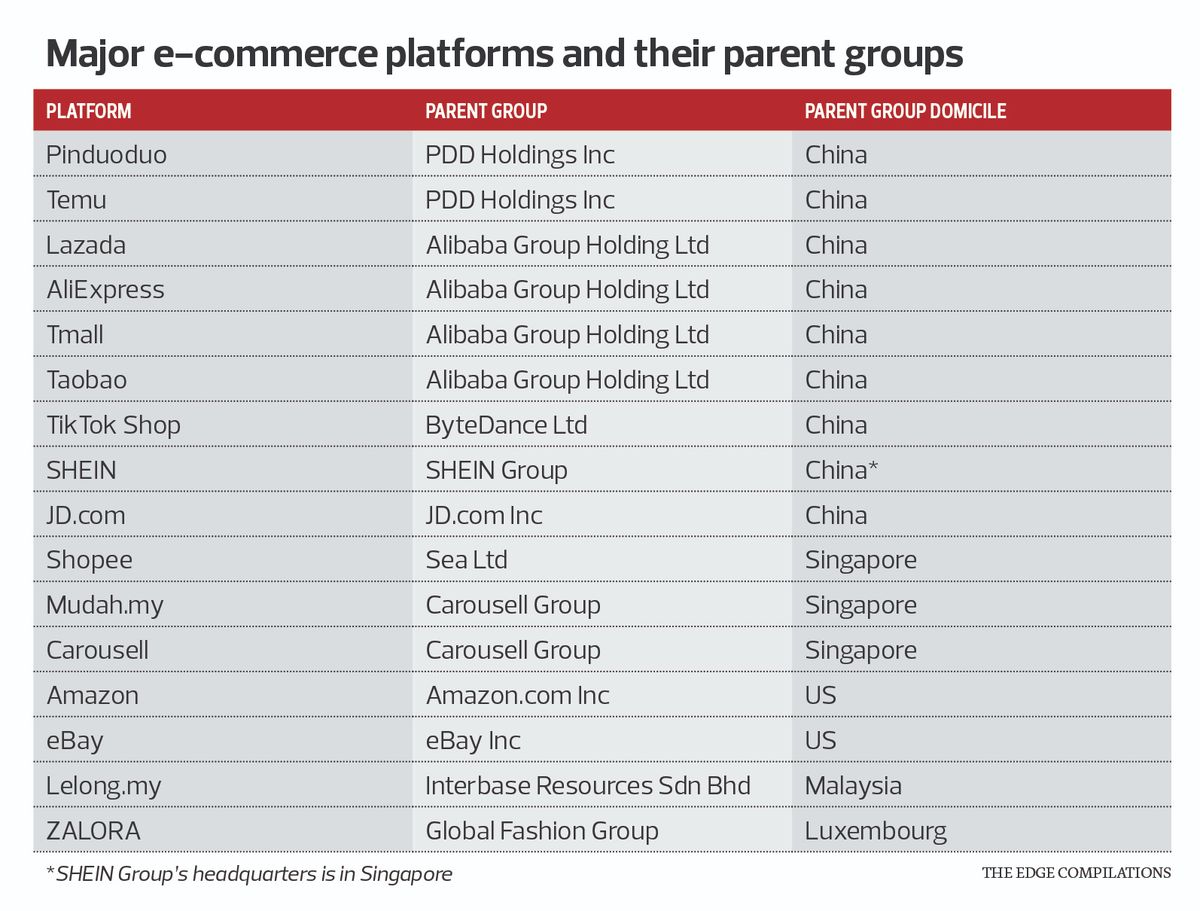
E-commerce players such as Shopee Malaysia, Lazada Malaysia and TikTok Shop Malaysia, which are represented under the E-Commerce Chapter of the Malaysian International Chamber of Commerce and Industry (MICCI), have built up local infrastructure over the years. They run warehouses, employ Malaysian staff, comply with local regulations and pay taxes.
Pinduoduo does not work the same way, as it is not a registered company in Malaysia, nor does it pay income taxes or have the need to comply with local regulations. Its business model includes connecting consumers directly with manufacturers and sellers in China, largely bypassing those local layers, essentially removing the need for a middle man. And through its team-sharing model, once more people join the “buy-in” for a single product, more discounts are unlocked, further reducing the price.
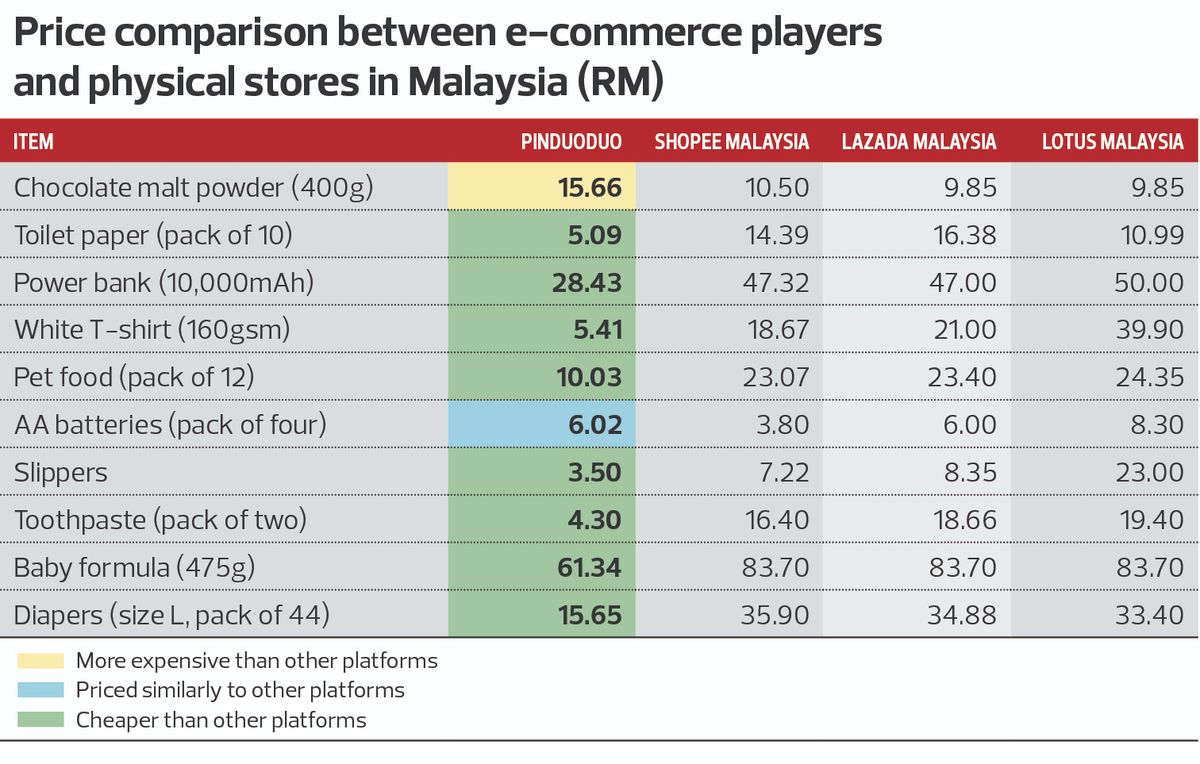
For example, a pair of slippers sold in a physical store is priced at an average of RM16 whereas a similar pair can be found on Pinduoduo for RM3.50. There is already a 78% difference between the two price points. Paired with Pinduoduo’s campaign of free shipping, shoppers need only pay the sales and service tax. Price-conscious shoppers are likely to gravitate towards the inexpensive option.
That is a largely why its prices are hard for local sellers in Malaysia match, hence growing concerns among retailers about Pinduoduo’s local presence.
Hafidzi Razali, spokesperson for MICCI’s E-Commerce Chapter, which also includes Mudah.my, Jaya Grocer and Carousell, describes the platform’s growth as “a natural development in a growing digital economy” that expands consumer choice and pushes the wider industry to keep improving.
But the line is drawn when different platforms run different business models, he says, and should not be judged the same way. That distinction is over cost structure, not just competition.
“We expect the impact to vary according to the product and business model. Widely available, highly price-sensitive products are likely to face greater competition because consumers can compare similar items easily. Businesses with distinctive products, strong local brands, specialist expertise, warranties or dependable after-sales service have more room to differentiate,” he says.
“Rather than viewing particular sectors as vulnerable, we believe the focus should be on ensuring fair competitive conditions while helping SMEs (small and medium enterprises) strengthen their productivity, branding and digital capabilities.”
From an economic perspective, Malaysia’s retail sector has held up reasonably well despite the new competition. Universiti Teknologi Mara associate professor Dr Abdul Rahim Ridzua, who specialises in entrepreneurship and economics, says data from the Department of Statistics Malaysia showed that the volume index of retail trade grew 4.2% year on year (y-o-y) in the second quarter of 2026, while the broader wholesale and retail volume index rose 4.8%. Private consumption made up 60.5% of GDP in 2025, when the economy grew 5.2%.
Consumer spending is shifting, with imports of consumption goods rising 27.6% y-o-y to RM13.1 billion in December 2025, accounting for about 9.8% of total imports that month. Abdul Rahim cautions, however, against attributing the increase entirely to cross-border e-commerce, since many factors can influence import figures, but he says it is a number worth watching.
There is also a less obvious shift: Spending on services rose to 43.4% of private consumption in 2025, up from 42.5% the year before. Abdul Rahim sees a possible silver lining in that money saved on cheaper goods does not necessarily leave the economy.
“If consumers redirect some of their savings towards Malaysian services, then part of the benefit from cheaper imported goods can circulate back into the domestic economy,” he says.
Cheaper prices can free up spending power in two ways: Consumers either buy more with the savings or shift that money towards dining out, travel or other local services. Either way, he notes, the gains are not evenly spread and consumers may come out ahead while local retailers absorb the lost sales.
Uneven playing field
The most consistent concern coming from industry groups is not about Pinduoduo’s presence itself but about the matter of whether everyone is playing by the same rules set by the government.
“We are not against foreign e-commerce platforms entering the Malaysian market,” says Associated Chinese Chambers of Commerce and Industry of Malaysia (ACCCIM) president Datuk Ng Yih Pyng. “In fact, these platforms can provide consumers with more choices, while creating new business models and opportunities for Malaysian businesses to access overseas markets.”
Ng highlights, however, the cost gaps and how local businesses shoulder import duties, warehousing, rental, wages, statutory contributions to the Employees Provident Fund (EPF) and the Social Security Organisation (Perkeso), and certification costs from bodies such as Sirim or Jakim. These costs are largely sidestepped for overseas sellers shipping directly to consumers.
That is not to say cross-border sellers operate in a free-for-all market. In 2024, Malaysia introduced a 10% sales tax on low-value goods priced up to RM500, alongside the Consumer Protection (Electronic Trade Transaction) Regulations, which tightened requirements on seller information, pricing and complaint channels. Ng sees these steps as useful but insufficient.
“Fair competition cannot be assessed based on taxation alone,” he says. “We also need to consider product standards, product safety, seller verification, consumer protection, import requirements and other regulatory responsibilities.”
Malaysian Retail Chain Association (MRCA) president Datuk Liew Bin takes a firmer line. MRCA’s roughly 600 members include Poh Kong, Bonia, 7-Eleven, Subway and AEON Co, and Liew says members are already seeing a drag in sales and revenue, particularly on products easily substituted by cheaper imports with knock-on effects for jobs.
He has also raised concerns about counterfeit goods and quality control, arguing that low prices should not come at the expense of consumer safety.
MICCI’s E-Commerce Chapter’s Hafidzi says: “As cross-border business models continue to evolve, the priority should be to ensure these requirements are effectively and consistently applied across different channels and business models, while continuing to clarify the responsibilities of sellers, platforms and other parties, and strengthening information-sharing between industry and regulators.”
The political sphere has also taken notice. Gopeng MP Tan Kar Hing has called for Pinduoduo to be suspended until Malaysia puts proper rules in place, arguing the platform’s factory-direct model lets sellers skip taxes, audits and compliance costs that every Malaysian shop owner has to bear.
Just last week, after officiating the TikTok Shop Summit 2026, Prime Minister Datuk Seri Anwar Ibrahim was questioned by a TikTok Shop participant about the influx of cheap products from cross-border platforms such as Temu and Pinduoduo. Anwar acknowledged the issue and spoke of foreign investors renting warehouses at Port Klang with no local job creation. He added that enforcement officers have begun acting on this matter, though he added it needs further looking into.
Period of adjustment
Asked for indicators to watch to gauge the impact on the retail sector, Abdul Rahim says no single number tells the story but it is a combination of signals: a sustained fall in domestic retailers’ market share, turnover and profitability, alongside rising imports of competing goods, falling employment and business closures. Domestic manufacturers losing economies of scale is another warning sign to watch, he says.
“One to two years of adjustment may not necessarily cause structural damage,” he says, noting that timing matters. “If the trend continues for many years, however, and affects domestic productive capacity, policymakers should step in.”
For now, the market is in a period of adjustment rather than in a state of crisis. Malaysian sellers still hold advantages that cross-border merchants are not easily replicated, such as faster delivery times, local customer service, easier returns and refund mechanisms, as well as the trust that comes with an established brand.
Hafidzi and Ng agree that players should compete on more than price.
“Malaysian businesses cannot continue to rely on selling the same products and simply competing by offering lower prices,” Ng says. “We need to encourage businesses to develop their own brands, product design, quality, innovation, after-sales service, as well as specialised and niche markets.”
Regulation, not prohibition
The economists broadly agree that shutting down the Pinduoduo platform is not the answer. Instead, Malaysia should strengthen the regulatory framework to ensure foreign and domestic players compete on a more level playing field.
Abdul Rahim favours regulation over a complete ban, including measures covering taxation, product standards and fair competition.
He says shutting down platforms offering cheaper goods could raise prices for consumers and remove incentives for domestic businesses to improve. Instead, government support should help improve SME productivity, innovation and market access.
Economist Professor Dr Yeah Kim Leng, who also opposes shutting down Pinduoduo, says the proposed E-Commerce Bill would give authorities greater powers to regulate the sector, including platform commissions, cross-border transactions and algorithmic practices, while imposing obligations on foreign platforms serving Malaysian consumers.
“This regulatory framework ensures foreign platforms play by the same rules as local businesses, creating fair competition without sacrificing consumer welfare,” Yeah adds.
He notes that Malaysia is already moving towards a more comprehensive regulatory framework, with the low-value goods (LVG) tax and service tax on overseas digital services (SToDS) removing some of the tax advantage previously enjoyed by foreign platforms.
But regulation alone will not resolve the underlying competitiveness gap. Both economists point to the need for Malaysian businesses to improve their productivity and ability to compete, rather than relying on protection from foreign platforms.
According to online speculation, the free shipping feature on Pinduoduo is set to end next month, which should offer local retailers some reprieve.
Whether that relief lasts before another disruptor emerges on the scene may come down to how local businesses innovate and whether the rules catch up with players such as Pinduoduo, whose unique team-sharing model still gives it a price advantage.
Save by subscribing to us for your print and/or digital copy.
P/S: The Edge is also available on Apple's App Store and Android's Google Play.