

This article first appeared in The Edge Malaysia Weekly on August 24, 2026 - August 30, 2026
IHH Healthcare Bhd’s (KL:IHH) plan to raise its stake in Fortis Healthcare Ltd from 31.17% to 51% in four years’ time is underpinned by surging demand for quality healthcare in India, as the ageing population, rising cases of chronic diseases and a shortage of hospital capacity fuel the sector’s growth.
Following the completion of a mandatory open offer last November, IHH’s stake in Indian-listed Fortis rose marginally to 31.17% from 31%. By increasing its stake in Fortis by up to five percentage points annually, IHH would reach its target 51% in about four years. This could be done through a primary infusion, where IHH injects fresh capital into Fortis in exchange for new shares, or through the purchases of existing shares in the secondary market.
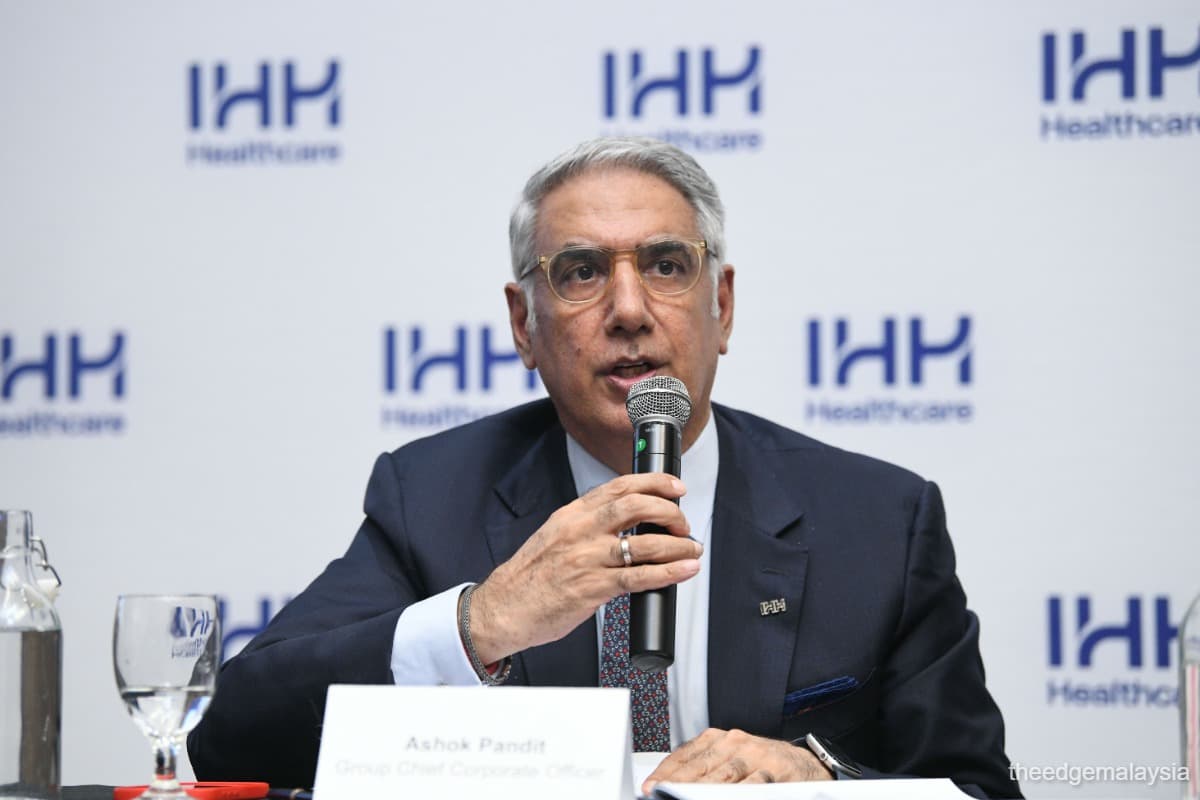
“We are quite comfortable with our current [shareholding], but we would like to see it go up to at least 51%,” said IHH Healthcare group chief corporate officer Ashok Pandit during a recent media visit to Fortis Memorial Research Institute (FMRI) in Gurgaon, south of New Delhi.
He added that IHH has no plans to take Fortis private as it is comfortable with keeping the hospital operator listed.
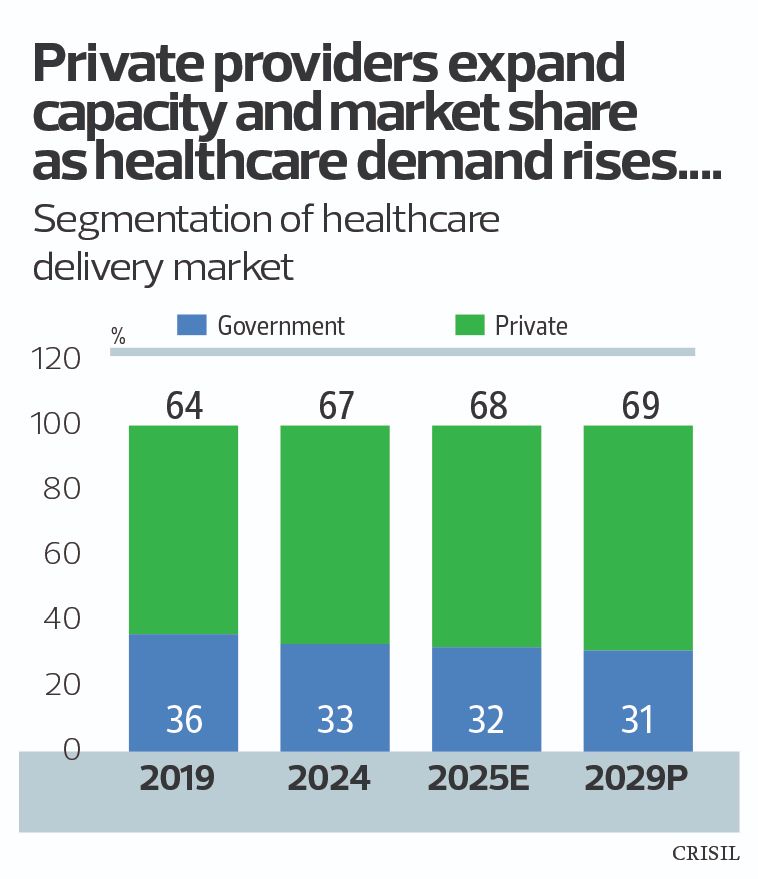
Private equity investment in Indian healthcare surged to 4,900 crore (US$572 million or RM2.31 billion) across 33 deals spanning hospitals, pharmaceuticals, healthtech and other segments in the second quarter of 2025, reflecting strong interest from global and domestic investors. India’s hospital sector accounts for about 80% of total healthcare spending, with the remaining 20% comprising pharmaceuticals, diagnostics and medical equipment.
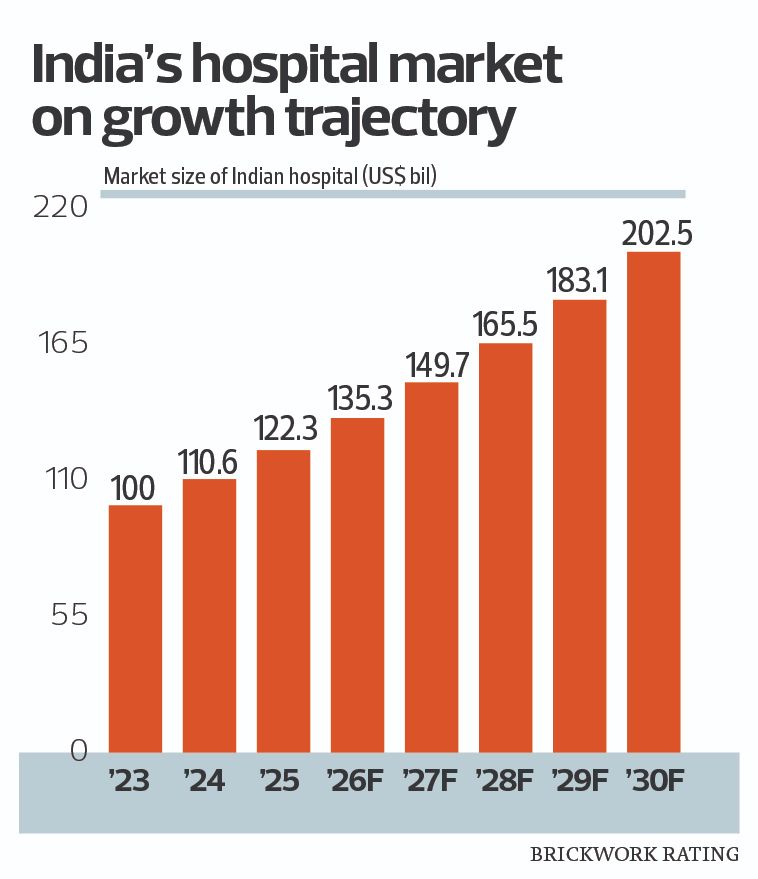
According to Indian credit rating agency Brickwork Ratings, the hospital market is expected to grow at a compound annual growth rate (CAGR) of 10.6%, from US$122.3 billion in 2025 to US$202.5 billion by 2030, driven by the rising prevalence of non-communicable diseases such as cardiovascular disease and cancer, longer life expectancy and growing demand for chronic and age-related care.
Major hospital groups are hoping to capture the lucrative market by investing in new beds, facilities and specialised services.
“Within the next five to 10 years, we can easily expand very, very comfortably. About 15% sort of a growth [in revenue is] expected annually [for Fortis], which is quite healthy. We have healthy operating margins in India. Ebitda (earnings before interest, taxes, depreciation and amortisation) margin is also expected to rise to around 25% in the next few years from 22%,” said Ashok.
With about 11% of India’s 1.46 billion population covered by private voluntary health insurance (including retail and employer-sponsored plans) while another 28% — largely the middle class — uninsured and relying on out-of-pocket payments, healthcare service providers like Fortis see potential to expand into markets with strong demand for specialised care as the number of people who can afford and seek private healthcare rises along with economic growth. The remaining 60% fall under government subsidised health insurance schemes.
“Another area where Fortis is excelling [in], and which differentiates it from some of its competitors, is the clinical talent it is able to attract, supported by the capex (capital expenditure) that Fortis has invested. Fortis also has a large laboratory, Agilus Diagnostics, which is quite different from some of the other hospital groups. This allows the laboratory and the hospital to work closely together on more targeted therapies, particularly in oncology,” he added.
According to Ashok, Fortis has delivered consistent double-digit revenue and Ebitda growth in recent years, with IHH seeing significant room for further expansion, driven by capacity additions, higher case complexity, operational efficiencies and rising demand for quality healthcare services.
Fortis’ financial performance has also strengthened the case for IHH’s investment.
For the first quarter ended June 30, 2026 (1QFY2027), Fortis’ profit after tax (PAT) rose 2.2% to 273 crore (RM115.56 million) from 267 crore a year earlier, while revenue grew 17.5% to 2,545 crore from 2,167 crore.
The growth was supported by higher average revenue per occupied bed, which rose to 2.71 crore per annum from 2.64 crore per annum, as well as a 16.7% increase in occupied beds. Recent acquisitions, including hospitals in Punjab and Bengaluru and a leased facility in Delhi-NCR, also contributed.
Operating Ebitda margin stood at 22.3%, compared with 22.6% a year earlier.
For its financial year ended March 31, 2026 (FY2026), Fortis’ PAT rose 31.5% to 1,064 crore from 809 crore in FY2025 when earnings were affected by impairment charges. Revenue increased 17.3% to 9,128 crore from 7,783 crore, driven by higher patient volumes.
The latest results mark a significant turnaround from FY2019 (before the Covid-19 pandemic) when Fortis recorded a net loss of 299 crore. Revenue has also more than doubled from 4,469 crore in FY2019.
Legal battle resolved
The mandatory offer followed the resolution of a seven-year legal process surrounding IHH’s investment in Fortis, enabling the company to focus on expanding its Indian operations. India was IHH’s fourth-largest market in FY2025, after Türkiye/Europe, Singapore and Malaysia, contributing about 16% of group revenue for the year ended Dec 31, 2025.
Fortis currently operates about 6,100 beds across 36 hospitals in India, making it the country’s fourth-largest hospital operator. It has a presence across 12 states, mainly in Tier 1 and Tier 2 cities, and also manages several Gleneagles hospitals.
By bed capacity, Fortis trails Temasek-backed Manipal Health Enterprises Ltd, Apollo Hospitals Enterprise Ltd and Max Healthcare Institute Ltd. Manipal leads with 13,037 beds across 49 hospitals, followed by Apollo with 10,970 beds across 78 hospitals and Max Healthcare with 6,131 beds across 21 hospitals.
Fortis plans to add about 3,900 beds by 2031, taking total capacity to roughly 10,000 beds, or about 64% more than its current base. The expansion will be split between brownfield projects, greenfield developments and acquisitions. Fortis managing director and CEO Dr Ashutosh Raghuvanshi said the company expects to spend about 700 crore a year over the next few years to support the expansion.
Rather than entering unfamiliar markets, Fortis plans to expand its presence in existing clusters — Punjab and Delhi-NCR, Mumbai, Bengaluru and Kolkata — where it can extract synergies in manpower, supply chain and other operations.
“Any acquisition must complement our existing operations and have a clear path to adding value,” Ashutosh said.
The expansion comes as Fortis’ larger rivals are also adding capacity. Manipal plans to add about 2,400 beds over the next three to four years, taking its capacity to 15,437 beds, while Apollo Hospitals plans to add 5,800 beds, taking its total capacity to 16,770 beds by FY2031.
Max Healthcare, meanwhile, plans to add 4,262 beds, lifting its capacity to 10,393 beds in the next few years.
Funding Fortis’ next phase
Fortis expects to fund its planned addition of about 3,900 beds through a combination of internal accruals, debt and potential new equity.
Each bed is estimated to cost about US$250,000, or roughly US$975 million for the full expansion, according to Ashutosh.
Brownfield expansion at existing hospitals would primarily be funded through internal accruals, while some debt and equity may be required for greenfield projects and acquisitions, he says.
“But then we have big support from the IHH’s parent. As you know, they have already stated their intent that they want to double down on the opportunity. It’s a very large opportunity, and since the operations of this company are already mature, building this platform further makes a lot of sense,” Ashutosh said.
“If there is a need for equity within Fortis, we will inject equity in the company. But we can also do what’s called a creeping acquisition, where we go and buy the stock from the secondary market,” Ashok added.
As at end-June, Fortis’ debt stood at 2,580 crore, while cash and cash equivalents amounted to 347 crore, resulting in net debt of 2,233 crore, up from 1,869 crore a year earlier.
For the period in review, its net debt-to-Ebitda ratio rose to 1.01 times from 0.92 times, while net debt-to-equity edged up to 0.21 times from 0.20 times. Net fixed assets, including intangibles and capital work-in-progress, rose 15.8% to 8,021 crore from 6,928 crore a year earlier.
Breaking the Indian investment jinx
IHH’s bigger bet on Fortis comes despite the mixed track record of Malaysian companies in India, where regulatory hurdles, intense competition and changing business conditions have challenged some investors.
Among the more prominent cases was the late Tan Sri T Ananda Krishnan’s Aircel-Maxis venture, which ended with his exit after suffering substantial losses. Among other Malaysian companies, TH Heavy Engineering Bhd and Mudajaya Group Bhd (KL:MUDAJAYA) encountered difficulties in the oil and gas and power sectors respectively.
IJM Corp Bhd (KL:IJM), meanwhile, has been among the more successful Malaysian investors in India, having built up its highway business before eventually cashing out.
Against this backdrop, IHH’s increasing stake and continued capital commitment to Fortis raises the question of whether it can buck the trend.
Ashok, however, dismissed the view that India remains a particularly challenging market for IHH, pointing to Fortis’ performance and the value generated since the group first invested in the hospital operator. This marks a different experience from some of IHH’s earlier investments in India, including Apollo Hospitals and Continental Hospitals, which faced difficulties.
“When we invested in Fortis in 2018 the stock was around 170 a share. Today, the stock was around 950 a share. We had a good outcome,” he said. Fortis’ shares were trading at 908.75 at the time of writing, giving the hospital operator a market capitalisation of about 693.96 billion (US$7.25 billion).
“I think we are actually very happy with our investments. If you go to a new market, there’s always some time for adjustment in terms of getting used to the lay of the land, some of the regulatory issues. I would call them mini speed bumps. As the largest shareholder of Fortis, as and when they need the capital, we are there to back them,” he added.
IHH holds its stake in Fortis through its indirectly wholly owned subsidiary, Northern TK Venture Pte Ltd. HDFC Asset Management Co Ltd is the second-largest shareholder with a 6.42% stake, followed by Kotak Mahindra Asset Management Co Ltd with a 5.81% stake, according to Bloomberg.
Fortis looks to Africa to grow medical tourism
Fortis is also seeking to grow its medical tourism business, with international patients currently accounting for about 8% of revenue. The Middle East is currently its largest source market.
Ashutosh expects the segment to grow by 11% to 12% annually, but said its contribution to overall revenue is unlikely to reach 20% as the domestic business is expanding faster, driven by rising patient volumes and capacity additions.
“Not all of our hospitals receive international patients. Only about six hospitals receive them. With the geopolitical tensions, especially the unrest in the Middle East and flight disruptions, this business is not stable; it keeps going up and down,” he said.
Fortis is targeting more patients from Africa, where limited access to specialised care and lower treatment costs make India an attractive destination.
“We focus a little more on Africa because African patients find that the availability of treatment is low over there and they are also price-conscious. We are able to provide services at lower cost than what other options they have. We feel the size of that market is huge,” Ashutosh said.
According to him, Fortis has information centres in Kenya, Ethiopia, Nigeria and Tanzania, focusing on oncology, advanced cardiac care and neurosciences. Its doctors also visit these markets to engage with local physicians and discuss cases, helping build referral networks.
Save by subscribing to us for your print and/or digital copy.
P/S: The Edge is also available on Apple's App Store and Android's Google Play.