

This article first appeared in The Edge Malaysia Weekly on August 24, 2026 - August 30, 2026

THE number of public-listed companies (PLCs) qualified to join The Edge Malaysia ESG Awards 2026 is at the highest since the awards were established five years ago, mirroring the growing maturity of ESG adoption among Malaysian PLCs.
In 2022, only FBM EMAS constituents had FTSE ESG scores and were eligible for the awards. This was expanded to Main Market PLCs in the following years and to ACE Market PLCs in 2025. The assessed universe in 2026 comprises 1,003 PLCs, up from 956 a year ago, driven by broader ACE Market coverage.
According to Bursa Malaysia Bhd (KL:BURSA), the weighted average FTSE4Good ESG scores of PLCs also increased in the last year from 2.50 (June 2025) to 2.72 (June 2026), reflecting not just growing adoption but also a commitment to improvement among Main Market and ACE Market PLCs.
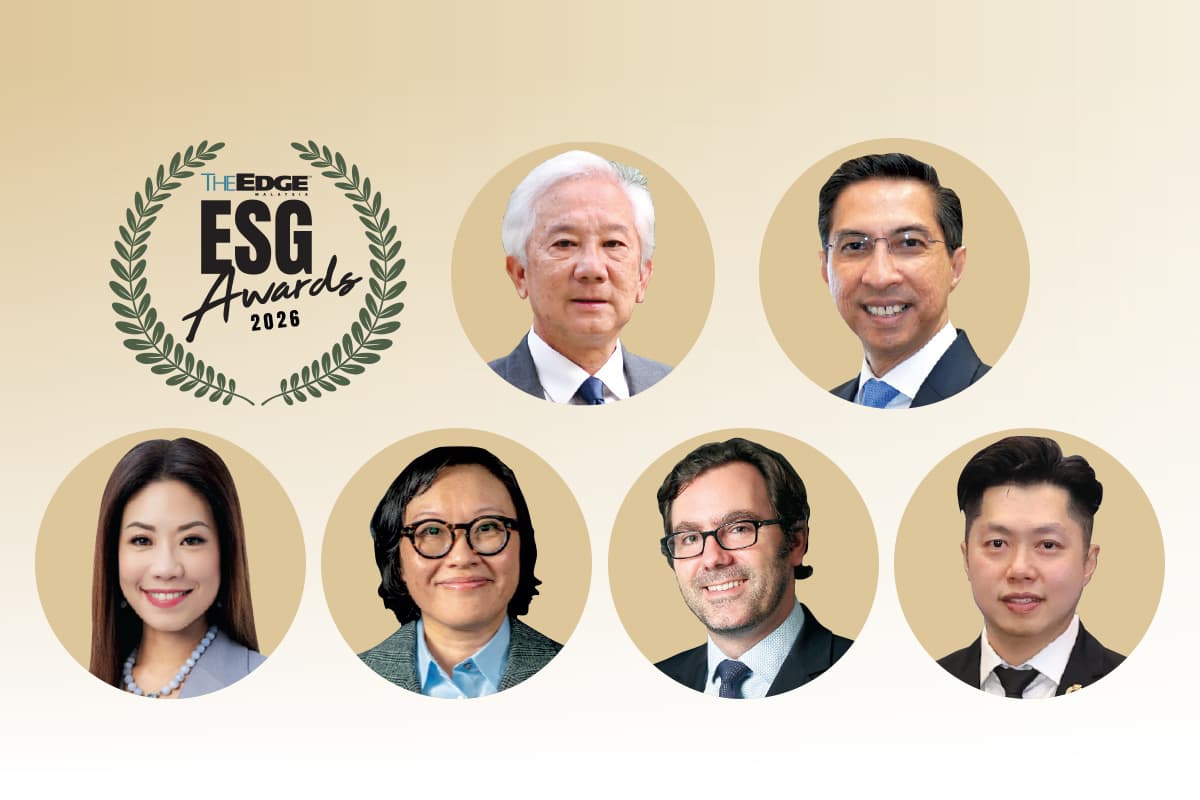
“The past year has been marked by economic uncertainty, geopolitical tensions and an energy crisis. It has not been an easy time for businesses, yet the leaders have stayed committed and used ESG to understand their long-term risks and opportunities to become more resilient,” says Datuk Ho Kay Tat, publisher and group CEO of The Edge Media Group.
The Edge Malaysia ESG Awards 2026 is organised by The Edge Malaysia in collaboration with Bursa Malaysia and FTSE Russell, with Morningstar as knowledge partner for the funds category and Deloitte as auditor. UOB is the main partner of the event, and Artelia is sponsor of the winners’ trophies.
As a PLC, Bursa Malaysia is also committed to the ESG agenda and strives to become an example for the market to follow. This year, it became the first Malaysian PLC to attain the highest FTSE4Good ESG score of 5.0.
“This reflects our belief that sustainability is not a separate agenda but an integral part of effective governance, risk management and long-term value creation,” says its CEO Datuk Fad’l Mohamed.
The number of Main Market PLCs that achieved a Four-Star ESG rating (scores between 3.7 and 5) grew 65.9% year on year to 146 in June 2026, and the average FTSE4Good ESG score improved by 9.1% in the same period.
Among ACE-Market issuers, the number of PLCs with a Three-Star ESG rating (scores between 2.5 and 3.6) rose 85.7% y-o-y to 78 in June 2026, and the average ESG score increased 11.6% in the same period.
To achieve a high ESG score, companies must understand and disclose their energy use, supply chains, governance practices and workforce data. This enables them to better navigate disruptions, manage risk and sustain performance, which translates into competitive advantages.
“The key is materiality. Companies should focus on the sustainability issues most relevant to their business model, operations and long-term strategy. As with any business priority, resources should be directed to areas that have the greatest impact on performance and long-term value creation,” says Fad’l.
ESG tied with business resilience and competitiveness
Fad’l’s view is echoed by Ng Wei Wei, CEO of UOB Malaysia, which has been a partner for the ESG Awards since inception. Ng says sustainability is closely linked to the long-term success and resilience of businesses and communities that the bank serves, and UOB believes it is important to recognise companies that are driving meaningful progress in this area.
“By showcasing organisations that are setting benchmarks for responsible and forward-looking business practices, the awards help to elevate the ESG agenda nationally,” says Ng.
The recent conflicts have highlighted the risks of energy dependence and supply chain vulnerabilities, prompting many companies to accelerate investments in renewable energy, resource efficiency and operational resilience.
This has made ESG increasingly tied to business resilience and competitiveness. Ng highlights that the UOB Business Outlook Study 2026 showed how businesses are focusing more on energy management and operational efficiency amid ongoing cost pressures.
“ESG matters more than ever because it has become a business imperative rather than a corporate responsibility initiative,” she says. “Companies that delay their sustainability transition may face increasing challenges in areas such as access to financing, participation in supply chains and maintaining investor confidence.”
Not just about reporting
This is also a global trend, whereby ESG is seen increasingly as a means of attracting investments and not just to meet reporting requirements. FTSE Russell’s 2025 Global Asset Owner Survey showed that 73% of asset owners continue to incorporate sustainability considerations into their investment strategies despite ongoing political and market headwinds.
“Financial performance (56%) and risk management (54%) are now the primary motivations, highlighting that sustainability is increasingly viewed as a tool for managing long-term risks and identifying opportunities rather than a standalone objective,” says Carmen Leung, head of sustainable products for Asia-Pacific at FTSE Russell.
Sustainability reporting requirements are likely to continue to increase, as regulators, stock exchanges and investors are demanding more consistent, comparable and reliable sustainability information from companies.
Leung says companies should watch out for climate transition and physical climate risks.
“The next phase of ESG will not be only about emissions targets but also about how companies manage energy costs, adaptation, resilience, supply chain disruption and changing stakeholder expectations,” she says.
Recovery is slower for SRI funds
On the other hand, sustainable and responsible investment (SRI) funds have been more negatively affected by global events, although there has been a slight rebound in interest.
Despite pushback from certain countries, global sustainable funds attracted US$3.5 billion (RM14.2 billion) in net inflows in the first quarter of 2026, following outflows in the previous quarter, according to Morningstar’s Global Sustainable Fund Flows report in May.
Recovery was uneven across the region, however, with US and Asia ex-Japan continuing to experience outflows. Global sustainable fund assets declined to US$3.51 trillion, owing largely to market volatility and fewer fund launches.
“Taken together, these trends indicate that investors are paying closer attention to investment fundamentals, portfolio construction and implementation quality. Rather than allocating capital simply because a strategy carries an ESG or sustainability label, investors increasingly want evidence of long-term value creation, robust risk management and credible sustainability outcomes,” says Nicolas Gisbert, head of sales for Southeast Asia at Morningstar, a global investment research firm that offers ESG resources and assessment tools.
He believes future growth is likely to be driven less by the quantity of new products and more by the quality, transparency and effectiveness of sustainable investment solutions.
Malaysia’s unique strength is in Islamic finance, adds Gisbert, and the Securities Commission Malaysia’s (SC) SRI Taxonomy explicitly highlights the close relationship between sustainable investing and Islamic finance. The shariah-integrated approach to sustainable investing is underexploited, though.
“To address this, Malaysia could consider adopting elements of Thailand’s approach by introducing demand-side incentives, such as tax benefits for investments in qualifying ESG funds and minimum holding periods designed to encourage long-term investment,” says Gisbert.
The Edge Malaysia ESG Awards judges PLCs based on FTSE4Good’s ESG ratings model, which looks at 14 themes and is underpinned by more than 300 indicators. PLCs do not have to apply for the awards, as all Malaysian PLCs on the Main and ACE Market are automatically given ESG scores by FTSE.
On the other hand, only funds under SC’s SRI list are eligible for the awards.
A gala dinner will be held in September to honour the winners, who will be awarded with Artelia’s exclusive and premium-quality products as trophies. The company, which is a curator of premium tableware and lifestyle brands, prioritises good craftmanship, ethical production and environmental responsibility.
“Supporting The Edge Malaysia ESG Awards for the second consecutive year reflects our shared belief that businesses should create long-term value not only through financial performance but also through responsible environmental, social and governance practices,” says Alex Toh, managing director of Artelia.
“For Artelia, sustainability also means preserving craftsmanship, supporting products with enduring value, and encouraging consumers to invest in quality over quantity.”
The full awards methodology and results will be published in a special pullout and on theedgemalaysia.com after the event.
Save by subscribing to us for your print and/or digital copy.
P/S: The Edge is also available on Apple's App Store and Android's Google Play.