

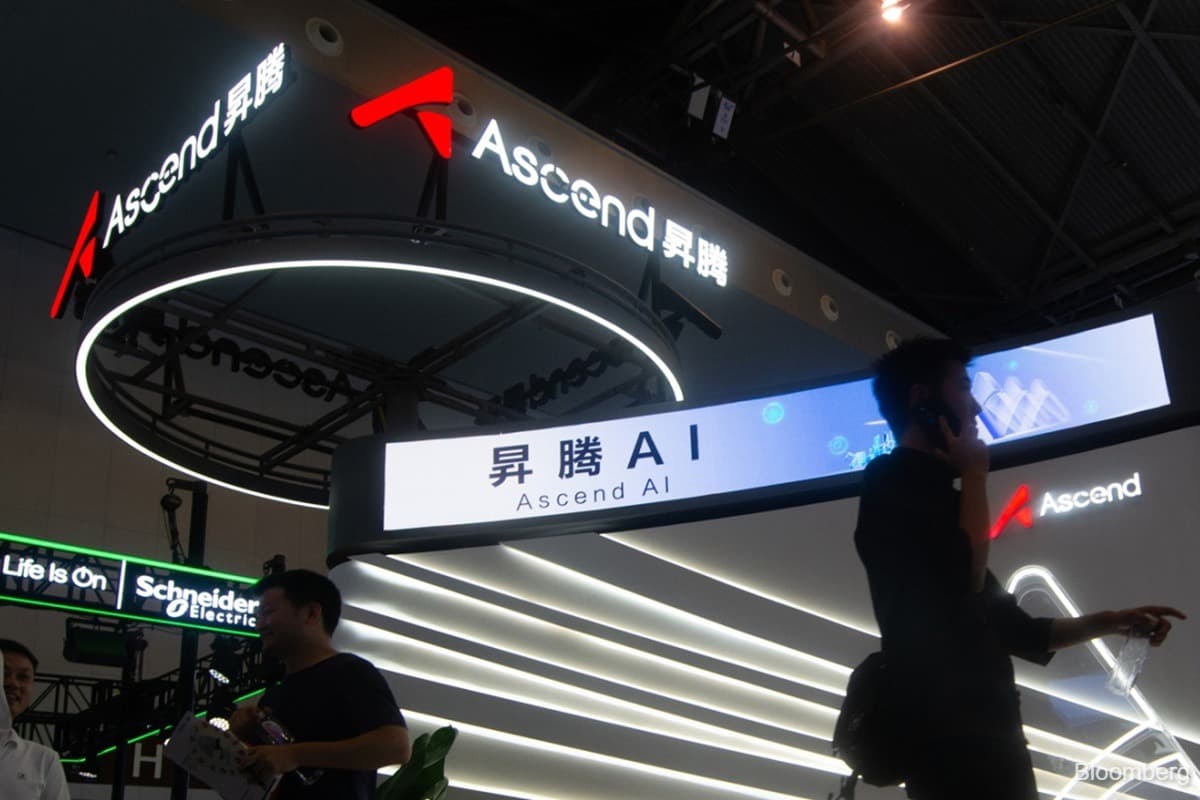
China’s top competitor to Nvidia Corp responded to a tender from Cairo with a proposal to export 1,408 of its top-end Ascend 950-series chips for an AI training cloud, plus 600 more of either those chips or the earlier 910B model to be used for two inference clusters — needed to run AI models once they’re trained, according to people familiar with the matter and documents reviewed by Bloomberg News. Huawei laid out a 12-month plan to build the infrastructure, the documents show.
If successful, the project would mark early but meaningful progress for China’s campaign to challenge American dominance in global AI infrastructure. It would make Huawei a key AI provider to Africa’s second-largest economy and lend a foothold in the Middle East, where the US has aggressively invested in the more lucrative AI data centre markets of the United Arab Emirates and Saudi Arabia. It also could be the first known export of Huawei’s Ascend accelerators after more than a year of attempts.
Huawei declined to comment, while the Egyptian ministry of foreign affairs didn’t respond to questions.
When President Donald Trump’s administration learned of the pitch, the State Department reached out to companies including Nvidia, Advanced Micro Devices Inc and Microsoft Corp about pulling together a US consortium to counter Huawei’s AI chip bid, said some of the people, who requested anonymity to disclose confidential conversations. Microsoft declined to comment, while Nvidia and AMD didn’t respond.
Trump’s team has also warned the world that using certain Huawei accelerators without Washington’s approval could result in legal penalty, though it’s unclear whether officials have invoked that guidance in conversations with Cairo.
Egypt now finds itself the latest sparring arena for the world’s dominant tech powers, underscoring the geopolitical challenge facing Global South countries that want their piece of the AI pie. The process may be the first time the US and China have directly competed for the same government AI data center tender. How it unfolds will be a test of Huawei’s chip capabilities, Trump’s nascent efforts at emerging-market semiconductor diplomacy, and Egypt’s ability to navigate bifurcating ecosystems while maintaining control over its AI future.
“Egypt is one of dozens of countries with whom we are speaking about US technology leadership on artificial intelligence,” a State Department spokesperson said. “American AI benefits the world,” the spokesperson added. The US “stands ready to partner with countries on AI development and deployment in ways that respect sovereignty and expand capabilities.”
Huawei’s strategy in Africa and globally closely mirrors Beijing’s diplomatic ties with individual countries, according to a person familiar with the firm’s thinking. The tech behemoth is broadly courting African government customers for areas such as education and healthcare, the person said, in countries including Egypt and Kenya. Kenya is home to a struggling US data centre that was the poster child for the Biden administration’s AI diplomacy on the continent.
Huawei’s Egypt proposal involves a partnership with iFlytek Co, the Chinese surveillance giant that along with Huawei has been blacklisted by the US since 2019. Among the firms’ offerings are vehicle and individual recognition based on a national population database, as well as broader “situation awareness” — packaged into a “one screen panoramic view of the city.” On one slide of the 102-page presentation, examples of “basic video applications” contain the insignia of China’s Ministry of Public Security. iFlytek didn’t respond to a request for comment.
It’s unclear what applications, if any, the American proposal would highlight — or whether there are any uses the US government would restrict. AI chip shipments to Egypt have required Washington’s permission since 2023, which gives Trump’s team the ability to impose conditions through the export licensing process.
Huawei’s bid builds on a decades-long presence in Egypt, a north African nation of more than 100 million people that has steadily deepened its cooperation with China in recent years, from trade to military drills. Winning the data centre contract would boost Huawei’s presence in a region key to its global vision — and demonstrate that there is indeed foreign demand for its AI chips, which significantly trail Nvidia’s in volume and capability.
American AI infrastructure companies, meanwhile, haven’t historically viewed Egypt as a target market, nor has the country been a top priority for Trump’s AI diplomacy efforts. The fact that it’s vaulted into AI chip export conversations underscores the degree of Washington’s concern about the global spread of Chinese AI hardware, especially after Trump’s team tried to get ahead of China’s advance with controversial policy changes for other parts of the Middle East.
To be sure, 2,008 chips is a fairly small amount. Under typical parameters for training AI models, that quantity of Huawei 950DT accelerators would provide roughly the same capability as a few hundred of the top commercially available Nvidia chips. That’s orders of magnitude less than the amount of computing power that Western companies routinely deploy.
Yet for Huawei — which has struggled to manufacture large volumes of AI chips thanks to US restrictions on purchases of key production tools, but is ramping up — a successful sale would be validating on both the demand and supply sides.
Last year, when Huawei was trying to woo countries in the Persian Gulf and Southeast Asia with offers of a couple thousand processors, it was only prepared to sell what were then its second-best chips — because production of the better 910C model was still too low. Bloomberg reported at the time that Huawei didn’t appear to have completed any Ascend exports, and there isn’t a clear indication that that has changed.
Now, Huawei is offering Egypt its very top processors, which are more powerful than the 910C. Huawei also touted those 950DT chips at an event in South Korea last year, local media reported, and the president of its Latin American cloud business told the South China Morning Post that the company is studying whether to offer the accelerators there, too.
This export strategy is what Nvidia and its political allies have been warning about. For now, the numbers are low, and seeking foreign customers doesn’t mean that Huawei’s managed to satiate its home market, where players like DeepSeek and Moonshot still rely on Nvidia hardware.
But the Egpyt bid is evidence of the growing swagger of a telecom titan that has Beijing’s full backing to challenge Nvidia — at home and abroad. Indeed, small initial shipments, designed to gain a foothold especially in nontraditional markets, are a repeat of the playbook that made Huawei the world’s preeminent telecommunications-equipment provider.
Washington, meanwhile, wasn’t under the illusion that even aggressive controls on chipmaking tools could entirely halt Huawei’s AI semiconductor advance. But having learned from the networking wars, Trump’s team tried to nip the AI chip export issue in the bud — in part via its anti-Huawei guidance.
That warning relies on a complex extraterritorial authority that raised more than a few eyebrows in other governments — but has nonetheless proven an effective deterrent. Malaysia last year announced a national AI system powered by Huawei chips, on a similar scale to Huawei’s Egypt proposal, but then quickly distanced itself from the project amid concerns from the White House.
“Malaysia remains committed to full compliance with all applicable export control laws,” the country’s investment ministry said at the time. “Malaysia also reaffirms its sovereign right to formulate its policies in line with national interest.”
While Malaysia is among the world’s fastest-growing AI data centre markets, Egypt’s ecosystem — and indeed, all of Africa’s — is much smaller. The country’s second national AI strategy aims to see the technology contribute 7.7% to GDP by 2030.
Hard infrastructure is an essential part of that vision — and since Egypt doesn’t make its own AI chips, it needs to get them from either the US or China. China hasn’t until recently been prepared to sell these processors. The US, meanwhile, has restricted exports to Egypt and around 40 other countries since 2023, building on controls for China that were introduced the year prior.
Last year, Trump’s team scrapped a Biden-era plan to expand those curbs globally, in large part to avoid unwittingly ceding global markets to Huawei. Egypt, however, remains restricted. But that’s not necessarily been a handicap for its AI infrastructure development. Rather, the country simply wasn’t a major commercial focus for Nvidia or AMD.
The Trump administration has a plan for places like Egypt, too: an export promotion programme that aims to offer comprehensive AI solutions with US government financing — targeting Global South nations that might otherwise opt for cheaper Chinese options, or where American firms may not find a strong business case without some federal support.
The State Department spokesperson pointed to that effort, which was launched over a year ago but has yet to produce any deals, when asked about the US proposal for Egypt. They didn’t directly answer whether federal money is on the table for Egypt specifically.
Uploaded by Liza Shireen Koshy